Assalamualaikum wa rahmatullahi wa barakatuhu,
You have said this word more times than you can count.
Barakallahu feekum. May Allah bless you. Masha'Allah, barakah fillah. What Allah wills, blessing in Allah. As-salamu alaykum wa rahmatullahi wa barakatuh. Peace upon you and the mercy of Allah and His blessings.
Every time you greet a fellow Muslim with the full greeting, you invoke barakah. Every time you attend a wedding and hear the Prophet's ﷺ dua for the couple, you hear barakah. Every time you say Tabarakallah upon seeing something good, you are invoking the same root.
And yet for most English-speaking Muslims, barakah is translated as "blessing" and left at that — as if that single word captures what is one of the most layered and precise concepts in Quranic Arabic.
It doesn't. And the gap between "blessing" and what barakah actually means in Arabic is exactly the kind of gap that makes the Quran feel like it's speaking in vague spiritual language, when in reality it is speaking with surgical precision.
This post is the complete barakah meaning — the Arabic root, what it literally evokes, the two types the scholars identified, where it appears in the Quran and your daily Salah, and what the Quran and authentic hadith say about how it is attained and lost.
The Root: B-R-K (ب-ر-ك)
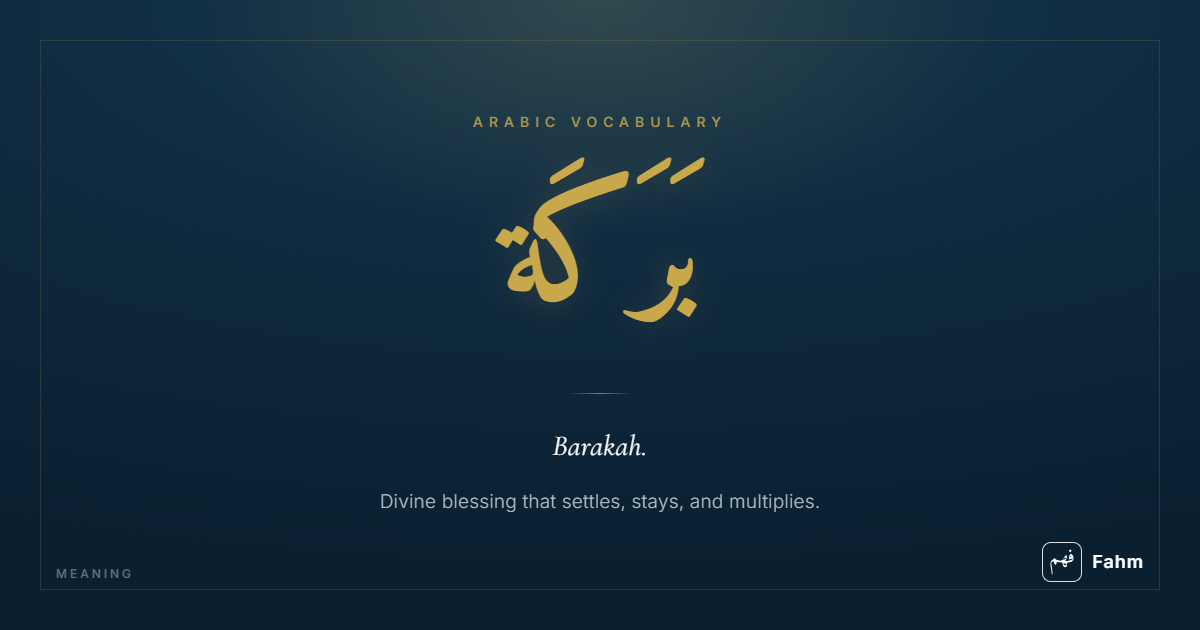
Barakah (بَرَكَة) comes from the three-letter Arabic root b-r-k (ب-ر-ك). Before this root means anything spiritual or divine, it means something very physical and concrete — and that concrete image is the key to understanding the entire concept.
The root's original image: a camel that sits down and will not move.
In classical Arabic, baraka al-jamal — the camel knelt — describes the specific act of a camel lowering itself to the ground, folding its legs beneath it, and settling into a position of stability. And crucially: once a camel sits down, it is notoriously difficult to make stand back up. It is settled. It is rooted. It is staying.
The second image from the same root: a pool of still water (birka, بِرْكَة) — water that has gathered and settled in one place, remaining there, not evaporating or flowing away. A birka does not move. It persists. It stays.
From these two images — the settled camel and the still pool — emerges the spiritual meaning of barakah: divine goodness that settles, that stays, that persists, that does not evaporate.
Barakah is not a flash. It is not a momentary experience of blessing. It is the quality of a blessing that remains and increases — like still water that continues to provide long after the rain has stopped, like a camel that carries its load steadily and refuses to be moved. [Source: SpiritualCulture.org, root analysis of b-r-k; IlmFruits.com, What Is Barakah; GoodTreeInstitute.com, Rooted in Barakah]
This is why "blessing" falls short as a translation. A blessing can be momentary — you receive something good and it passes. Barakah is what makes a blessing stay, multiply, and outlast its apparent source.
The Word Family: B-R-K Across Arabic
The root b-r-k generates a rich word family, all carrying the core meaning of settled, multiplying divine good:
Barakah (بَرَكَة) — the noun: blessing, divine abundance, the quality of increase
Tabaraka (تَبَارَكَ) — the superlative verb form: exalted in blessing, supremely and endlessly blessed — used only for Allah in the Quran. We covered this word in detail in the Surah Al-Mulk post — it opens the surah: Tabarakal-ladhi biyadihil-Mulk.
Mubarak (مُبَارَك) — blessed, filled with barakah: used for the Quran itself (kitabun mubarak), for certain nights (laylatin mubarakatin), and as a congratulations in Islamic culture
Barakallahu feekum (بَارَكَ اللَّهُ فِيكُمْ) — May Allah place barakah in you: the dua the Prophet ﷺ taught for expressing gratitude
Birka (بِرْكَة) — a pool of still, gathered water: the physical image embedded in the spiritual concept
Where Barakah Appears in the Quran
The Quran describes barakah as something Allah places — deliberately, specifically — in people, places, times, and things. It is not random. It is not automatic. It is a divine infusion.
In the Quran itself:
"And this is a Book We have revealed — blessed — so follow it and fear Allah that you may receive mercy." — Surah Al-An'am (6:155)
"And this is a blessed Book which We have sent down, confirming what came before it." — Surah Al-An'am (6:92) and Surah Al-Anbiya (21:50) contain similar descriptions
The Quran is mubarak — filled with barakah. Every recitation carries it. Every letter of it, as the Prophet ﷺ said in the narration on Surah Al-Mulk, carries benefit. The scholars explain this as barakah in action: the Quran gives more than what is visible, more than its words on a page should rationally produce. [Source: HadithAnswers.com, Take Barakah from the Quran, citing multiple Quranic verses]
In the Night of Al-Qadr:
"Indeed, We sent it down during a blessed night." — Surah Ad-Dukhan (44:3)
Laylat al-Qadr is described as a night with barakah — a night in which worship is equivalent to a thousand months, in which the angels descend, in which every act of devotion is multiplied beyond its apparent weight. The barakah of the night is precisely this: it produces more than it should, by divine design.
Tied directly to iman and taqwa:
"And if the people of the towns had believed and had taqwa, certainly We would have opened for them blessings from the heaven and the earth." — Surah Al-A'raf (7:96)
This is the Quran's clearest statement about the relationship between belief, God-consciousness, and barakah. Maarif ul-Quran (Mufti Muhammad Shafi) explains this verse in detail: the barakah of heaven refers to proper and timely rain, abundant agricultural produce, and above all — the ability to enjoy what one has without anxiety. Barakah manifests in two ways, the tafsir explains: sometimes the thing itself increases in quantity (as happened with the Prophet's ﷺ food miracles, feeding hundreds from a small amount) — and sometimes the quantity remains the same but its usefulness or efficacy increases manifold. [Source: Maarif ul-Quran, Mufti Muhammad Shafi, Quran.com tafsir, 7:96]
The second type is the barakah most of us encounter in daily life: the same salary that doesn't stretch for one person somehow covers everything for another. The same 24 hours that feels insufficient for one person contains remarkable productivity for another. The same small meal that logically cannot feed everyone somehow does. The quantity didn't change — what changed is what Allah placed inside it.
In the Prophet Ibrahim's lineage:
"Peace be upon Ibrahim. Thus We reward those who do good. Indeed, he was of Our believing servants. And We gave him good tidings of Isaac and Jacob — both were righteous. And We blessed him and Isaac." — Surah As-Saffat (37:109-113)
The barakah placed in Ibrahim (عليه السلام) and his lineage is the same barakah we invoke in Durood Ibrahim — Allahumma barik ala Muhammad wa ala ali Muhammad kama barakta ala Ibrahima wa ala ali Ibrahim. We ask Allah to give the Prophet ﷺ the same category of divine, enduring, multiplying barakah He gave Ibrahim. The word is the same. The concept is the same.
Barakah in Your Daily Prayer
You encounter the root b-r-k in your Salah more than you may realize:
In the Tashahhud:
"As-salamu alayka ayyuhan-Nabiyyu wa rahmatullahi wa barakatuh" Peace be upon you O Prophet, and the mercy of Allah and His blessings.
The third gift in the greeting of the Prophet ﷺ — after salam (peace) and rahmat (mercy) — is barakah. We covered this in detail in the Tashahhud word-by-word post. Barakah here means divine abundance that flows through the Prophet ﷺ and persists — his influence, his Sunnah, his intercession, his Ummah — all are manifestations of the barakah placed in him.
In Durood Ibrahim:
"Allahumma barik ala Muhammad wa ala ali Muhammad kama barakta ala Ibrahima wa ala ali Ibrahim"
We ask Allah to place barakah in the Prophet ﷺ — the same settled, enduring, multiplying divine goodness He placed in Ibrahim. Every Durood Ibrahim recited is a conscious invocation of this concept. We covered this in full in the Durood Ibrahim word-by-word post.
In Surah Al-Mulk:
"Tabaraka alladhi biyadihil-Mulk"
The superlative of b-r-k — Tabaraka — is the word Allah uses to describe Himself in the opening of Surah Al-Mulk. It means: exalted beyond all measure in blessed goodness, the source of all barakah, the One in Whom all abundance originates. We covered this in the Surah Al-Mulk word-by-word post.
In the Salam (Islamic greeting):
"As-salamu alaykum wa rahmatullahi wa barakatuh"
Every time you greet a Muslim with the full greeting, you are offering them three things: peace, mercy, and barakah. The Prophet ﷺ taught that the one who adds wa barakatuh to the greeting receives 30 rewards. [Source: Sunan Abu Dawud (5195); Jami' al-Tirmidhi (2689) — graded Hasan]
The Two Types of Barakah
Maarif ul-Quran's tafsir of Surah Al-A'raf (7:96) identifies two distinct manifestations of barakah that are worth understanding separately:
Type 1: Quantitative increase — the actual amount of something increases beyond what is naturally possible. The most famous examples are the Prophet's ﷺ food miracles: a small pot of food feeding an entire army during the battle of Khandaq, a small amount of water sufficing for hundreds. [Source: Sahih al-Bukhari (3070) — feeding a thousand people from a small sheep; Amaliah.com citing Sahih Bukhari]
This type of barakah is miraculous and granted to those Allah chooses. It cannot be manufactured or engineered.
Type 2: Qualitative increase — the quantity remains the same, but its benefit, usefulness, or efficacy multiplies. This is the type of barakah accessible to every believer in daily life. The same amount of money provides more contentment and coverage. The same number of hours produces more meaningful work. The same small deed carries more weight with Allah. The same portion of food satisfies more hunger. [Source: Maarif ul-Quran, Mufti Muhammad Shafi, 7:96 tafsir]
This is why two people can have identical resources and have entirely different experiences of abundance. Barakah is not in the number — it is in what Allah places inside the number.
How Barakah Is Attained: Quran and Authentic Hadith
The Quran and Sunnah are explicit about what brings barakah and what removes it:
Iman and Taqwa: The clearest Quranic formula: "If the people of the towns had believed and had taqwa, We would have opened for them blessings from heaven and earth." (7:96) Barakah flows through iman and taqwa — God-consciousness in daily choices, halal earnings, and fulfilling obligations to Allah.
Saying Bismillah: The Prophet ﷺ said: "Every matter of importance that does not begin with Bismillah is cut off from barakah." [Source: Musnad Ahmad; referenced in multiple scholarly compilations] Beginning work, meals, and important acts with Allah's name invites His barakah into them.
Waking early for Fajr: The Prophet ﷺ said: "O Allah, bless my Ummah in their early mornings." [Source: Sunan Ibn Majah (2236); Sunan al-Tirmidhi (1212) — graded Sahih by al-Albani] The early part of the day was specifically blessed. The Prophet ﷺ would send his armies out in the morning, recognizing that the early hours carry barakah.
Honesty in transactions: The Prophet ﷺ said: "The two parties to a transaction have the option of cancelling until they part. If they are honest and disclose any defects, their transaction will be blessed — but if they lie and conceal defects, the blessing will be erased." [Source: Sahih al-Bukhari (2079); Sahih Muslim (1532)] Honesty in dealings is directly connected to barakah in provision.
Gratitude — shukr:
"If you are grateful, I will surely increase you in favor." — Surah Ibrahim (14:7)
Shukr (gratitude) is one of the named channels through which Allah increases barakah. IslamQA explains this based on Ibn Kathir's commentary: expressing gratitude to Allah — verbally, in the heart, and in action — invites more of what prompted the gratitude. [Source: IslamQA.info, Answer 266249, How to Get Barakah; Tafsir Ibn Kathir, 14:7]
Upholding family ties (silat ar-rahim): The Prophet ﷺ said: "Whoever desires that his provision be increased and his lifespan be extended, let him maintain the ties of kinship." [Source: Sahih al-Bukhari (5986); Sahih Muslim (2557)] Maintaining family relationships is a specifically named means of barakah in rizq (provision) and lifespan.
Reciting Surah Al-Baqarah in the home: The Prophet ﷺ said: "Do not make your houses into graves. Indeed Shaytan flees from the house in which Surah Al-Baqarah is recited." [Source: Sahih Muslim (780)] Scholars have connected this to barakah in the home — where the Quran is present and recited, barakah settles. [Source: IslamQA.org, HadithAnswers.com on Surah Baqarah and barakah]
How Barakah Is Removed
The Quran is equally clear about what strips barakah from people and places:
Riba (interest and usury):
"Allah destroys interest and gives increase for charities." — Surah Al-Baqarah (2:276)
Ibn Kathir explains this verse explicitly: Allah destroys riba — meaning He removes the barakah from the wealth of the one who engages in it, so that he does not benefit from it even if it appears to increase numerically. [Source: Tafsir Ibn Kathir, 2:276; IslamQA.info, Answer 266249]
Dishonesty in dealings: As established in the hadith above — lies and concealment in transactions erase barakah. The wealth may increase in number but its barakah is gone.
Ingratitude: The Quran's formula works in both directions: if gratitude brings increase, ingratitude brings its opposite. Surah Ibrahim (14:7) continues: "but if you deny — indeed, My punishment is severe."
Abandoning obligations: Surah Al-A'raf (7:96) makes the inverse clear: the towns that denied their prophets and abandoned what Allah commanded lost the barakah of heaven and earth. Their material prosperity became a test, not a sign of divine favor — and was eventually taken away entirely.
Barakah vs. Rizq: An Important Distinction
These two words are often used together and sometimes confused.
Rizq (رِزْق) — provision — refers to what Allah has assigned each soul by decree. It is fixed, predetermined, and cannot be increased or decreased in its total amount. Every soul's rizq is written.
Barakah in rizq refers to what Allah places inside the rizq to make it go further — more contentment from it, more coverage from it, more benefit from what one has been given. Two people can have the same rizq in quantity but entirely different experiences of it based on the barakah Allah places in it.
This is why the Islamic tradition emphasizes seeking barakah in provision — not as an attempt to change the divine decree of what one receives, but to maximize the benefit of what one has been given. The same amount can carry radically different fruit depending on whether barakah is present. [Source: IlmFruits.com, What Is Barakah; classical Islamic scholarship on the relationship between rizq and barakah]
Barakallahu Feekum: The Prophet's ﷺ Dua of Gratitude
When someone does something good for you — a gift, a favor, a kindness — the Prophet ﷺ taught a specific response:
"Whoever has a favor done for him and says 'Barakallahu feekum' has done his utmost in expressing thanks." — Sunan al-Tirmidhi (2035) — graded Sahih by al-Albani; Sunan Ibn Majah (1265)
Barakallahu feekum — May Allah place barakah in you — is the Prophetically recommended expression of gratitude. Not merely "thank you." Not jazakallahu khayran alone (though that is also a valid response). Barakallahu feekum — may what you have, what you do, and who you are be filled with settled, enduring, multiplying divine goodness.
It is simultaneously an expression of thanks and a dua. You are thanking the person and asking Allah to bless them in the same breath. The Prophet ﷺ said this exhausts what one can do to express gratitude.
Frequently Asked Questions
What does barakah mean in English? Barakah (بَرَكَة) is most often translated as "blessing" — but the Arabic carries a more specific meaning: divine goodness that settles, remains, and increases beyond its apparent source. The root b-r-k evokes a camel that sits and won't move (stable, settled) and a pool of still water (gathered, persistent). Barakah is not a momentary blessing but one that stays and multiplies — like food that feeds more than it should, or time that produces more than its hours allow.
What is the difference between barakah and ni'mah? Ni'mah (نِعْمَة) refers to a blessing or favor in the sense of a gift received — something good that Allah gives. Barakah refers to the quality of divine increase placed inside something — what makes that gift go further, last longer, and produce more than expected. Ni'mah is what you receive; barakah is what makes what you received multiply.
What does Tabarakallah mean? Tabarakallah (تَبَارَكَ اللَّه) means "Blessed is Allah" — invoking the Tabaraka form of b-r-k, which is a superlative meaning exalted, supreme, and endless in divine goodness. It is said upon seeing something admirable or impressive, acknowledging that all good ultimately traces back to Allah. It is distinct from MashaAllah (what Allah wills) — though both are often said in similar contexts.
What does Barakallahu feekum mean? Barakallahu feekum means "May Allah place barakah in you." It is the Prophetically recommended response to a favor or gift, described in authentic hadith as the most complete expression of gratitude available to a Muslim. [Sunan al-Tirmidhi (2035) — graded Sahih by al-Albani]
How do you get barakah in your life? The Quran and Sunnah identify several channels: iman and taqwa (Surah Al-A'raf 7:96), beginning acts with Bismillah, waking early for Fajr (Sunan Ibn Majah 2236), honesty in all dealings (Sahih al-Bukhari 2079), gratitude to Allah (Surah Ibrahim 14:7), maintaining family ties (Sahih al-Bukhari 5986), and reciting the Quran — especially Surah Al-Baqarah — in the home (Sahih Muslim 780).
What removes barakah? The Quran and authentic hadith identify: riba/interest (Surah Al-Baqarah 2:276 — Ibn Kathir says Allah removes barakah from the wealth of the one who engages in it), dishonesty in transactions (Sahih al-Bukhari 2079), ingratitude, and abandonment of what Allah commands.
Is barakah mentioned in the Quran? Yes — though only in its plural form barakatun in the Quran itself. The Quran describes the Book itself as mubarak (Surah Al-An'am 6:155), certain nights as mubarakatin (Surah Ad-Dukhan 44:3), the prophets and their lineages as recipients of barakah, and establishes the direct connection between iman, taqwa, and barakah opening from the heavens and the earth (Surah Al-A'raf 7:96).
How Barakah Connects to Fahm's Curriculum
The root b-r-k is one of the most frequently encountered roots across your daily Islamic practice:
- You invoke it every time you say the full Islamic greeting — wa barakatuh
- You invoke it every time you recite the Tashahhud — wa barakatuh in the greeting to the Prophet ﷺ
- You invoke it every time you recite Durood Ibrahim — barik ala Muhammad, kama barakta ala Ibrahim
- You hear it every time Tabarakallah is said in your presence
- You encounter it in the opening of Surah Al-Mulk — Tabaraka alladhi biyadihil-Mulk
This is one root — b-r-k — appearing across your greeting, your Salah, your dhikr, and the Quran. When you know it, all of these instances light up with recognition.
This is the insight Fahm is built on: the Quran's vocabulary is a connected web of roots, not a list of isolated words. Learn the roots and the Book opens — word by word, surah by surah, prayer by prayer.
Barakallahu feekum. May Allah place barakah in your time, your provision, your family, and your understanding of His Book.
Start learning the words of your prayer today.
Sources
- Sahih al-Bukhari, Hadith 2079 (honesty in transactions and barakah; dishonesty removes it)
- Sahih al-Bukhari, Hadith 3070 (feeding a thousand people from a small sheep — Khandaq)
- Sahih al-Bukhari, Hadith 5986 (maintaining family ties increases provision and lifespan)
- Sahih Muslim, Hadith 780 (Surah Al-Baqarah recited in the home — Shaytan flees)
- Sahih Muslim, Hadith 1532 (honest transaction is blessed; dishonest transaction has barakah erased — parallel chain)
- Sahih Muslim, Hadith 2557 (silat ar-rahim and increase in provision)
- Sunan al-Tirmidhi, Hadith 2035 (Barakallahu feekum as the most complete expression of thanks — graded Sahih by al-Albani)
- Sunan al-Tirmidhi, Hadith 1212 (barakah in early mornings — graded Sahih by al-Albani)
- Sunan al-Tirmidhi, Hadith 2689 (reward for the full Islamic greeting with wa barakatuh — graded Hasan)
- Sunan Ibn Majah, Hadith 1265 (Barakallahu feekum — parallel chain)
- Sunan Ibn Majah, Hadith 2236 (barakah in early mornings)
- Sunan Abu Dawud, Hadith 5195 (reward for full Islamic greeting)
- Musnad Imam Ahmad (Bismillah and barakah — referenced in scholarly compilations)
- Surah Al-A'raf (7:96) — iman and taqwa open barakah from heaven and earth
- Surah Ibrahim (14:7) — gratitude brings increase; ingratitude brings punishment
- Surah Al-Baqarah (2:276) — Allah destroys interest; Ibn Kathir on removal of barakah
- Surah Al-An'am (6:155) — the Quran described as mubarak
- Surah Ad-Dukhan (44:3) — Laylat al-Qadr described as mubarakatin
- Surah As-Saffat (37:109-113) — barakah placed in Ibrahim and his lineage
- Tafsir Ibn Kathir — commentary on Surah Al-Baqarah (2:276) on riba and barakah; Surah Al-A'raf (7:96)
- Maarif ul-Quran (Mufti Muhammad Shafi) — two types of barakah, commentary on Surah Al-A'raf (7:96), via Quran.com
- IslamQA.info, Answer 266249 — How to Get Barakah in Your Life (islamqa.info)
- HadithAnswers.com — Take Barakah from the Quran (hadithanswers.com)
- IlmFruits.com — What Is Barakah? (ilmfruits.com), citing classical Arabic scholarship on b-r-k