Assalamualaikum wa rahmatullahi wa barakatuhu,
In the previous post, we broke down the Tashahhud — the testimony you recite in every sitting of every prayer. But the Tashahhud doesn't stand alone. In your final sitting, it is followed immediately by something even more profound: Durood Ibrahim — the blessing upon the Prophet ﷺ and the family of Ibrahim (عليه السلام) that the Prophet ﷺ himself taught his companions, by name, in response to a direct question.
Most Muslims recite it fluently. Very few know what they are saying.
This post is the complete Durood Ibrahim translation, word by word — the full Arabic text, transliteration, and the meaning behind every phrase of Darood e Ibrahim. By the end, the final sitting of your Salah will never feel the same.
What Is Durood Ibrahim?
Durood Ibrahim (also written as Darood e Ibrahim, Durood Ibrahimi, or Salat al-Ibrahimiyya) is the supplication Muslims recite in the final sitting (Qa'dah Akhirah) of every Salah, immediately after the Tashahhud.
The word Durood (درود) is a Persian/Urdu term meaning "blessings" or "salutation." In classical Arabic, this category of supplication is called Salawat (صَلَوَات) — the plural of Salah — meaning blessings sent from Allah upon His Prophet ﷺ.
Ibrahim refers to Prophet Ibrahim (Abraham), peace be upon him — one of the five greatest prophets in Islam (Ulul Azm), known by the title Al-Khalil: the Intimate Friend of Allah.
The reason Ibrahim is named in this supplication is at the heart of what makes it so extraordinary — and we'll unpack that fully below.
The Quranic Command Behind Durood Ibrahim
Before we examine the text itself, it's worth understanding why Muslims recite this at all. It is not optional. It is a direct command from Allah in the Quran:
إِنَّ اللَّهَ وَمَلَائِكَتَهُ يُصَلُّونَ عَلَى النَّبِيِّ ۚ يَا أَيُّهَا الَّذِينَ آمَنُوا صَلُّوا عَلَيْهِ وَسَلِّمُوا تَسْلِيمًا
"Indeed, Allah and His angels send blessings upon the Prophet. O you who have believed, send blessings upon him and peace in abundance." — Surah Al-Ahzab (33:56)
This ayah is unique in the entire Quran: it is the only verse where Allah describes Himself and His angels performing the same act, then commands the believers to join them. When you recite Durood Ibrahim, you are responding to a personal invitation from Allah to participate in something He and His angels are already doing.
The companions understood the weight of this verse and immediately asked the Prophet ﷺ how to fulfill it. His response is what we now call Durood Ibrahim. [Source: Sahih al-Bukhari, 3370; Sahih Muslim, 406]
How the Prophet ﷺ Taught It
The narration that established Durood Ibrahim is one of the most well-attested in the hadith literature. It is recorded in multiple authentic chains, most famously through Ka'b ibn Ujrah (رضي الله عنه):
"Ka'b ibn Ujrah met me and said: 'Shall I not give you a present I received from the Prophet ﷺ?' I said: 'Yes.' He said: 'We asked the Messenger of Allah ﷺ: O Messenger of Allah, we know how to greet you (with salam), but how do we send blessings upon you?' He said: 'Say...'" — Sahih al-Bukhari (3370), Sahih Muslim (406)
And then he taught them the words we now recite in every Salah.
Notice the framing: the companions had already learned the Tashahhud, which contains As-salamu alayka ayyuhan-Nabiyyu — the salam upon the Prophet ﷺ. But they wanted to know how to go further: how to send the salawat that Allah commanded in Surah Al-Ahzab. The Prophet ﷺ responded with Durood Ibrahim.
The Full Durood Ibrahim: Arabic, Transliteration, and Translation
Arabic:
اللَّهُمَّ صَلِّ عَلَى مُحَمَّدٍ وَعَلَى آلِ مُحَمَّدٍ، كَمَا صَلَّيْتَ عَلَى إِبْرَاهِيمَ وَعَلَى آلِ إِبْرَاهِيمَ، إِنَّكَ حَمِيدٌ مَجِيدٌ، اللَّهُمَّ بَارِكْ عَلَى مُحَمَّدٍ وَعَلَى آلِ مُحَمَّدٍ، كَمَا بَارَكْتَ عَلَى إِبْرَاهِيمَ وَعَلَى آلِ إِبْرَاهِيمَ، إِنَّكَ حَمِيدٌ مَجِيدٌ
Transliteration:
Allahumma salli ala Muhammadin wa ala ali Muhammadin, kama sallayta ala Ibrahima wa ala ali Ibrahima, innaka Hamidum Majid. Allahumma barik ala Muhammadin wa ala ali Muhammadin, kama barakta ala Ibrahima wa ala ali Ibrahima, innaka Hamidum Majid.
Translation:
O Allah, send Your blessings upon Muhammad and upon the family of Muhammad, as You sent Your blessings upon Ibrahim and upon the family of Ibrahim. Indeed, You are Praiseworthy and Glorious. O Allah, bestow Your grace upon Muhammad and upon the family of Muhammad, as You bestowed Your grace upon Ibrahim and upon the family of Ibrahim. Indeed, You are Praiseworthy and Glorious.
Now let's go inside every phrase.
Word-by-Word Breakdown
1. اللَّهُمَّ
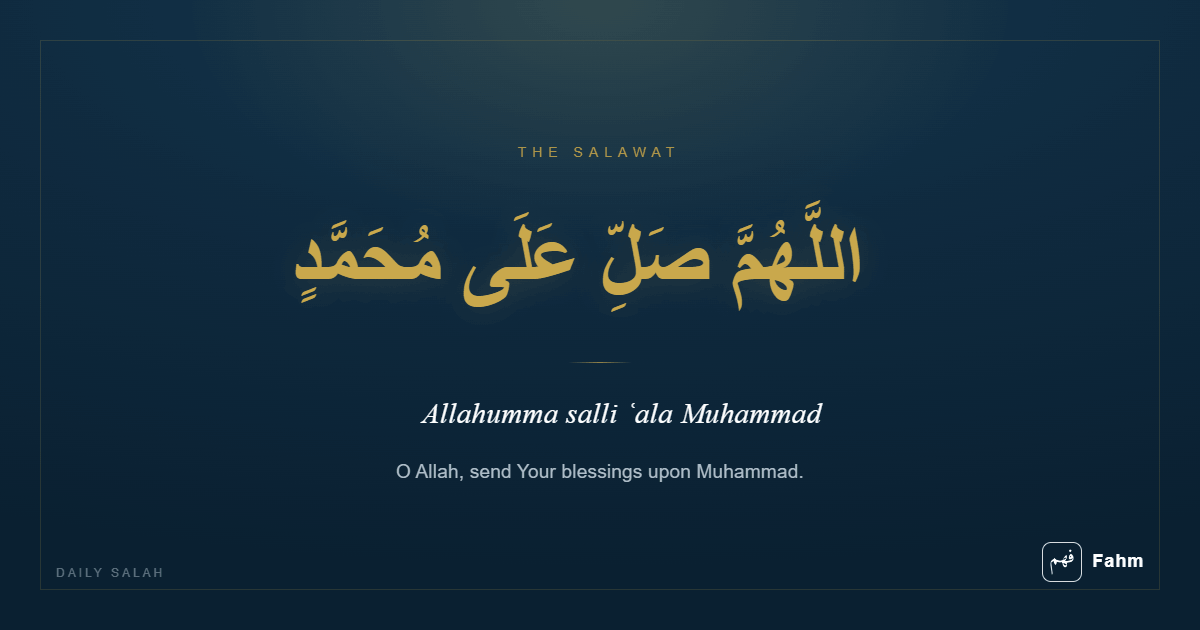
Allahumma "O Allah"
| Arabic | Transliteration | Meaning |
|---|---|---|
| اللَّهُمَّ | Allahumma | O Allah (direct address) |
Allahumma is a contraction of Ya Allah (يَا اللَّه) — the Arabic vocative particle ya (O) merged with the divine name Allah. The mim (م) at the end is a grammatical intensifier that replaces the vocative, making it more emphatic and formal than a simple "O Allah." It is the most reverent form of address to Allah in classical Arabic.
Every dua of any significance in the Prophetic tradition opens with Allahumma. This is not coincidence — it is a linguistic signal that what follows is directed entirely and solely to Allah. You are not making an announcement; you are making a request to the One who can grant it.
2. صَلِّ عَلَى مُحَمَّدٍ
Salli ala Muhammadin "Send Your blessings upon Muhammad"
| Arabic | Transliteration | Meaning |
|---|---|---|
| صَلِّ | Salli | Send blessings / bestow honor (imperative form) |
| عَلَى | ala | Upon |
| مُحَمَّدٍ | Muhammadin | Muhammad |
Salli is the imperative form of Salah (صَلَاة) — the same root as the five daily prayers. But when the word Salah is used with Allah as the subject, it carries a specific meaning distinct from human prayer.
The scholars have explained the meaning of Salah from Allah upon the Prophet ﷺ as: praise in the highest assembly (the angels), mercy, and honor. Ibn Abbas (رضي الله عنه) explained it as Allah's praise and mention of the Prophet ﷺ among His angels. [Source: Sahih al-Bukhari, commentary on 33:56]
So when you say Allahumma salli ala Muhammad, you are asking Allah to:
- Praise the Prophet ﷺ among the highest gathering of angels
- Shower His mercy upon him
- Elevate his honor and rank before all of creation
Muhammadin — the Prophet's name itself comes from the root h-m-d (ح-م-د), the same root as hamd (praise) and Hamid (the Praiseworthy — one of Allah's names). Muhammad literally means "the one who is repeatedly praised" or "the most praised." You are asking Allah to send honor upon the one whose very name means "praiseworthy."
3. وَعَلَى آلِ مُحَمَّدٍ
Wa ala ali Muhammadin "And upon the family of Muhammad"
| Arabic | Transliteration | Meaning |
|---|---|---|
| وَعَلَى | wa ala | And upon |
| آلِ | ali | Family / household / close followers |
| مُحَمَّدٍ | Muhammadin | Muhammad |
Al (آل) is a classical Arabic term meaning the household, close family, and by extension the closest followers and companions of a person. The scholars have differed on precisely who is included in Ali Muhammad, with the most comprehensive scholarly position including: his close blood relatives (ahl al-bayt) — particularly Fatimah, Ali, Hasan, Hussain, and their descendants; his wives (the Mothers of the Believers); and the righteous among his Ummah who follow him sincerely. [Source: IslamQA.info, Answer 41028]
The inclusion of the Prophet's ﷺ family alongside him is itself an act of honor — their elevation is connected to their connection to him. It is a reminder that the blessing flows outward from him to those who carry his legacy.
4. كَمَا صَلَّيْتَ عَلَى إِبْرَاهِيمَ وَعَلَى آلِ إِبْرَاهِيمَ
Kama sallayta ala Ibrahima wa ala ali Ibrahima "As You sent Your blessings upon Ibrahim and upon the family of Ibrahim"
| Arabic | Transliteration | Meaning |
|---|---|---|
| كَمَا | kama | Just as / in the same manner as |
| صَلَّيْتَ | sallayta | You sent blessings (past tense — You have already done this) |
| عَلَى | ala | Upon |
| إِبْرَاهِيمَ | Ibrahima | Ibrahim (Abraham) |
| وَعَلَى آلِ إِبْرَاهِيمَ | wa ala ali Ibrahima | And upon the family of Ibrahim |
This is the theological heart of Durood Ibrahim — and one of the most beautiful structures in any Islamic supplication.
Kama means "just as" or "in the manner of." You are not asking for a generic blessing; you are asking for a specific, already-realized blessing — the one Allah gave Ibrahim — to be given to Muhammad ﷺ in equal or greater measure.
Why Ibrahim specifically? Because Ibrahim (عليه السلام) received from Allah a level of honor that is explicitly described in the Quran as unparalleled:
"And Allah took Ibrahim as an intimate friend." — Surah An-Nisa (4:125)
The title Al-Khalil (الخليل) — the Intimate Friend of Allah — was given to Ibrahim alone among all the prophets before Muhammad ﷺ. His family produced a lineage of prophethood: Ismail, Ishaq, Yaqub, Yusuf, Musa, Isa (عليهم السلام) — the Abrahamic prophetic tradition that culminated in Muhammad ﷺ himself.
By invoking Ibrahim's blessings as the benchmark, this supplication draws a direct theological line: Muhammad ﷺ is the seal and completion of everything Ibrahim began. The blessing upon the final prophet must be at least as great as the blessing upon the patriarch who made his arrival possible.
The past tense in sallayta ("You have sent") is significant. It acknowledges that Allah's blessing on Ibrahim is already a done, witnessed, historical fact — established in scripture, confirmed in prophethood. You are asking Allah to match a certainty, not a wish.
5. إِنَّكَ حَمِيدٌ مَجِيدٌ
Innaka Hamidum Majid "Indeed, You are Praiseworthy and Glorious"
| Arabic | Transliteration | Meaning |
|---|---|---|
| إِنَّكَ | innaka | Indeed You / Verily You (emphatic) |
| حَمِيدٌ | Hamid | The Praiseworthy — worthy of all praise |
| مَجِيدٌ | Majid | The Glorious — noble in essence and generous in action |
The supplication closes — both halves of it — with these two divine names. This is not decoration. It is the justification for why your dua will be answered.
Hamid (حَمِيد) comes from the root h-m-d (ح-م-د) — the same root as hamd (praise), Alhamdulillah (all praise belongs to Allah), and the Prophet's ﷺ name Muhammad. Al-Hamid means Allah is worthy of praise in His attributes, His names, His actions, and His very Person — He is the only One who is praiseworthy in every way. Importantly, He is worthy of praise whether or not anyone praises Him. His praiseworthy nature does not depend on our recognition of it.
Majid (مَجِيد) comes from the root m-j-d (م-ج-د). This root carries connotations of being dignified, noble, lauded, sublime, glorious, majestic, and exceedingly generous. Ibn Kathir explained the pairing of these two names in his commentary: "Hamid means Allah is Praiseworthy in all His actions and statements, and Majid means He is praised and glorified in His attributes and His essence." [Source: Tafsir Ibn Kathir, commentary on Surah Hud, 11:73]
The pairing appears in the Quran itself, in Surah Hud (11:73), where the angels greet the family of Ibrahim with: "May the mercy of Allah and His blessings be upon you, people of the house. Indeed, He is Praiseworthy (Hamid) and Honorable (Majid)." The same two names that close the angels' greeting to Ibrahim's family are the same two names that close your supplication for blessings upon the family of Muhammad ﷺ. The echo is intentional.
Why do these two names close the dua? Because they are the answer to an implicit question: "Will Allah accept this request?" The answer is: He is Al-Hamid — His actions are always praiseworthy, always good. And He is Al-Majid — He is the most noble and generous, and it costs Him nothing to give. The dua closes by invoking the very attributes that guarantee its acceptance.
6. اللَّهُمَّ بَارِكْ عَلَى مُحَمَّدٍ وَعَلَى آلِ مُحَمَّدٍ
Allahumma barik ala Muhammadin wa ala ali Muhammadin "O Allah, bestow Your grace upon Muhammad and upon the family of Muhammad"
| Arabic | Transliteration | Meaning |
|---|---|---|
| اللَّهُمَّ | Allahumma | O Allah |
| بَارِكْ | barik | Bestow barakah / bless with increasing, flowing grace |
| عَلَى | ala | Upon |
| مُحَمَّدٍ | Muhammadin | Muhammad |
| وَعَلَى آلِ مُحَمَّدٍ | wa ala ali Muhammadin | And upon the family of Muhammad |
The second half of Durood Ibrahim is a distinct request, not a repetition. Notice the shift: the first half asks for Salah (بlessings, praise, mercy, honor); the second asks for Barakah (بَرَكَة).
Barik is the imperative form of Barakah — one of the most layered words in Arabic. We saw it in the Tashahhud (wa barakatuh) and here it appears again as a direct request. For the full picture of what barakah actually means — its root, its two types, and how it is attained — see our dedicated post.
Barakah is commonly translated as "blessing," but that doesn't fully capture it. In classical Arabic, barakah carries the meaning of abundance that flows, increases, and spreads. A meal with barakah satisfies more people than it should. Time with barakah produces more than the hours allow. Knowledge with barakah reaches further than expected. The word's root is connected to the image of a camel kneeling by water — settled, stable, continuously nourished.
So the first half of Durood Ibrahim asks for salah: elevated praise, mercy, and honor — things that come down from Allah. The second half asks for barakah: a divine grace that multiplies, spreads, and endures through time and through the Prophet's ﷺ lineage and legacy.
Two different types of divine favor, asked for separately, because they are not the same thing.
7. كَمَا بَارَكْتَ عَلَى إِبْرَاهِيمَ وَعَلَى آلِ إِبْرَاهِيمَ
Kama barakta ala Ibrahima wa ala ali Ibrahima "As You bestowed Your grace upon Ibrahim and upon the family of Ibrahim"
| Arabic | Transliteration | Meaning |
|---|---|---|
| كَمَا | kama | Just as / in the manner of |
| بَارَكْتَ | barakta | You bestowed barakah (past tense — already done) |
| عَلَى إِبْرَاهِيمَ | ala Ibrahima | Upon Ibrahim |
| وَعَلَى آلِ إِبْرَاهِيمَ | wa ala ali Ibrahima | And upon the family of Ibrahim |
Again, the past tense: barakta — You have already bestowed. Consider for a moment what the barakah of Ibrahim's family actually looks like in history:
From Ibrahim (عليه السلام) came two great prophetic lines — through Ismail (عليه السلام), the Arabs and ultimately Muhammad ﷺ; through Ishaq (عليه السلام), the Israelite prophets including Musa and Isa (عليهم السلام). The Abrahamic tradition encompasses every major monotheistic revelation. The Ka'bah, which Ibrahim built with his son Ismail, remains the direction of prayer for 1.8 billion Muslims today. That is the barakah of Ibrahim's family — still flowing, still multiplying, more than four thousand years later.
When you say kama barakta ala Ibrahima, you are pointing to that reality and asking Allah to give the Prophet ﷺ and his family something at least as enduring and as far-reaching.
8. إِنَّكَ حَمِيدٌ مَجِيدٌ
Innaka Hamidum Majid "Indeed, You are Praiseworthy and Glorious"
The same closing as the first half — Hamid and Majid — repeated to seal the second request with the same theological affirmation. The structure is symmetrical and intentional: two requests, each closed with the same reminder of who you are asking. He is the Praiseworthy. He is the Glorious. Both requests will be answered, because the One you are asking is capable of both.
The Reward Allah Promises for Reciting It
The Prophet ﷺ was explicit about what happens when you send Durood upon him:
"Whoever sends one blessing upon me, Allah will send ten blessings upon him." — Sahih Muslim (408)
Ten blessings — of the same type as Salah from Allah, meaning ten instances of praise in the highest assembly, ten descents of divine mercy — for every single recitation of Durood Ibrahim. You recite it at least once in every obligatory prayer, typically twice in Dhuhr, Asr, and Isha. That is a minimum of nine recitations per day, meaning at least ninety divine blessings upon the believer who prays all five prayers and recites Durood Ibrahim in each.
When to Recite Durood Ibrahim Beyond Salah
Durood Ibrahim is recited in Salah, but the Prophet ﷺ also encouraged its recitation in specific other contexts:
On Fridays: The Prophet ﷺ said: "Send blessings upon me frequently on the day of Jumu'ah, for it is presented to me." [Source: Sunan Abu Dawud, 1047] Friday is considered the most virtuous day of the week in Islam, and sending Durood on this day carries especially amplified reward.
Before and after dua: Beginning and ending supplications with Durood Ibrahim is widely recommended by scholars of Islamic jurisprudence across all four madhabs, as it is believed to increase the likelihood of the dua being accepted. The logic: if your supplication is framed by an act that Allah has explicitly promised to reward, it arrives before Allah from a state of elevation.
After the Adhan: It is Sunnah to recite Durood upon hearing the call to prayer, after repeating its words.
Anytime as dhikr: There is no restricted time or quantity. More is always better.
Why Salli and Barik Are Different: A Deeper Look
One of the most common questions about Durood Ibrahim is: why does it repeat? Why not just say it once?
The answer lies in understanding that Salli and Barik are not synonyms — they are requesting two distinct types of divine favor:
Salli (صَلِّ): Refers to Allah's mercy, praise, and honor descending upon the Prophet ﷺ. It is vertical — it comes from Allah, to the Prophet ﷺ. It is about his elevated status in the sight of Allah and His angels.
Barik (بَارِكْ): Refers to barakah — the flowing, multiplying grace that spreads outward through the Prophet's ﷺ legacy, his family, his community, and his influence across time. It is horizontal and temporal — it concerns the spread and endurance of his impact in the world.
Together, they cover both dimensions of blessing: the divine (vertical) and the worldly/historical (horizontal). The dua is complete precisely because it asks for both.
The Madhab Positions on Durood Ibrahim in Salah
In the final sitting (Qa'dah Akhirah) of every prayer: All four Sunni schools agree that reciting Durood Ibrahim in the final sitting is obligatory (wajib or fard). In the Shafi'i and Hanbali schools, it is considered a rukn (pillar) of the prayer — omitting it intentionally or forgetfully invalidates the prayer. In the Hanafi school, it is wajib — omitting it requires a prostration of forgetfulness (Sujud al-Sahw). [Source: IslamWeb, Fatwa 99904; al-Islam.org comparative fiqh]
In the middle sitting (Qa'dah Ula) of three and four rak'ah prayers: Durood Ibrahim is not typically recited in the middle sitting — only the Tashahhud is recited there. The full Durood Ibrahim follows in the final sitting only.
Frequently Asked Questions
What is the difference between Durood Ibrahim and Durood Sharif? "Durood Sharif" (the noble Durood) is a general term for any salawat upon the Prophet ﷺ. Durood Ibrahim is the specific, most authentic version taught by the Prophet ﷺ himself, and is the form recited in Salah. It is considered the gold standard among all forms of Durood.
Is Darood e Ibrahim and Durood Ibrahim the same thing? Yes — completely identical. "Darood" is the Urdu/Persian spelling and "Durood" is an alternative transliteration of the same word. "Darood e Ibrahim," "Durood Ibrahim," "Durood Ibrahimi," and "Salat al-Ibrahimiyya" all refer to the same supplication.
Why is Prophet Ibrahim mentioned in the Durood for Prophet Muhammad ﷺ? Because Ibrahim (عليه السلام) received from Allah a unique and historically vast blessing — the Abrahamic prophetic lineage and the title Al-Khalil (the Intimate Friend of Allah). By invoking Ibrahim's blessing as the benchmark, Muslims are asking Allah to grant the Prophet Muhammad ﷺ blessings of at least that magnitude and historical reach. It is also an acknowledgment of the theological continuity between the two prophets — Muhammad ﷺ is the seal and completion of what Ibrahim began.
How many times should Durood Ibrahim be recited daily? At minimum, in your five obligatory prayers. Beyond that, there is no upper limit. The Prophet ﷺ encouraged its recitation especially on Fridays. Many scholars recommend making it a constant companion of the tongue.
What are the benefits of reciting Durood Ibrahim? As explicitly stated in authentic hadith: ten divine blessings (of mercy, praise, and honor from Allah) for every single recitation. [Sahih Muslim, 408] Beyond the numerical reward, it is a fulfillment of the Quranic command in Surah Al-Ahzab (33:56) and a means of drawing closer to the Prophet ﷺ.
Can Durood Ibrahim be recited in a language other than Arabic? During Salah: No — the recitation in prayer must be in Arabic, as it was taught and transmitted. Outside of Salah: Scholars permit supplication in any language, but recommend the Arabic form for its authenticity and precision of meaning.
Sources
All hadith references are from primary authenticated collections:
- Sahih al-Bukhari, Hadith 3370 (Ka'b ibn Ujrah narration of the companions asking how to send blessings)
- Sahih Muslim, Hadith 406 (same narration, parallel chain)
- Sahih Muslim, Hadith 408 (ten blessings in return for one Durood)
- Sunan Abu Dawud, Hadith 1047 (on increasing Durood on Fridays)
- Surah Al-Ahzab (33:56) — Quranic command to send blessings upon the Prophet ﷺ
- Surah An-Nisa (4:125) — Allah taking Ibrahim as Al-Khalil
- Surah Hud (11:73) — Angels greeting the family of Ibrahim with Hamid and Majid
- Tafsir Ibn Kathir, commentary on Surah Hud (11:73–74) — on the meaning of Hamid and Majid paired together
- IslamQA.info, Answer 41028 — Who is included in the family of Muhammad in Durood Ibrahim (islamqa.info)
- IslamWeb, Fatwa 99904 — Ruling on Durood Ibrahim in Salah (islamweb.net)
- Dorar.net — Salawat al-Ibrahimiyya: Fiqh and Explanation (dorar.net)
Barakallahu Feekum. May every recitation of Durood Ibrahim in your Salah from today forward carry the weight of understanding — and may Allah send His blessings upon you in return, tenfold.
If you want to own the vocabulary of your entire Salah — not just Durood Ibrahim, but the Tashahhud, Al-Fatiha, the Ruku phrases, the Sujood phrases, every word of every posture — that is exactly what Fahm is built for. Your prayer has a meaning. Start learning it today.