Assalamualaikum wa rahmatullahi wa barakatuhu,
Jabir ibn Abdillah (رضي الله عنه) narrated:
"The Prophet ﷺ would not sleep until he recited Alif-Lam-Mim Tanzil (Surah Al-Sajdah) and Tabaraka alladhi bi yadihi al-Mulk (Surah Al-Mulk)." — Sunan al-Tirmidhi (2892); recorded by Imam Ahmad
Every night. Without exception. The Prophet ﷺ — the man who received revelation, who led armies, who interceded for his Ummah — would not close his eyes until he had recited Surah Al-Mulk.
This is the surah the scholars called Al-Waqiyah (the Preventer) and Al-Mani'ah (the One that Holds Back) — because the authentic hadith promises it will intercede for its companion in the grave until he is forgiven. This is the surah that opens with a word — Tabaraka — that in classical Arabic is reserved for Allah alone. And this is the surah most Muslims have memorized without ever knowing what they are actually saying.
Surah Al-Mulk (سُورَةُ الْمُلْك) is the 67th chapter of the Quran, revealed in Makkah, consisting of 30 ayat. Its name means "The Sovereignty" or "The Dominion." It is one of the most recited surahs in the Quran — and one of the least understood.
This post is the complete Surah Al-Mulk word by word translation — every key phrase broken down, transliterated, and explained with tafsir from Imam Ibn Kathir and Maududi's Tafheem ul-Quran. Because Surah Al-Mulk is 30 ayat — significantly longer than the short surahs we've covered — we give the first five ayat full word-by-word tables, then cover each thematic section in depth. Every key word is explained. Nothing essential is skipped.
What Is Surah Al-Mulk?
Surah Al-Mulk takes its name from its opening ayah: biyadihi al-Mulk — in Whose Hand is the Mulk (sovereignty, dominion, kingdom). The word Al-Mulk refers not to any limited kingdom but to absolute, total sovereignty over everything that exists — the heavens, the earth, this life, and the Hereafter. Nothing is outside it. [Source: Tafheem ul-Quran, Maududi, Surah Al-Mulk introduction]
It carries several names used by the companions and scholars:
- Tabaraka — named after its opening word, the name most frequently used by the companions
- Al-Waqiyah — the Preventer (from punishment of the grave)
- Al-Mani'ah — the One that Holds Back (punishment)
- Al-Munjiyah — the Deliverer
It was revealed in Makkah — making it among the earlier revelations. Its themes are the great Makkan themes: the absolute sovereignty and power of Allah, the reality of death and what follows, the test of this life, accountability on the Day of Judgement, and the stark contrast between those who reflect and those who refuse.
The Hadith That Makes This Surah Unique
Before breaking down any words, the hadith establishing Surah Al-Mulk's virtue must be understood — because it is the reason the Prophet ﷺ never slept without it, and the reason scholars called it the intercessor in the grave.
Abu Hurayrah (رضي الله عنه) narrated that the Prophet ﷺ said:
"There is a surah in the Quran of thirty verses that interceded for a man until he was forgiven. It is: Tabaraka alladhi biyadihi al-Mulk." — Sunan Abu Dawud (1400); Sunan al-Tirmidhi (2891) — graded Hasan; Sunan Ibn Majah (3786); Musnad Ahmad (2/299) Authenticated by Imam al-Tirmidhi, Ibn Hibban, al-Hakim, and al-Dhahabi.
This narration is not describing general reward. It describes shafa'ah — intercession — a surah that will argue your case before Allah, plead on your behalf, and continue until you are forgiven.
Abdullah ibn Mas'ud (رضي الله عنه) described it even more directly, in a narration recorded by al-Hakim as Sahih:
"It is the Preventer. It protects from the punishment of the grave. Whoever recites it at night has indeed been abundant and copious." — Mustadrak al-Hakim (3839) — graded Sahih; referenced in IslamQA.info, Answer 191947
The scholars explain: when a companion of the Prophet ﷺ speaks about unseen matters such as the grave, we understand he took it from the Prophet ﷺ — it is not something one invents. Ibn Mas'ud's description carries the weight of a marfu' narration in practice. [Source: IslamAnswers.co.uk, citing al-Hakim and classical usul al-hadith principles]
This is the surah. Now let's understand what it says.
The Full Surah Al-Mulk: Arabic, Transliteration, and Translation
Arabic (Ayahs 1-5):
تَبَارَكَ الَّذِي بِيَدِهِ الْمُلْكُ وَهُوَ عَلَىٰ كُلِّ شَيْءٍ قَدِيرٌ ﴿١﴾ الَّذِي خَلَقَ الْمَوْتَ وَالْحَيَاةَ لِيَبْلُوَكُمْ أَيُّكُمْ أَحْسَنُ عَمَلًا ۚ وَهُوَ الْعَزِيزُ الْغَفُورُ ﴿٢﴾ الَّذِي خَلَقَ سَبْعَ سَمَاوَاتٍ طِبَاقًا ۖ مَّا تَرَىٰ فِي خَلْقِ الرَّحْمَٰنِ مِن تَفَاوُتٍ ۖ فَارْجِعِ الْبَصَرَ هَلْ تَرَىٰ مِن فُطُورٍ ﴿٣﴾ ثُمَّ ارْجِعِ الْبَصَرَ كَرَّتَيْنِ يَنقَلِبْ إِلَيْكَ الْبَصَرُ خَاسِئًا وَهُوَ حَسِيرٌ ﴿٤﴾ وَلَقَدْ زَيَّنَّا السَّمَاءَ الدُّنْيَا بِمَصَابِيحَ وَجَعَلْنَاهَا رُجُومًا لِّلشَّيَاطِينِ ۖ وَأَعْتَدْنَا لَهُمْ عَذَابَ السَّعِيرِ ﴿٥﴾
Transliteration (Ayahs 1-5):
Tabarakal-ladhi biyadihil-mulku wa Huwa 'ala kulli shay'in Qadir. Alladhi khalaqal-mawta wal-hayata liyabluwakum ayyukum ahsanu 'amalan wa Huwal-'Azizul-Ghafur. Alladhi khalaqa sab'a samawatin tibaqan ma tara fi khalqir-Rahmani min tafawut farji'il-basara hal tara min futur. Thummarji'il-basara karratayni yanqalib ilaykal-basaru khaasi'an wa huwa hasir. Wa laqad zayyanas-sama'ad-dunya bimasabeeha wa ja'alnaha rujuman lish-shayateeni wa a'tadna lahum 'adhab as-sa'ir.
Full translation (all 30 ayat, grouped by theme):
Ayahs 1-5: Blessed is He in Whose Hand is the dominion, and He is over all things competent — Who created death and life to test you as to which of you is best in deed. And He is the Almighty, the All-Forgiving. He who created seven heavens in layers. You do not see in the creation of the Most Merciful any inconsistency. So return your vision; do you see any rifts? Then look again and yet again — your vision will return to you humbled while it is worn out. And We have certainly beautified the nearest heaven with stars and have made them projectiles against the devils and have prepared for them the punishment of the Blaze.
Ayahs 6-11: And for those who disbelieved in their Lord is the punishment of Hell, and how wretched is the destination. When they are thrown into it, they hear from it a frightening roar while it boils up — it almost bursts with rage. Every time a group is thrown into it, its keepers will ask them: "Did there not come to you a warner?" They say: "Yes, a warner had come to us, but we denied and said: 'Allah has not sent down anything. You are not but in great error.'" And they say: "If only we had listened or reasoned, we would not be among the companions of the Blaze." And they will acknowledge their sin. So away with the companions of the Blaze.
Ayahs 12-15: Indeed, those who fear their Lord unseen will have forgiveness and great reward. And whether you conceal your word or make it known, indeed He is Knowing of that within the chests. Does He who created not know, while He is the Subtle, the Acquainted? It is He who made the earth tame for you — so walk among its slopes and eat of His provision — and to Him is the resurrection.
Ayahs 16-22: Do you feel secure that He who is above will not cause the earth to swallow you and suddenly it will sway? Or do you feel secure that He who is above will not send against you a storm of stones? Then you would know how severe My warning was. And already had those before them denied, so how terrible was My reproach. Do they not see the birds above them with wings spread out and folded in? None holds them aloft except the Most Merciful. Indeed He is, of all things, Seeing. Or who is it that could be an army for you to aid you other than the Most Merciful? The disbelievers are not but in delusion. Or who is it that could provide for you if He withheld His provision? But they have persisted in insolence and aversion. Then is one who walks fallen on his face better guided or one who walks erect on a straight path?
Ayahs 23-30: Say: "It is He who has produced you and made for you hearing and vision and hearts; little are you grateful." Say: "It is He who has multiplied you throughout the earth, and to Him you will be gathered." And they say: "When is this promise, if you should be truthful?" Say: "The knowledge is only with Allah, and I am only a clear warner." But when they see it approaching, the faces of those who disbelieved will be distressed, and it will be said: 'This is that for which you used to call.' Say: "Have you considered: if Allah should cause my death and those with me or have mercy upon us, who can protect the disbelievers from a painful punishment?" Say: "He is the Most Merciful; we have believed in Him, and upon Him we have relied. And you will know who it is that is in clear error." Say: "Have you considered: if your water was to become sunken into the earth, then who could bring you flowing water?"
Word-by-Word Breakdown: Ayahs 1-5
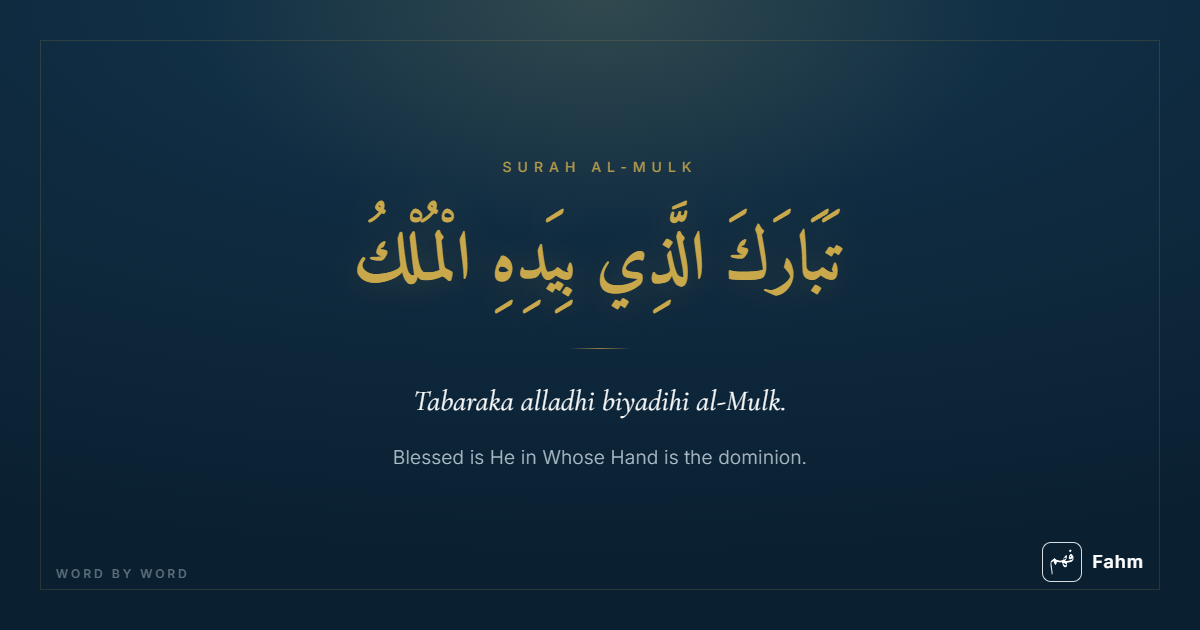
Ayah 1: Tabaraka alladhi biyadihi al-Mulku wa Huwa 'ala kulli shay'in Qadir
تَبَارَكَ الَّذِي بِيَدِهِ الْمُلْكُ وَهُوَ عَلَىٰ كُلِّ شَيْءٍ قَدِيرٌ
"Blessed is He in Whose Hand is the dominion, and He is over all things competent"
| Arabic | Transliteration | Meaning |
|---|---|---|
| تَبَارَكَ | Tabaraka | Blessed / Exalted in blessing (superlative, Allah alone) |
| الَّذِي | Alladhi | He Who / the One Who |
| بِيَدِهِ | Biyadihi | In His Hand |
| الْمُلْكُ | Al-Mulku | The dominion / sovereignty / kingdom |
| وَهُوَ | Wa Huwa | And He is |
| عَلَىٰ كُلِّ شَيْءٍ | 'Ala kulli shay'in | Over all things / over everything |
| قَدِيرٌ | Qadirun | Competent / All-Powerful |
Tabaraka — this is the word that gives the surah one of its names, and it deserves the deepest attention.
The root is b-r-k (ب-ر-ك) — the same root as barakah (blessing, abundance, divine increase). But Tabaraka is not simply "blessed." It is a superlative form — in Arabic grammar, a morphological pattern that intensifies the root's meaning to an extreme degree. Maududi explains in Tafheem ul-Quran: "Barkat comprehends the meanings of exaltation and greatness, abundance and plentifulness, permanence and multiplicity of virtues and excellences. When the superlative tabaraka is formed from it, it gives the meaning that Allah is infinitely noble and great; He is superior to everything beside Himself in His essence, attributes and works; His beneficence is infinite, and His excellences are permanent and everlasting." [Source: Tafheem ul-Quran, Maududi, 67:1]
Imam Ibn Kathir explains this superlative carries two combined meanings: greatness in essence, and abundance of good. This is why Tabaraka in classical Arabic is used only for Allah — no created being can claim either attribute in the absolute, unlimited sense this word carries. [Source: Islamtics.com, citing Imam Ibn Kathir; Tafsir Ibn Kathir, 67:1]
Biyadihi al-Mulku — "In His Hand is the Mulk." The word yad (hand) used here is one of the divine attributes — affirmed as it came, without asking how or comparing it to created hands. Maududi notes: "As the word al-Mulk has been used definitely, it cannot be taken in any limited meaning. Inevitably it would imply sovereignty over everything that exists in the Universe." [Source: Tafheem ul-Quran, 67:1] This is sovereignty over life and death, the seen and unseen, the first moment of creation and the last moment of existence.
Qadirun — from the root q-d-r (ق-د-ر), the same root as Qadar (divine decree) and Qadir (All-Powerful). He is not merely powerful — He is All-Powerful, over every single thing without exception. The indefinite kulli shay'in (every thing) admits no exceptions.
Ayah 2: Alladhi khalaqa al-mawta wal-hayata liyabluwakum
الَّذِي خَلَقَ الْمَوْتَ وَالْحَيَاةَ لِيَبْلُوَكُمْ أَيُّكُمْ أَحْسَنُ عَمَلًا
"Who created death and life to test you as to which of you is best in deed"
| Arabic | Transliteration | Meaning |
|---|---|---|
| الَّذِي خَلَقَ | Alladhi khalaqa | Who created |
| الْمَوْتَ | Al-mawta | Death |
| وَالْحَيَاةَ | Wal-hayata | And life |
| لِيَبْلُوَكُمْ | Liyabluwakum | To test you / to try you |
| أَيُّكُمْ | Ayyukum | Which of you |
| أَحْسَنُ عَمَلًا | Ahsanu 'amalan | Is best in deed |
| وَهُوَ الْعَزِيزُ الْغَفُورُ | Wa Huwal-'Azizul-Ghafur | And He is the Almighty, the All-Forgiving |
This ayah is considered by scholars to be one of the most significant in the entire Quran — because it answers the question every human being eventually asks: why are we here?
Notice what Allah says He created first: Al-mawta — death. Before life is mentioned, death is mentioned. This is theologically precise: death came before life in one sense — we were nothing, then we were given life, then we will return. But also: placing death first re-orients the listener. The surah is not asking you to celebrate being alive. It is asking you what you are doing with the life you have been given before the death that is coming.
Liyabluwakum — to test you. The root b-l-w (ب-ل-و) means to try, to test, to examine — specifically through practical experience, not theoretical knowledge. This life is a test of action, not belief alone.
Ahsanu 'amalan — best in deed. Not most in deed. Not most in knowledge. Not most in appearance. Best. The scholars explain that ahsan al-'amal (best in deed) requires two conditions: that the action is done sincerely for Allah (ikhlas), and that it follows the methodology of the Prophet ﷺ (ittiba'). An action done with great effort but wrong intention is not ahsan. An action done with sincere intention but contrary to the Sunnah is not ahsan. Only both together qualify. [Source: Tafsir Ibn Kathir, 67:2, citing al-Fudayl ibn 'Iyad's explanation]
Al-'Azizul-Ghafur — the Almighty, the All-Forgiving. These two names closing Ayah 2 are precisely paired: He is 'Aziz (Almighty — no one can escape His power or His test) and Ghafur (All-Forgiving — He forgives those who turn back to Him despite failing the test). The test is real. Failure is possible. But forgiveness is available.
Ayah 3: Alladhi khalaqa sab'a samawatin tibaqan
الَّذِي خَلَقَ سَبْعَ سَمَاوَاتٍ طِبَاقًا
"He who created seven heavens in layers"
| Arabic | Transliteration | Meaning |
|---|---|---|
| الَّذِي خَلَقَ | Alladhi khalaqa | He Who created |
| سَبْعَ سَمَاوَاتٍ | Sab'a samawatin | Seven heavens |
| طِبَاقًا | Tibaqan | In layers / one above another |
| مَّا تَرَىٰ | Ma tara | You do not see |
| فِي خَلْقِ الرَّحْمَٰنِ | Fi khalqir-Rahman | In the creation of the Most Merciful |
| مِن تَفَاوُتٍ | Min tafawut | Any inconsistency / any fault / any disproportion |
| فَارْجِعِ الْبَصَرَ | Farji'il-basar | So return your vision / look again |
| هَلْ تَرَىٰ مِن فُطُورٍ | Hal tara min futur | Do you see any rifts / any cracks? |
After declaring His sovereignty and establishing the purpose of life, the surah invites the reader to look at the evidence. Tibaqan — layered, one above another — describes the seven heavens as a structured, ordered creation, not random or accidental.
The challenge in the second half of this ayah is extraordinary: Look at the creation of the Most Merciful. Do you see any inconsistency? Any flaw? Any crack?
Tafawut — inconsistency, disproportion, fault. The word implies a mismatch — something out of place, something that doesn't fit, a design error. Allah is challenging the observer to find one. Ibn Kathir records the companions' explanation: the sky was described as having no futur (cracks or rifts) — it is seamless, consistent, and perfectly ordered. [Source: Tafsir Ibn Kathir, 67:3]
Farji'il-basar — return your vision, look again. This is a command to observe. Not to take the claim on faith without reflection — but to actually look at the creation. The Quran consistently invites contemplation of the physical world as evidence of the divine. The sky — the nearest observable layer of creation — is presented as proof of a Creator whose craftsmanship admits no flaw.
Ayah 4: Thummarji'il-basara karratayni
ثُمَّ ارْجِعِ الْبَصَرَ كَرَّتَيْنِ
"Then look again and yet again"
| Arabic | Transliteration | Meaning |
|---|---|---|
| ثُمَّ | Thumma | Then |
| ارْجِعِ الْبَصَرَ | Irji'il-basar | Return your vision / look again |
| كَرَّتَيْنِ | Karratayni | Twice / again and again |
| يَنقَلِبْ إِلَيْكَ الْبَصَرُ | Yanqalib ilaykal-basar | Your vision will return to you |
| خَاسِئًا | Khasi'an | Humbled / repelled / unable to find fault |
| وَهُوَ حَسِيرٌ | Wa huwa hasirun | While it is worn out / exhausted |
The invitation to look is intensified: look once, then look again, then look again. Karratayni literally means "two times" but in Arabic idiom indicates repeated effort — look as many times as you wish, examine as carefully as you can. The result will be the same.
Khasi'an — humbled, repelled. This word is used for an animal driven away from a place it cannot enter — eyes that searched for a flaw and were turned back, unable to find one. Hasirun — exhausted, worn out — from the effort of looking. The imagery is of a person who stares at the sky trying to find a crack, a flaw, a discontinuity — and fails completely, eyes aching from the search.
Ibn Kathir records the scholars' commentary: "Look at it as carefully as you want, search it however you wish — your sight will come back to you defeated, having failed to find any deficiency in Allah's creation." [Source: Tafsir Ibn Kathir, 67:4, citing Ibn Abbas and Qatadah]
Ayah 5: Wa laqad zayyanas-sama'ad-dunya bimasabih
وَلَقَدْ زَيَّنَّا السَّمَاءَ الدُّنْيَا بِمَصَابِيحَ
"And We have certainly beautified the nearest heaven with stars"
| Arabic | Transliteration | Meaning |
|---|---|---|
| وَلَقَدْ زَيَّنَّا | Wa laqad zayyanna | And We have certainly beautified |
| السَّمَاءَ الدُّنْيَا | As-sama'ad-dunya | The nearest heaven |
| بِمَصَابِيحَ | Bimasabih | With lamps / stars |
| وَجَعَلْنَاهَا | Wa ja'alnaha | And We have made them |
| رُجُومًا لِّلشَّيَاطِينِ | Rujuman lish-shayatin | Projectiles against the devils |
| وَأَعْتَدْنَا لَهُمْ | Wa a'tadna lahum | And We have prepared for them |
| عَذَابَ السَّعِيرِ | 'Adhab as-sa'ir | The punishment of the Blaze |
Masabih — lamps, lights — the stars of the nearest heaven. They serve a dual purpose established here: beauty (zayyanna — We beautified) and protection (rujum — projectiles hurled at shayateen who attempt to ascend and eavesdrop on the divine assembly). Both functions are simultaneously real: the same stars that make the night sky beautiful are the same forces that guard the heavens from unsanctioned access by evil.
Rujuman lish-shayatin — projectiles against the devils. The Quran describes in other surahs (Al-Hijr, Al-Jinn) that the shayateen used to ascend and steal fragments of heavenly news before revelation — and after the revelation began, they were repelled by shooting stars. This ayah establishes the stars as active elements of a defended, ordered creation. [Source: Tafsir Ibn Kathir, 67:5]
'Adhab as-sa'ir — the punishment of the Blaze. The term sa'ir describes a fire that is stoked, intensified, burning at maximum force. It closes the opening section with a reminder that the order of creation includes ultimate consequences.
Thematic Breakdown: Ayahs 6-22
The People of the Grave Who Refused to Listen (Ayahs 6-11)
After the opening declaration of sovereignty and the evidence of creation, Surah Al-Mulk turns to consequences. Ayahs 6-11 describe the people of Hell — not as cartoon villains, but as people who were warned and chose not to think.
The most devastating exchange in this section is Ayahs 8-9. The keepers of Hell ask those being thrown in: "Did there not come to you a warner?" They answer: "Yes — but we denied him." Then in Ayah 10, they say what may be the most honest admission in the Quran: "If only we had listened or reasoned, we would not be among the companions of the Blaze."
Listened — sami'na — if we had heard the warnings properly. Reasoned — 'aqalna — if we had used our intellect. The word 'aql (reason, intellect) comes from the root meaning to tether or restrain — the intellect is what tethers a person from running into destruction. They admit they had both the message and the capacity to reason — and used neither.
Ibn Kathir records: "This is their admission of sin and their acknowledgment that the messengers had delivered the warnings to them clearly." [Source: Tafsir Ibn Kathir, 67:10-11]
Fear of the Unseen and Divine Knowledge (Ayahs 12-14)
Ayah 12 contrasts directly with the people of the Blaze: "Indeed, those who fear their Lord unseen will have forgiveness and great reward."
Bil-ghayb — in the unseen, with the unseen, fearing Allah without seeing Him. This is the defining characteristic of true iman: you believe in, fear, and love Allah while He remains unseen to you. The people of Hell said "if only we had used our reason" — here the believing people who used their reason to conclude that Allah exists and deserves to be feared are promised forgiveness.
Ayah 14 delivers one of the most rhetorically powerful questions in the surah: "Does He who created not know?" The answer is embedded in the question. The One who designed the human heart, the One who created the capacity for thought and intention — is He unaware of what is inside it? The Arabic word Al-Latif (the Subtle) means the One who perceives even the most refined, hidden things. Al-Khabir (the Acquainted) means the One who has full, complete information of everything. Both names together: nothing interior, no matter how hidden or subtle, escapes Him. [Source: Tafsir Ibn Kathir, 67:14]
The Birds, Sustenance, and Tawakkul (Ayahs 15-22)
Ayahs 15-22 form one of the most beautifully argued sections in the surah. Allah invites reflection on three things:
The earth (Ayah 15): "It is He who made the earth tame for you." The word dhalul — tame, submissive — describes the earth as something that has been made manageable specifically for human habitation. Walk across it. Eat from its provision. But know: "to Him is the resurrection."
The birds (Ayah 19): "Do they not see the birds above them, spreading their wings and folding them? None holds them aloft except the Most Merciful."
At-Tirmidhi, al-Nasa'i, and Ibn Majah all record the hadith connected to this ayah: "If you were to rely upon Allah with the reliance He deserves, He would provide for you as He provides for the birds — they set out in the morning with empty stomachs and return in the evening with full stomachs." [Source: Jami' al-Tirmidhi, 2344 — graded Hasan Sahih; recorded in Tafsir Ibn Kathir, 67:21]
The bird does not doubt. The bird does not despair. The bird flies out each morning with no stored food — and returns each evening having been sustained. This is tawakkul (complete reliance on Allah) illustrated by creation itself.
The army (Ayah 20): "Or who is it that could be an army for you to aid you other than the Most Merciful?" In the moment of real vulnerability, when no human power can help — who is your defender? The surah answers: only He who holds the Mulk in His Hand.
The Closing Section: Accountability and the Final Warning (Ayahs 23-30)
The final section of Surah Al-Mulk closes what the opening declared. Ayah 23 returns to the theme of creation and gratitude: "It is He who has produced you and made for you hearing and vision and hearts — little are you grateful."
Al-sam' (hearing), al-absar (vision/sight), al-af'idah (hearts/minds) — the three faculties that give the human being the capacity to receive revelation, observe evidence, and understand meaning. These three were given specifically to enable the test of Ayah 2. The same faculties the people of Hell admitted they had but failed to use.
Ayah 30 closes the surah with one of its most striking rhetorical challenges:
"Say: Have you considered — if your water was to become sunken into the earth, who could bring you flowing water?"
Water — the foundation of all biological life — is given freely by Allah. It is not earned. It is not manufactured by human ingenuity. If He withdrew it, there would be no replacement. No army. No technology. No nation. The surah ends here: with the most basic dependence of the human being on the Creator who holds the Mulk.
The Virtues of Surah Al-Mulk: Authentic Summary
It intercedes until its companion is forgiven: Abu Hurayrah (رضي الله عنه): The Prophet ﷺ said: "There is a surah in the Quran of thirty verses that interceded for a man until he was forgiven. It is Tabaraka alladhi biyadihi al-Mulk." [Sunan Abu Dawud (1400); Sunan al-Tirmidhi (2891) — Hasan; Ibn Hibban — Sahih; authenticated by al-Dhahabi]
It protects from the punishment of the grave: Ibn Mas'ud (رضي الله عنه): "It is the Preventer. It protects from the punishment of the grave." [Mustadrak al-Hakim (3839) — Sahih; IslamQA.info, Answer 191947]
The Prophet ﷺ never slept without it: Jabir (رضي الله عنه): "The Prophet ﷺ would not sleep until he recited Alif-Lam-Mim Tanzil (Surah Al-Sajdah) and Tabaraka alladhi biyadihi al-Mulk (Surah Al-Mulk)." [Sunan al-Tirmidhi (2892); Musnad Ahmad]
Ibn Mas'ud's extended description: "Surah Tabarak will argue on behalf of its reciter until it admits him into Paradise." [Shu'ab al-Iman of al-Bayhaqi, (2508); referenced in Islamic sources on the surah's virtues]
When to Recite Surah Al-Mulk
Before sleeping every night — the most established Sunnah, confirmed by Jabir's narration. The Prophet ﷺ made this a consistent nightly practice without exception.
After every fard Salah — some scholars recommend this based on the general emphasis on reciting it regularly to gain its intercession.
As general dhikr — there is no restriction. The more consistently it is recited, the more firmly its intercession is established for the reciter.
Frequently Asked Questions
What is the meaning of Surah Al-Mulk in English? Surah Al-Mulk means "The Chapter of Sovereignty" or "The Chapter of Dominion." Al-Mulk refers to absolute, total sovereignty over all of existence — the heavens, the earth, life, death, and the Hereafter. Nothing falls outside it. The surah opens by declaring this sovereignty as belonging entirely to Allah and proceeds through evidence of His creation, the reality of the test of life, and the consequences of belief and disbelief.
What does Tabaraka mean? Tabaraka is a superlative form from the root b-r-k (the same root as barakah). It carries the combined meaning of infinite greatness in essence and infinite abundance of good — a form reserved in classical Arabic for Allah alone. No created being can be described with tabaraka in the absolute sense. Ibn Kathir explains it as combining Allah's exaltation and the permanence of His excellences.
Does Surah Al-Mulk protect from the punishment of the grave? Yes — based on authentic narrations. The hadith of Abu Hurayrah in Sunan Abu Dawud (1400) and Sunan al-Tirmidhi (2891) describes it as interceding until its companion is forgiven. Abdullah ibn Mas'ud's narration in al-Hakim's Mustadrak (graded Sahih) explicitly calls it "the Preventer" from the punishment of the grave. IslamQA.info and classical scholars affirm these as the primary evidences.
Is it Sunnah to recite Surah Al-Mulk before sleeping? Yes. Jabir ibn Abdillah's narration in Sunan al-Tirmidhi (2892) establishes that the Prophet ﷺ would not sleep until he had recited Surah Al-Sajdah and Surah Al-Mulk. This is among the most established nightly recitation practices in the Prophetic Sunnah.
How long does it take to memorize Surah Al-Mulk? Surah Al-Mulk has 30 ayat and approximately 330 words in Arabic. For someone who already knows the sounds and letters of Arabic, a realistic timeline for full memorization is 30-60 days of consistent daily practice, learning 1-3 ayat per day. Understanding what you're memorizing — as this post establishes — significantly speeds up and improves retention.
Why is Surah Al-Mulk also called Tabaraka? Because its opening word is Tabaraka — and the companions of the Prophet ﷺ frequently referred to surahs by their most distinctive opening words. The Prophet ﷺ himself sometimes used this name when referring to it. [Source: Tafheem ul-Quran, Maududi, Surah Al-Mulk introduction]
How Surah Al-Mulk Connects to Fahm's Curriculum
Many of the key words in Surah Al-Mulk are words you have already encountered across our series of posts:
- Tabaraka — root b-r-k — the same root as barakah in the Tashahhud (wa barakatuh) and in Durood Ibrahim
- Al-Mulk — sovereignty — appears in Ayat Al-Kursi (wa Huwal-'Aliyyul-'Azim), whose Kursi encompasses the heavens and the earth in the same way Al-Mulk declares dominion over them
- Khalaq — created — appears in Surah Al-Falaq (min sharri ma khalaq), in the Quran's descriptions of creation throughout
- Al-Hayah / Al-Mawt — life and death — root h-y-y (life) appears in Al-Hayy (Ever-Living) in Ayat Al-Kursi; mawt appears across dozens of Quranic contexts
- Al-'Aziz / Al-Ghafur — the Almighty, the All-Forgiving — both names appear throughout the Quran in pairs, recognizable once their roots are known
- 'Amal — deed/action — the root '-m-l appears in Surah Al-Asr (amilas-salihat) and throughout the Quranic descriptions of accountability
This is the reality of the Quranic vocabulary: the roots repeat. The words of Surah Al-Mulk are the words of your prayer, the words of Ayat Al-Kursi, the words of the surahs you already know. Fahm's curriculum sequences these roots deliberately — so that what you learn in one surah unlocks recognition in every other.
Barakallahu Feekum. May Surah Al-Mulk be your intercessor in the grave, your companion before sleep, and from this day forward — a surah you understand rather than merely recite.
Start learning the words of your prayer today.
Sources
- Sunan Abu Dawud, Hadith 1400 (Surah Al-Mulk intercedes until forgiven — Abu Hurayrah)
- Sunan al-Tirmidhi, Hadith 2891 (same narration — graded Hasan; authenticated by al-Dhahabi)
- Sunan al-Tirmidhi, Hadith 2892 (Jabir — Prophet ﷺ did not sleep without Al-Mulk)
- Sunan Ibn Majah, Hadith 3786 (Abu Hurayrah narration — parallel chain)
- Musnad Imam Ahmad, 2/299 (same narration — parallel chain)
- Mustadrak al-Hakim, Hadith 3839 (Ibn Mas'ud — Surah Al-Mulk is the Preventer from the grave — graded Sahih)
- Shu'ab al-Iman, al-Bayhaqi, Hadith 2508 (Ibn Mas'ud — Surah Tabarak intercedes until Paradise)
- Jami' al-Tirmidhi, Hadith 2344 (the birds hadith on tawakkul — graded Hasan Sahih)
- Tafsir Ibn Kathir, Surah Al-Mulk, Ayahs 1-30 (Imam Ismail ibn Kathir, d. 774 AH)
- Tafheem ul-Quran (Syed Abu-al-A'la Maududi) — Surah Al-Mulk, commentary on Ayahs 1-5
- IslamQA.info, Answer 191947 — What Surah Protects from the Punishment of the Grave? (islamqa.info)
- Dorar.net — Tafsir of Surah Al-Mulk (dorar.net)
- IslamAnswers.co.uk — Does Reciting Surah Mulk Protect from Punishment in the Grave? (islamanswers.co.uk)