Assalamualaikum wa rahmatullahi wa barakatuhu,
Umar ibn al-Khattab (رضي الله عنه) — the second Caliph, the man the Prophet ﷺ said Shaytan himself avoids — once asked a companion to define taqwa.
The companion didn't give him a theological lecture. He asked a question:
"Have you ever walked a path full of thorns?"
Umar said yes.
"What did you do?"
"I rolled up my garment and walked carefully — watching every step."
The companion replied: "That is taqwa." — Recorded by Imam Bayhaqi; cited in Tafsir Al-Baghawi, commentary on Surah Al-Baqarah (2:2)
Not a feeling. Not a mood. Not a one-time decision. A way of moving — through every moment of every day — with the awareness that there are thorns, that stepping wrongly has consequences, and that the careful, deliberate walker is the one who arrives intact.
This post is the complete taqwa meaning in Islam — the Arabic root, what it literally means, the companion definitions that have defined Islamic scholarship for fourteen centuries, the Quranic verses that establish it as the foundation of the entire Book, the three levels Ibn al-Qayyim identified, and the Prophet's ﷺ own dua to attain it.
What Is Taqwa? The Short Answer Before the Deep One
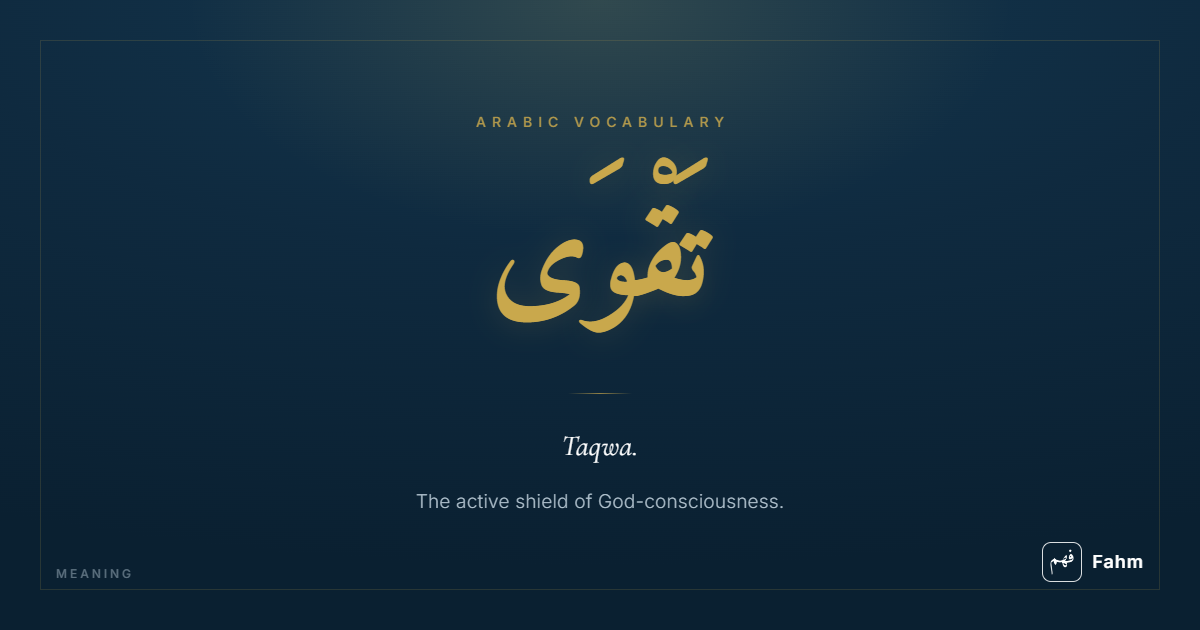
Taqwa (تَقْوَى) is one of the most repeated concepts in the Quran — derivatives of its root appear over 250 times. It is most often translated as "fear of Allah," "God-consciousness," or "piety." None of these are wrong. None of them are complete.
The most precise translation, once you understand the Arabic root, is: the active state of protecting yourself from what displeases Allah — built through constant awareness of Him.
It is not passive. It is not occasional. It is a permanent orientation of the heart that shapes every step.
The Root: W-Q-Y (و-ق-ي) — To Protect, To Shield
Taqwa comes from the trilateral Arabic root w-q-y (و-ق-ي), meaning to protect, to guard, to shield against harm.
From this root:
- Waqā (وَقَى) — he protected
- Wiqāyah (وِقَايَة) — a shield, a protective covering
- Ittaqā (اتَّقَى) — he protected himself (the eighth verbal form — doing the action for one's own benefit, with diligence)
- Taqwa (تَقْوَى) — the ongoing state of self-protection
- Muttaqi (مُتَّقِي) — one who practices taqwa; the muttaqun are those in a state of taqwa
The eighth verbal form ittaqā — from which taqwa directly derives — carries a specific grammatical meaning in Arabic: it implies performing the action of the root for oneself, with full deliberate effort. So ittaqā is not merely "he was protected" — it is "he actively protected himself, with care and diligence." [Source: Islamtics.com, Taqwa Meaning, citing Lane's Arabic-English Lexicon, Vol. 8; QuranicTeachings.org, root analysis of W-Q-Y]
The image embedded in this root is the wiqāyah — the shield a soldier carries into battle. A shield is not passive protection. The soldier must hold it, position it, move it deliberately to block what is coming. Taqwa is not a state you fall into — it is something you actively maintain, position, and carry.
The Quranic scholar and root linguist also notes the image of ittaqa al-matar — "he sought shelter from the rain" — as an example of the root's usage: someone actively moving, looking for cover, making decisions to avoid getting hit. [Source: QuranicTeachings.org, W-Q-Y root analysis]
This is why "fear of Allah" is an incomplete translation. Fear implies a feeling — something that happens to you. Taqwa describes something you do — an active, ongoing, effortful state of protecting yourself through the awareness of Allah. The fear is part of it. But it is the action that fear produces, maintained consistently, that constitutes taqwa.
Taqwa Is the Foundation of the Entire Quran
The Quran's first direct address to the reader — after Al-Fatiha — is Surah Al-Baqarah, and its second verse says:
"This is the Book about which there is no doubt, a guidance for those who have taqwa." — Surah Al-Baqarah (2:2)
Before any ruling is given. Before any story is told. Before any command or prohibition. The Quran declares who it is for: the muttaqun — the people of taqwa.
Ibn Kathir explains this verse: "Guidance here means benefit — meaning this Quran is a guidance for and a cure for the hearts of the believers who have taqwa. Allah said in other places: 'Say: it is for those who believe a guidance and a cure.'" [Source: Tafsir Ibn Kathir, 2:2]
Ibn Abbas (رضي الله عنه) defined the muttaqun simply: "Believers who avoid shirk with Allah and who work in His obedience." [Source: Wikipedia, Taqwa, citing Ibn Abbas; confirmed in multiple classical tafsir]
The placement is not coincidental. The Quran is its own complete guide — but its guidance only reaches those who come to it with taqwa. A heart without taqwa reads the Quran and it passes through. A heart with taqwa reads the Quran and is transformed by it.
Key Quranic Verses on Taqwa
The Quran returns to taqwa in almost every context — worship, law, relationships, commerce, death, the afterlife. Here are the most defining verses:
Taqwa as the purpose of Salah:
"O you who have believed, fasting has been prescribed for you as it was prescribed for those before you — so that you may attain taqwa." — Surah Al-Baqarah (2:183)
Fasting is prescribed so that you may attain taqwa. Not as an end in itself but as a means. Every act of worship in Islam — Salah, fasting, Hajj, Zakat — is ultimately in service of building taqwa. The worship is the training. Taqwa is the product. [Source: Tafsir Ibn Kathir, 2:183]
Taqwa as the criterion on the Day of Judgement:
"O mankind, indeed We have created you from male and female and made you peoples and tribes that you may know one another. Indeed, the most noble of you in the sight of Allah is the most having-taqwa of you. Indeed, Allah is All-Knowing and All-Acquainted." — Surah Al-Hujurat (49:13)
The most noble. Not the wealthiest. Not the most educated. Not the most connected. Not the one with the longest lineage. The one with the most taqwa. This verse dismantles every human hierarchy and replaces it with a single divine criterion — invisible to all except Allah.
Taqwa and barakah:
"And if the people of the towns had believed and had taqwa, certainly We would have opened for them blessings from the heaven and the earth." — Surah Al-A'raf (7:96)
We covered this verse in the barakah post — iman and taqwa together are what open the doors of barakah. Taqwa is not only about the afterlife. Its rewards begin in this world.
Taqwa and the way out:
"And whoever has taqwa of Allah — He will make for him a way out. And will provide for him from where he does not expect." — Surah At-Talaq (65:2-3)
This is among the most hope-giving verses in the Quran for the believer in difficulty. The makhraj — the way out — is guaranteed for the person of taqwa. Not maybe. Not sometimes. He will make for him a way out. Ibn Kathir records that this verse was a direct answer to the concerns of those who felt trapped — financially, socially, in any difficulty — and that it applies to every dimension of life. [Source: Tafsir Ibn Kathir, 65:2-3]
Taqwa lives in the chest:
"It is that — and whoever honors the symbols of Allah, it is from the taqwa of the hearts." — Surah Al-Hajj (22:32)
And most directly, the Prophet ﷺ himself pointed to where taqwa lives:
"Taqwa resides here" — and he pointed three times to his chest. — Sahih Muslim (2564)
Taqwa is not in the external appearance. It is not in the length of the beard or the style of the clothes. It is in the heart — and Allah is the only one who sees it. This is why the Quran's criterion of nobility (49:13) cannot be judged by any human being — only Allah knows whose chest holds taqwa.
The Companions on Taqwa: Four Definitions That Span Everything
The companions of the Prophet ﷺ defined taqwa from four different angles — and together they form a complete picture:
Ubayy ibn Ka'b (رضي الله عنه) — the thorny path: When Umar ibn al-Khattab asked him to define taqwa, he asked in return: "Have you ever walked a path full of thorns? What did you do?"
Umar said: "I rolled up my garment and walked carefully."
Ubayy said: "That is taqwa."
The thorn path is not avoided — you still have to walk through life. The world is full of haram, of temptation, of things that can wound the soul. Taqwa is not hiding from the path. It is walking it — with every step deliberate, clothing gathered, attention fully on where you are treading. [Source: Tafsir Al-Baghawi, commentary on 2:2; recorded by Imam Bayhaqi; HadithAnswers.com, which notes the Abu Hurayrah version is recorded in Az-Zuhdul Kabir (978)]
Ali ibn Abi Talib (رضي الله عنه) — four dimensions: When asked about taqwa, Ali (رضي الله عنه) answered:
"It is fear of the Majestic, action by the revelation, contentment with little, and preparation for the day of departure."
Four components: the heart (fear of Allah), the body (acting by what was revealed), the material (contentment with less), and the future (preparing for death and what follows). Between these four, taqwa covers a person's entire life — inner, outer, material, and ultimate. [Source: Islamtics.com, citing Ali ibn Abi Talib's definition, cross-referenced with classical scholarly sources]
Ibn Abbas (رضي الله عنه) — the simplest definition: "The muttaqun are believers who avoid shirk with Allah and who work in His obedience."
Two movements: away from shirk and toward obedience. Taqwa pushes you away from the greatest harm and pulls you toward the greatest good simultaneously. [Source: Classical tafsir sources; Wikipedia, Taqwa, citing Ibn Abbas]
Hasan al-Basri (رحمه الله) — going beyond the minimum: The great scholar and successor-generation scholar Hasan al-Basri said:
"The people of taqwa abstain from what Allah has prohibited and act upon what He has commanded. Their taqwa continues until they leave even much of the halal, fearing it could be haram."
The highest level of taqwa goes beyond the clear prohibitions — the person of deep taqwa creates distance even from the permissible when it is close to the boundary of what is not. This is the cautious walk of Umar's example: not just avoiding the thorns, but avoiding the parts of the path where thorns might be hidden. [Source: NewMuslims.com citing Hasan al-Basri; SoundVision.com on the concept of taqwa]
The Three Levels of Taqwa: Ibn al-Qayyim
Ibn al-Qayyim al-Jawziyyah — one of the most profound scholars in Islamic history — identified three levels of taqwa in his scholarly works, each building on the previous:
Level 1: Protecting the heart and limbs from sins and all forbidden matters. This is the minimum threshold — avoiding the haram. Avoiding what Allah has explicitly prohibited. This level, Ibn al-Qayyim said, gives the servant his life — spiritual life. Without it, the heart is dead.
Level 2: Protecting the heart and limbs from disliked matters (makruh). Beyond the forbidden, the person of deeper taqwa also avoids what is disliked — things not explicitly haram but close to harm, or habitual in ways that dull the heart's awareness of Allah. This level gives the servant health and strength — a heart that is not merely alive but functioning well.
Level 3: Protecting oneself from fudool — curiosity and what does not concern him. The highest level. Not just avoiding haram, not just avoiding makruh, but also stepping back from the unnecessary — conversations that don't benefit, content that doesn't serve, knowledge that doesn't concern the soul's journey to Allah. This level, Ibn al-Qayyim said, enables the servant to gain happiness, contentment, and light.
[Source: Ibn al-Qayyim al-Jawziyyah, three levels of taqwa — recorded in IbnulQayyim.tumblr.com citing Ibn al-Qayyim's scholarly works; Islamtics.com cross-referencing with Ibn al-Qayyim's written tradition]
These three levels describe a progression — not three separate categories of Muslims, but a single path of spiritual development. Most believers operate between levels one and two. The third level is the territory of those who have purified the heart beyond the obvious obligations and prohibitions.
Taqwa and Salah: The Connection Most Muslims Miss
Here is something worth pausing on: Salah — the prayer — was described by Allah as the primary means of developing taqwa:
"Indeed, prayer prohibits immorality and wrongdoing." — Surah Al-'Ankabut (29:45)
And fasting was prescribed specifically in order to develop taqwa (2:183). And Hajj is connected to taqwa in Surah Al-Baqarah (2:197): "And take provisions — but indeed the best provision is taqwa."
Every pillar of Islamic worship is aimed at building the same thing: a heart that is alert, shielded, and moving through life with the awareness of Allah in every step.
But here is the connection to Fahm's specific mission: the words you say in Salah — Al-Fatiha, the Tashahhud, Durood Ibrahim — are the words of a muttaqi speaking to Allah. When Salah becomes a conscious conversation rather than a memorized recitation, it actually does what it was designed to do. It builds taqwa.
A person who recites "iyyaka na'budu wa iyyaka nasta'in" knowing that it means "You alone I worship, You alone I ask for help" — that declaration becomes a real-time renewal of commitment. A person who recites "ihdinas-siratal mustaqim" knowing it means "guide me to the straight path" is actually asking for guidance with their full attention, not just moving their lips.
Understanding the words of your prayer is not an academic exercise. It is how Salah produces what it was designed to produce — taqwa.
The Prophet's ﷺ Dua for Taqwa
The Prophet ﷺ taught his companions a specific supplication for taqwa — not as an occasional dua but as a regular, consistent request:
Arabic:
اللَّهُمَّ إِنِّي أَسْأَلُكَ الْهُدَى وَالتُّقَى وَالْعَفَافَ وَالْغِنَى
Transliteration:
Allahumma inni as'aluka al-huda wat-tuqa wal-'afafa wal-ghina
Translation:
"O Allah, I ask You for guidance, taqwa, chastity, and self-sufficiency." — Sahih Muslim (2721)
Four things asked together: huda (guidance), tuqa (taqwa), 'afaf (chastity/restraint), and ghina (self-sufficiency of the heart — contentment). They are sequential: guidance produces taqwa, taqwa produces chastity and restraint, and restraint produces the contentment of one who needs nothing beyond what Allah has provided.
The fact that the Prophet ﷺ asked Allah for taqwa — the man who was guaranteed Paradise, the man in whose heart taqwa was complete — tells you something about the nature of this dua. Taqwa is not a destination you arrive at and stop requesting. It is something maintained, sustained, and renewed through continuous supplication. Asking Allah for it is itself part of having it.
Taqwa and the Criterion of the Day of Judgement
Surah Al-Hujurat (49:13) establishes the single criterion of nobility in the sight of Allah: "The most noble of you in the sight of Allah is the most having-taqwa of you."
This verse deserves to be sat with.
On the Day of Judgement, none of the metrics that humans use to rank each other will mean anything. Wealth — gone. Lineage — irrelevant. Education — not the question. Physical appearance — no factor. Nationality — no weight.
The one question Allah's criterion asks: how much taqwa did this person carry? How alert was this heart? How carefully did this person walk the thorny path of life — how deliberately, how deliberately gathered, how intentionally shielding themselves from what displeases Allah?
That is the only rank that will matter. And it is the only rank that cannot be seen by any other human being — only by Allah Himself. Which means the entire competition humans run throughout their lives — for status, for recognition, for being seen as more — is running on the wrong track entirely.
Frequently Asked Questions
What does taqwa mean in English? Taqwa (تَقْوَى) is most precisely translated as "the active state of protecting yourself from what displeases Allah through constant awareness of Him." It is commonly translated as "God-consciousness," "piety," or "fear of Allah" — but the Arabic root w-q-y (to shield, to protect) makes clear it is an active, ongoing state of self-protection, not merely a feeling of fear.
What is the root of taqwa? The root is w-q-y (و-ق-ي) — to protect, to shield, to guard against harm. The same root gives wiqāyah (a battle shield), waqā (he protected), and ittaqā (he protected himself, with diligence). Taqwa is the noun describing the ongoing state of this self-protection through Allah-consciousness.
Who are the muttaqun? The muttaqun (المُتَّقِين) are those who practice taqwa — the God-conscious, the shield-carriers. Ibn Abbas defined them as: "believers who avoid shirk with Allah and who work in His obedience." The Quran identifies them as the audience for its guidance from its second verse (2:2) and as the most noble in Allah's sight (49:13).
What are the three levels of taqwa? Ibn al-Qayyim identified three levels: (1) protecting the heart and limbs from sins and all forbidden matters — this gives spiritual life; (2) protecting the heart and limbs from disliked matters (makruh) as well — this gives spiritual health and strength; (3) protecting oneself from fudool (unnecessary curiosity and what doesn't concern the soul's journey) — this gives happiness, contentment, and light. Each level builds on the previous.
What is the difference between taqwa and khashyah? Khashyah (خَشْيَة) refers specifically to the fear of Allah — a feeling of awe and reverence. Taqwa is broader: it includes khashyah but also encompasses the active behavior that fear produces. You can feel khashyah in a moment; taqwa is what you do with that feeling consistently over a lifetime.
How do you develop taqwa? The Quran and Sunnah identify several means: consistent Salah with presence of heart (29:45), fasting (2:183), making the Prophet's ﷺ dua for taqwa regularly (Sahih Muslim 2721), taking account of oneself daily, choosing companions of taqwa (Sunan Abu Dawud 4833), seeking Islamic knowledge, and sincere istighfar — since returning to Allah is itself a manifestation of taqwa.
Is taqwa only about avoiding haram? At its first level, yes — taqwa begins with avoiding what Allah has prohibited. But the companions and scholars established it as much broader: Hasan al-Basri noted that deep taqwa extends to avoiding even much of the halal out of caution. Ali ibn Abi Talib's definition added fear of Allah, acting by revelation, contentment with little, and preparation for death. Ibn al-Qayyim's third level extends taqwa to guarding against fudool — unnecessary engagement that doesn't benefit the heart.
How Taqwa Connects to Fahm's Curriculum
The root w-q-y appears directly in the words of your daily Salah and in the Quran you already know:
- Al-Fatiha — "Ihdinas-siratal mustaqim" — guide us to the straight path: this is the path of the muttaqun, those described in the following verse as receiving Allah's blessing and guidance
- Surah Al-Baqarah (2:2) — covered in the last two ayat of Surah Al-Baqarah post — the Book is guidance for the muttaqun
- Surah Al-A'raf (7:96) — covered in the barakah post — iman and taqwa open the doors of barakah from heaven and earth
- Surah Al-Mulk (67:12) — covered in the Surah Al-Mulk post: "Indeed, those who fear their Lord unseen will have forgiveness and great reward" — this is taqwa: fearing Allah when He is unseen, which is the definition itself
The more vocabulary you know from the Quran, the more taqwa makes direct sense — because taqwa is ultimately about a relationship with the One whose words you are reading and reciting. Every word of Al-Fatiha, every phrase of the Tashahhud, every ayah of Ayat Al-Kursi — they all point to the same Being whose awareness in your heart is taqwa.
Barakallahu feekum. May Allah give us all the taqwa of those who walk the thorny path carefully — sleeves rolled up, eyes down, steps deliberate — and arrive at the end of the journey unscathed.
Start learning the words of your prayer today.
Sources
- Sahih Muslim, Hadith 2564 (Prophet ﷺ pointing to his chest — "Taqwa resides here")
- Sahih Muslim, Hadith 2721 (the Prophet's ﷺ dua: Allahumma inni as'aluka al-huda wat-tuqa wal-'afafa wal-ghina)
- Sunan Abu Dawud, Hadith 4833 (a person follows the religion of his close friend)
- Tafsir Al-Baghawi (Ma'alim al-Tanzil), commentary on Surah Al-Baqarah (2:2) — Ubayy ibn Ka'b's thorny path definition; recorded by Imam Bayhaqi with his chain
- Az-Zuhdul Kabir (al-Bayhaqi), Hadith 978 — Abu Hurayrah's version of the thorny path definition (HadithAnswers.com: "This version is suitable to quote")
- Tafsir Ibn Kathir, Surah Al-Baqarah (2:2), Surah Al-Hujurat (49:13), Surah At-Talaq (65:2-3), Surah Al-Baqarah (2:183)
- Surah Al-Baqarah (2:2) — guidance for the muttaqun
- Surah Al-Baqarah (2:183) — fasting prescribed for taqwa
- Surah Al-Hujurat (49:13) — the most noble is the most having taqwa
- Surah Al-A'raf (7:96) — iman and taqwa open barakah
- Surah At-Talaq (65:2-3) — taqwa brings a way out and provision
- Surah Al-'Ankabut (29:45) — prayer prohibits immorality
- Surah Al-Hajj (22:32) — honoring Allah's symbols is from taqwa of the hearts
- Ibn al-Qayyim al-Jawziyyah — three levels of taqwa, from his scholarly works; cited in IbnulQayyim.tumblr.com and cross-referenced in Islamtics.com
- Ali ibn Abi Talib (رضي الله عنه) — four-component definition of taqwa; cited in Islamtics.com with classical scholarly cross-reference
- Hasan al-Basri — definition of the people of taqwa; cited in NewMuslims.com and SoundVision.com
- Ibn Abbas (رضي الله عنه) — definition of the muttaqun; cited in classical tafsir sources
- HadithAnswers.com — Umar Asks Ubayy ibn Ka'b Regarding Taqwa — chain verification and source guidance (hadithanswers.com)
- IslamQA.info, Answer 10843 — What is taqwa and how can it be attained? (islamqa.info)
- Dorar.net — Taqwa in the Quran and Sunnah (dorar.net)