Assalamualaikum wa rahmatullahi wa barakatuhu,
A question for you: how many times did you recite the Tashahhud in Salah today?
If you prayed all five obligatory prayers, the answer is at least nine times — and likely more if you pray Sunnah or Nafl prayers. Over the course of a year, that number climbs past 3,000 recitations.
Now a harder question: how many of those times did you actually know what you were saying?
For most English-speaking Muslims, the Tashahhud is something we memorized as children, recite faithfully, and understand vaguely — if at all. We know it means something about peace and bearing witness. But the specific words, their individual meanings, the weight of each phrase — that often gets lost.
This post is the full Tashahhud translation, word by word — the complete Arabic text, transliteration, and the meaning behind every phrase of the Tashahhud in Salah. By the end, your next prayer will feel different.
What Is the Tashahhud?
The Tashahhud (تَشَهُّد) takes its name from the Arabic root sh-h-d (ش-ه-د), meaning "to bear witness" or "to testify." The word shahada — the Islamic declaration of faith — comes from the same root. The Tashahhud is, at its core, a testimony: a seated declaration of who Allah is, who the Prophet ﷺ is, and who we are in relation to both.
It is also known as At-Tahiyyat (ٱلتَّحِيَّات), named after its opening word — a term we will unpack in detail below.
The full Tashahhud is recited while seated (the position known as Qa'dah), facing the Qiblah, with the right index finger raised during the Shahada. In Salah, it appears:
- After the second rak'ah in any prayer of three or four rak'ahs (the middle sitting)
- At the end of every prayer, in the final sitting before the Tasleem
The Authentic Source: How the Prophet ﷺ Taught It
Before we break it down word by word, it matters to understand where this text comes from — because this is not something composed by scholars. It was taught directly by the Prophet Muhammad ﷺ to his companions.
The most authentic and widely agreed-upon narration is from Abdullah ibn Mas'ud (رضي الله عنه), recorded in both Sahih al-Bukhari and Sahih Muslim:
"The Messenger of Allah ﷺ taught me the Tashahhud, holding my hand between his hands, just as he would teach me a Surah from the Quran." — Ibn Mas'ud (رضي الله عنه), Sahih al-Bukhari (6265), Sahih Muslim (402)
Imam al-Tirmidhi confirmed: "The hadith of Ibn Mas'ud is the soundest hadith about the Tashahhud, and is to be acted upon according to most of the scholars among the Companions and Successors." [Source: Jami' al-Tirmidhi, commentary on hadith 289]
The Prophet ﷺ didn't hand his companions a scroll. He held Ibn Mas'ud's hand between both of his own and taught him these words the way he taught Quran — with care, repetition, and deliberate attention to every letter. That alone tells you something about the weight of what you're about to learn.
The Full Tashahhud: Arabic, Transliteration, and Translation
Arabic:
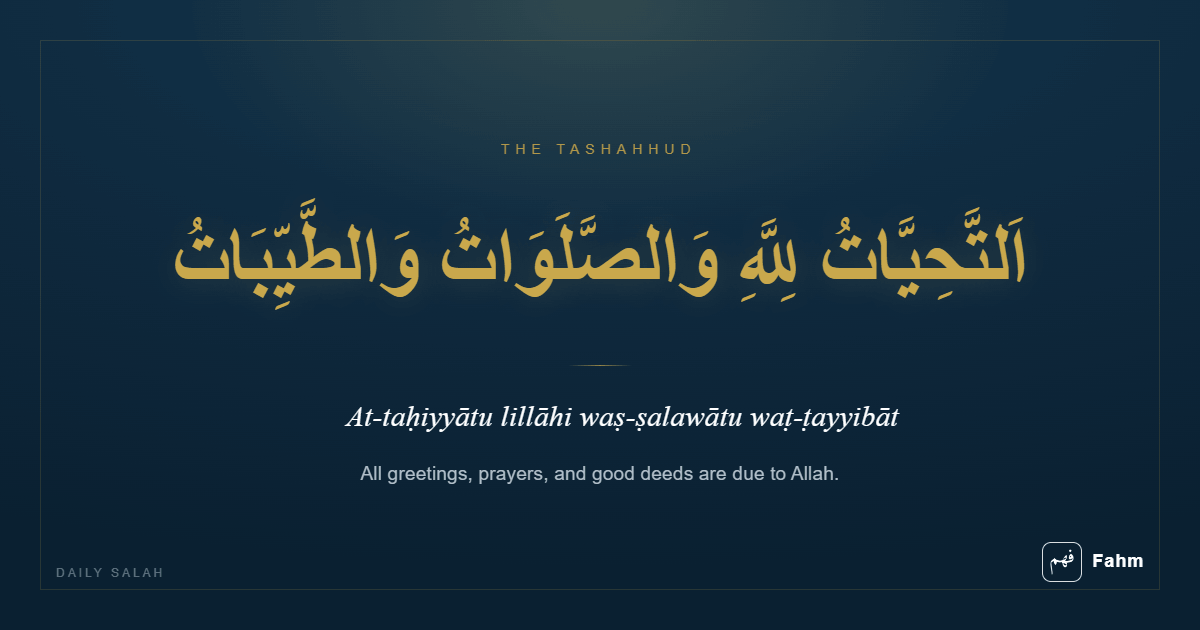
اَلتَّحِيَّاتُ لِلَّهِ وَالصَّلَوَاتُ وَالطَّيِّبَاتُ، اَلسَّلَامُ عَلَيْكَ أَيُّهَا النَّبِيُّ وَرَحْمَةُ اللهِ وَبَرَكَاتُهُ، اَلسَّلَامُ عَلَيْنَا وَعَلَى عِبَادِ اللهِ الصَّالِحِينَ، أَشْهَدُ أَنْ لَا إِلَهَ إِلَّا اللهُ وَأَشْهَدُ أَنَّ مُحَمَّدًا عَبْدُهُ وَرَسُولُهُ
Transliteration:
At-tahiyyatu lillahi was-salawatu wat-tayyibat. As-salamu alayka ayyuhan-Nabiyyu wa rahmatullahi wa barakatuh. As-salamu alayna wa ala ibadillahis-salihin. Ash-hadu alla ilaha illallah wa ash-hadu anna Muhammadan abduhu wa rasuluh.
Translation:
All greetings, prayers, and pure expressions belong to Allah. Peace be upon you, O Prophet, and the mercy of Allah and His blessings. Peace be upon us and upon all the righteous servants of Allah. I bear witness that there is no deity worthy of worship except Allah, and I bear witness that Muhammad is His servant and His messenger.
Now let's go inside every phrase.
Word-by-Word Breakdown
1. اَلتَّحِيَّاتُ لِلَّهِ
At-tahiyyatu lillahi "All greetings and acts of veneration belong to Allah"
| Arabic | Transliteration | Meaning |
|---|---|---|
| اَلتَّحِيَّاتُ | At-tahiyyatu | The greetings / acts of veneration (plural) |
| لِلَّهِ | lillahi | Belong to Allah / are for Allah |
At-tahiyyatu (التَّحِيَّاتُ) comes from the root h-y-y (ح-ي-ي), related to life (hayat) and vitality. Historically, Arab kings were greeted with grand salutations — wishes of long life, honor, and glory. Tahiyyat referred to the highest form of greeting one could offer a ruler.
By opening with At-tahiyyatu lillahi, we are making a declaration: all veneration, all honor, all salutation belongs to Allah alone. No king, no emperor, no human being is owed this. It is a statement of Tawheed — the absolute Oneness of Allah — before a single word about the Prophet ﷺ or ourselves is spoken.
2. وَالصَّلَوَاتُ
Was-salawatu "And all prayers"
| Arabic | Transliteration | Meaning |
|---|---|---|
| وَ | wa | And |
| الصَّلَوَاتُ | as-salawatu | The prayers / acts of worship (plural of Salah) |
As-salawatu is the plural of Salah — the same word for the five daily prayers. Here it refers to all acts of worship and devotion. Some scholars also interpret it as meaning all forms of supplication and glorification directed at Allah.
The word Salah itself, in its root meaning, carries the sense of connection — to be joined to, to be in communication with. By saying was-salawatu lillahi, we acknowledge that every act of worship and every channel of connection leads back to Allah. Nothing we do in devotion is for anyone other than Him.
3. وَالطَّيِّبَاتُ
Wat-tayyibat "And all pure and good things"
| Arabic | Transliteration | Meaning |
|---|---|---|
| وَ | wa | And |
| الطَّيِّبَاتُ | at-tayyibat | The pure / good things (plural of tayyib) |
At-tayyibat comes from the root t-y-b (ط-ي-ب), meaning pure, good, pleasant, and wholesome. You'll recognize this root in the word tayyib — something is tayyib when it is clean, lawful, and of good character. In Quranic Arabic, this root appears dozens of times: rizq tayyib (wholesome provision), kalimah tayyibah (a good word), balad tayyib (a good land).
By including wat-tayyibat in the opening, we are saying: all good things — all pure words, all righteous deeds, all wholesome sustenance — their source is Allah and their gratitude belongs to Him.
Together, these three opening phrases form a complete act of worship: we are declaring that all honor (tahiyyat), all devotion (salawat), and all goodness (tayyibat) are Allah's alone.
4. اَلسَّلَامُ عَلَيْكَ أَيُّهَا النَّبِيُّ
As-salamu alayka ayyuhan-Nabiyyu "Peace be upon you, O Prophet"
| Arabic | Transliteration | Meaning |
|---|---|---|
| اَلسَّلَامُ | As-salamu | Peace (with the definite article — "the Peace") |
| عَلَيْكَ | alayka | Upon you |
| أَيُّهَا | ayyuha | O (form of direct address) |
| النَّبِيُّ | an-Nabiyyu | The Prophet |
Notice the definite article: not just salam but As-salam — the peace. This is the comprehensive peace that emanates from Allah Himself. One of Allah's names is As-Salam, meaning the Source of Peace and the One who is free from all imperfection.
Ayyuhan-Nabiyyu is a vocative — a direct address. You are speaking directly to the Prophet ﷺ in the present tense. This greeting reaches him — the scholars note that Allah conveys the salutations of His servants to the Prophet ﷺ.
There is an important and beautiful detail here, recorded in Sahih al-Bukhari: during the Prophet's ﷺ lifetime, the companions said "As-salamu alayka ayyuhan-Nabiyyu" — "upon you." After his passing, Ibn Mas'ud reported that they changed it to "As-salamu alan-Nabiyyi" — "upon the Prophet" (third person). [Source: Sahih al-Bukhari, 6266] This is a historical footnote worth knowing, though the direct form is still recited by the majority.
5. وَرَحْمَةُ اللهِ وَبَرَكَاتُهُ
Wa rahmatullahi wa barakatuh "And the mercy of Allah and His blessings"
| Arabic | Transliteration | Meaning |
|---|---|---|
| وَ | wa | And |
| رَحْمَةُ اللهِ | rahmatullahi | The mercy of Allah |
| وَ | wa | And |
| بَرَكَاتُهُ | barakatuh | His blessings (plural of barakah) |
Rahmat (رَحْمَة) — mercy — comes from the root r-h-m (ر-ح-م), the same root as Ar-Rahman and Ar-Rahim, two of Allah's most repeated names. The word carries a tenderness that the English word "mercy" doesn't fully capture: it is closer to the love a mother has for a newborn — encompassing, unconditional, protective.
Barakah (بَرَكَة) is often translated as "blessing" but means something closer to abundance that flows and increases. Barakah in food means it satisfies more than it should. Barakah in time means you accomplish more than the hours allow. The plural form barakatuh intensifies this: we are wishing the Prophet ﷺ the fullness of divine abundance in all its forms.
This greeting to the Prophet ﷺ — salam, rahmat, and barakah — is the same formula used in the Islamic greeting between Muslims. Every time you say Assalamualaikum wa rahmatullahi wa barakatuh, you are offering someone the same three gifts offered to the Prophet ﷺ in your Salah.
6. اَلسَّلَامُ عَلَيْنَا وَعَلَى عِبَادِ اللهِ الصَّالِحِينَ
As-salamu alayna wa ala ibadillahis-salihin "Peace be upon us and upon all the righteous servants of Allah"
| Arabic | Transliteration | Meaning |
|---|---|---|
| اَلسَّلَامُ | As-salamu | Peace |
| عَلَيْنَا | alayna | Upon us |
| وَعَلَى | wa ala | And upon |
| عِبَادِ اللهِ | ibadillahi | The servants of Allah |
| الصَّالِحِينَ | as-salihin | The righteous ones |
This phrase is where the Tashahhud opens outward. We move from praising Allah, to greeting the Prophet ﷺ, to now including ourselves and every righteous person who has ever lived.
Ibad (عِبَاد) is the plural of abd — servant, or slave. To be an abd of Allah is not a demotion; it is the highest station a human can occupy. The Prophet ﷺ himself is referred to as abduhu ("His servant") in the very next phrase.
As-salihin (الصَّالِحِينَ) — the righteous — comes from the root s-l-h (ص-ل-ح), meaning to be sound, correct, reformed, and in good order. The salihin are those whose relationship with Allah is in proper order: they do what He commands and abstain from what He forbids.
The Prophet ﷺ drew attention to the extraordinary reach of this phrase, saying:
"When you say 'As-salamu alayna wa ala ibadillahis-salihin,' you have sent salutations upon every righteous servant of Allah in the heavens and on earth." — Sahih al-Bukhari (6230), Sahih Muslim (402)
When you sit in your Salah and say this phrase, you are not just mumbling ritual words. You are sending a greeting that reaches every righteous soul — every prophet, every angel assigned to good, every believer who has ever lived — simultaneously. That is the reach of a single sentence in your prayer.
7. أَشْهَدُ أَنْ لَا إِلَهَ إِلَّا اللهُ
Ash-hadu alla ilaha illallah "I bear witness that there is no deity worthy of worship except Allah"
| Arabic | Transliteration | Meaning |
|---|---|---|
| أَشْهَدُ | Ash-hadu | I bear witness / I testify |
| أَنْ | an | That |
| لَا | la | No / There is no |
| إِلَهَ | ilaha | Deity worthy of worship |
| إِلَّا | illa | Except |
| اللهُ | Allah | Allah |
This is the first half of the Shahada — the declaration of faith that enters a person into Islam. But notice the word choice: Ash-hadu — I bear witness. This is first person singular, present tense. Not "I once believed," not "Muslims generally believe" — but I, right now, am testifying.
The word Ash-hadu carries legal weight in Arabic. A shahid is a witness in court — someone who makes a formal, binding declaration of what they know to be true. Every time you say this in Salah, you are re-entering the stand and re-giving your testimony.
La ilaha is a negation: there is no deity. Before affirming what is true, you first sweep away everything false. Then: illallah — except Allah. The structure is deliberate: empty the heart of false worship first, then fill it with the truth.
8. وَأَشْهَدُ أَنَّ مُحَمَّدًا عَبْدُهُ وَرَسُولُهُ
Wa ash-hadu anna Muhammadan abduhu wa rasuluh "And I bear witness that Muhammad is His servant and His messenger"
| Arabic | Transliteration | Meaning |
|---|---|---|
| وَأَشْهَدُ | Wa ash-hadu | And I bear witness |
| أَنَّ | anna | That |
| مُحَمَّدًا | Muhammadan | Muhammad |
| عَبْدُهُ | abduhu | His servant (abd + hu = servant + his) |
| وَ | wa | And |
| رَسُولُهُ | rasuluh | His messenger (rasul + hu = messenger + his) |
The second Shahada. And look carefully at the word order: abduhu comes before rasuluh — servant before messenger. This is theologically intentional. The Prophet ﷺ is first and foremost a servant of Allah — fully human, not divine. His servanthood is mentioned before his prophethood to protect against the elevation of any human being to the status of Allah.
Rasul (رَسُول) comes from the root r-s-l (ر-س-ل), meaning to send. A rasul is a messenger who carries a specific mission and a revealed book. This distinguishes the Prophet ﷺ from a nabi (prophet) who receives revelation but is not necessarily sent with a new law or scripture — though Muhammad ﷺ was both.
The two possessive pronouns — -hu in abduhu and rasuluh — both refer back to Allah. He is Allah's servant. He is Allah's messenger. Not ours, not humanity's in any proprietary sense — Allah's.
The Finger in the Tashahhud: Why We Point
If you've wondered about the raised index finger during the Tashahhud — specifically during the Shahada — this is an established Sunnah with scholarly consensus.
The Prophet ﷺ would raise his right index finger and move it slightly during the Ash-hadu phrases. [Source: Sahih Muslim, 580; Abu Dawud, 989]
The finger points upward — toward Allah — as a physical embodiment of Tawheed: the Oneness of Allah. Some scholars describe it as the body making the same declaration the tongue is making. You are not merely reciting la ilaha illallah — your finger is pointing to the One.
The Rulings on Tashahhud Across the Four Madhabs
For completeness and for those from different schools of thought, here is how the four main Sunni schools treat the Tashahhud:
The First (Middle) Tashahhud:
- Hanafi: Wajib (obligatory) — missing it requires a prostration of forgetfulness (Sujud al-Sahw)
- Hanbali: Wajib (obligatory)
- Shafi'i: Sunnah — recommended but not obligatory
- Maliki: Sunnah — recommended but not obligatory [Source: IslamWeb Fatwa 99904; al-Islam.org comparative fiqh]
The Final Tashahhud:
- All four schools agree: the final Tashahhud is obligatory. In the Shafi'i school, it is considered a rukn (pillar) of the prayer — missing it invalidates the prayer entirely. [Source: Dorar.net, Summary of Fiqh, Section XI]
These differences are not errors in any school — they reflect legitimate scholarly reasoning from authentic sources. If you follow a particular madhab, follow its ruling on this.
What Changes When You Understand It
When Fahm users begin recognizing Quranic Arabic vocabulary in their daily prayers, they consistently describe the same experience: the prayer slows down. Not physically — but mentally. There is a shift from reciting at Allah to speaking to Allah. From performing a ritual to having a conversation.
Consider what happens in the Tashahhud when you know the words:
You open by declaring that all honor and all goodness belongs to Allah — an act of Tawheed before you've said anything else. You send peace upon the Prophet ﷺ by name, with mercy and abundance. You extend that peace to every righteous soul in existence. And then you testify — twice, with the weight of a witness in court — that Allah alone deserves worship and that Muhammad ﷺ is His servant and messenger.
That is not a ritual. That is a covenant, renewed at least nine times every day.
How Fahm Helps You Own the Tashahhud Vocabulary
The words in the Tashahhud are not unique to it — they appear throughout the Quran and throughout Salah. The root s-l-m (peace) appears in Surah Al-Fatiha word by word. Rahmat appears in nearly every Juz. Ibad and salihin appear in stories of the prophets, in the descriptions of paradise, in the supplications Allah praises.
This is the insight at the heart of Fahm: when you learn Salah vocabulary, you are not learning isolated phrases. You are learning building blocks that unlock the Quran itself.
Our 300-word curriculum — built on the highest-frequency roots in the Quran — is sequenced so that Salah vocabulary comes first. The words of Al-Fatiha, the Tashahhud, the Ruku and Sujood phrases — these are Phase A and Phase B of the Fahm curriculum. Before you encounter any unfamiliar verse, you already know the language of your own prayer.
The spaced repetition system then ensures that what you learn on Day 1 is still with you on Day 90 — and in every Salah between.
A Note on the Salat al-Ibrahimiyyah (Durood Ibrahim / Darood e Ibrahim)
In the final Tashahhud of every prayer, the Tashahhud is followed by Salat al-Ibrahimiyyah — the blessings upon the Prophet ﷺ and his family, which opens with Allahumma salli ala Muhammad... This is widely known as Durood Ibrahim (also spelled Darood e Ibrahim or Durood Ibrahimi) and is a separate but connected supplication.
We have published our full word-by-word Durood Ibrahim breakdown with the same depth as this post. It extends the greeting of the Tashahhud into a complete invocation of divine blessing upon the Prophet ﷺ and the lineage of Ibrahim (عليه السلام) — and by reciting it, you receive ten blessings from Allah in return. [Source: Sahih Muslim, 408]
Frequently Asked Questions
How many times is the Tashahhud recited in each prayer?
- Fajr (2 rak'ahs): once, at the end
- Dhuhr, Asr, Isha (4 rak'ahs): twice — after the 2nd rak'ah and at the end
- Maghrib (3 rak'ahs): twice — after the 2nd rak'ah and at the end
In a full day of obligatory prayers: a minimum of 9 recitations.
What is the difference between Tashahhud and Attahiyat? They refer to the same recitation. Tashahhud describes its meaning (the act of bearing witness/testimony). Attahiyat (or At-Tahiyyat) is its opening word. Both names are used interchangeably.
What is the difference between the first and final Tashahhud? The first Tashahhud (in the middle sitting) consists of the recitation above only. The final Tashahhud adds the Salat al-Ibrahimiyyah (Durood Ibrahim) and, optionally, additional duas before the Tasleem.
Is there more than one version of the Tashahhud? Yes. The version above (from Ibn Mas'ud) is the most widely authenticated and used by Hanafi and Hanbali schools. A version attributed to Ibn Abbas (from Sahih Muslim) is used by the Shafi'i school, with slight variations in wording. Both are authentic. [Source: Jami' al-Tirmidhi, 289; Hadith Answers]
What does Tashahhud mean literally? Tashahhud literally means "the act of bearing witness" or "testifying." It derives from the same Arabic root as Shahada (the declaration of faith) and Shahid (a witness or martyr).
What is the Shahada meaning inside the Tashahhud? The Shahada — "I bear witness that there is no deity worthy of worship except Allah, and I bear witness that Muhammad is His servant and His messenger" — is the testimony of faith embedded at the end of every Tashahhud. It is the same declaration recited to enter Islam, repeated here as a renewal of that commitment in every prayer. See our full Shahada word-by-word breakdown for a complete explanation of every word.
Sources
All hadith references in this article are from primary authenticated collections:
- Sahih al-Bukhari, Hadith 6265 (Ibn Mas'ud on the Tashahhud)
- Sahih al-Bukhari, Hadith 6230 (on the reach of the salam to righteous servants)
- Sahih al-Bukhari, Hadith 6266 (on the change of wording after the Prophet's ﷺ passing)
- Sahih Muslim, Hadith 402 (Ibn Mas'ud Tashahhud narration)
- Sahih Muslim, Hadith 408 (on the reward for Salat al-Ibrahimiyyah)
- Sahih Muslim, Hadith 580 / Abu Dawud, Hadith 989 (on the raised finger)
- Jami' al-Tirmidhi, Hadith 289 (Imam Tirmidhi's authentication of Ibn Mas'ud's narration)
- IslamQA.info, Answer 98031 — What to Say in Tashahhud (islamqa.info)
- IslamWeb, Fatwa 99904 — Prostration of Forgetfulness for Skipping the First Tashahhud (islamweb.net)
- Dorar.net — Summary of Fiqh, Section XI: The Tashahhud (dorar.net)
- IslamQA.info, Answer 11417 — He Wants to Learn the Tashahhud (islamqa.info)
- Hadith Answers — The Different Versions of the Tashahhud (hadithanswers.com)
Barakallahu Feekum. May this understanding of the Tashahhud bring a new depth to every prayer you offer from this day forward.
If you want to own not just the Tashahhud but the full vocabulary of your Salah — Al-Fatiha, the Ruku phrases, the Sujood phrases, the full language of your prayer — that is exactly what Fahm is built for. Start learning the words of your prayer today.