Assalamualaikum wa rahmatullahi wa barakatuhu,
Every single rak'ah of every single Salah begins with the same seven verses.
Not the same topic. Not the same theme. The exact same words.
Surah Al-Fatiha is recited a minimum of 17 times per day in the five obligatory prayers — and every additional Sunnah or Nafl prayer adds to that. Over a lifetime of consistent prayer, a Muslim recites it hundreds of thousands of times.
And yet, for most English-speaking Muslims, those seven verses remain a familiar mystery. We know the sounds. We know the rhythm. We know it is obligatory — the Prophet ﷺ said: "There is no prayer for the one who does not recite the Opening of the Book." [Source: Sahih al-Bukhari, 756; Sahih Muslim, 394]
But most of us have never sat with the words themselves and learned what every single one means.
This post is the complete Surah Al-Fatiha word by word translation — every Arabic phrase broken down, transliterated, and explained with tafsir from Imam Ibn Kathir, grounded in the authentic hadith that reveals something extraordinary: Allah responds to every verse you recite, in real time, while you are praying.
What Is Surah Al-Fatiha?
Surah Al-Fatiha (سُورَةُ الْفَاتِحَة) is the first chapter (surah) of the Quran. Its name comes from the Arabic root f-t-h (ف-ت-ح), meaning to open, to unlock. It is Al-Fatihah — The Opening.
It is known by many other names, each of which reveals something about its nature:
- Umm Al-Quran / Umm Al-Kitab — The Mother of the Quran / The Mother of the Book, because it contains the essence of the entire Quran within seven verses. Recorded in Sahih al-Bukhari (4704) and Jami' al-Tirmidhi (3124) from Abu Hurayrah.
- Al-Sab' Al-Mathani — The Seven Oft-Repeated Verses, referenced directly in the Quran: "And We have certainly given you the seven oft-repeated verses and the magnificent Quran." (Surah Al-Hijr, 15:87)
- Ash-Shifa — The Cure, because the Prophet ﷺ approved its use as a ruqyah (spiritual healing). [Source: Sahih al-Bukhari, 5736]
- Al-Ruqyah — The Remedy
- Al-Kafiyah — The Sufficient, because it suffices from everything else, while nothing else suffices for it
Ibn Kathir records that Al-Fatiha consists of seven ayat, twenty-five words, and one hundred and thirteen letters. [Source: Tafsir Ibn Kathir, Surah Al-Fatiha introduction]
It was revealed in Makkah, making it among the earliest revelation given to the Prophet ﷺ — and the first complete surah he taught his companions. [Source: Tafsir Ibn Kathir, 1:101]
The Hadith Qudsi That Changes Everything
Before we break down the words, there is something you must know — because it will change how you recite Al-Fatiha for the rest of your life.
In a Hadith Qudsi recorded in Sahih Muslim, Allah says:
"I have divided the prayer between Myself and My servant into two halves, and My servant shall have what he has asked for."
When the servant says: Al-hamdu lillahi Rabbil-'alamin — Allah says: "My servant has praised Me." When he says: Ar-Rahmanir-Rahim — Allah says: "My servant has extolled Me." When he says: Maliki yawmid-din — Allah says: "My servant has glorified Me." When he says: Iyyaka na'budu wa iyyaka nasta'in — Allah says: "This is between Me and My servant, and My servant shall have what he asked for." When he says: Ihdinas-siratal mustaqim, siratal-ladhina an'amta 'alayhim, ghayril-maghdubi 'alayhim wa lad-dallin — Allah says: "This is for My servant, and My servant shall have what he asked for." — Sahih Muslim (395); also recorded in Sunan Abu Dawud and Jami' al-Tirmidhi
Allah is not silent while you recite Al-Fatiha. He is responding — to each verse, in each rak'ah, every single time. This is not a metaphor. This is a Hadith Qudsi: the words of Allah reported by the Prophet ﷺ.
Knowing this, every word of Al-Fatiha carries an entirely new weight.
The Full Surah Al-Fatiha: Arabic, Transliteration, and Translation
Arabic:
بِسْمِ اللَّهِ الرَّحْمَٰنِ الرَّحِيمِ ﴿١﴾ الْحَمْدُ لِلَّهِ رَبِّ الْعَالَمِينَ ﴿٢﴾ الرَّحْمَٰنِ الرَّحِيمِ ﴿٣﴾ مَالِكِ يَوْمِ الدِّينِ ﴿٤﴾ إِيَّاكَ نَعْبُدُ وَإِيَّاكَ نَسْتَعِينُ ﴿٥﴾ اهْدِنَا الصِّرَاطَ الْمُسْتَقِيمَ ﴿٦﴾ صِرَاطَ الَّذِينَ أَنْعَمْتَ عَلَيْهِمْ غَيْرِ الْمَغْضُوبِ عَلَيْهِمْ وَلَا الضَّالِّينَ ﴿٧﴾
Transliteration:
Bismillahir-Rahmanir-Rahim. Al-hamdu lillahi Rabbil-'alamin. Ar-Rahmanir-Rahim. Maliki yawmid-din. Iyyaka na'budu wa iyyaka nasta'in. Ihdinas-siratal mustaqim. Siratal-ladhina an'amta 'alayhim, ghayril-maghdubi 'alayhim wa lad-dallin.
Translation:
In the name of Allah, the Most Gracious, the Most Merciful. All praise is due to Allah, Lord of all the worlds. The Most Gracious, the Most Merciful. Master of the Day of Judgement. You alone we worship, and You alone we ask for help. Guide us to the straight path — the path of those upon whom You have bestowed Your grace, not of those who have earned Your anger, nor of those who went astray.
Now let's go inside every word.
Ayah 1: Bismillahir-Rahmanir-Rahim
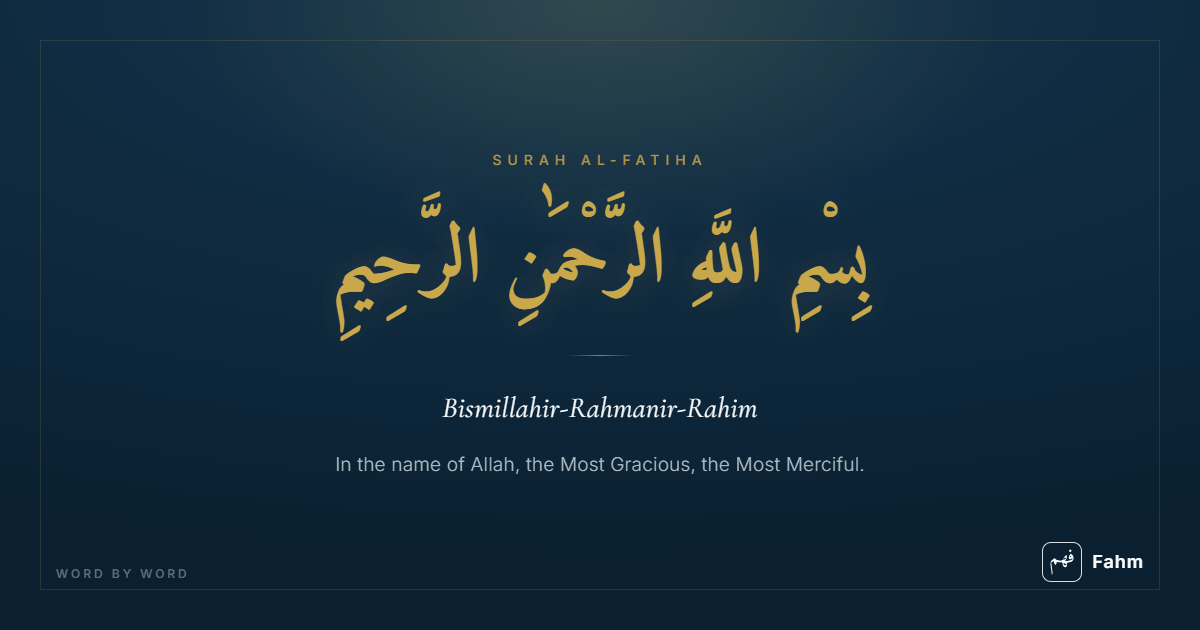
بِسْمِ اللَّهِ الرَّحْمَٰنِ الرَّحِيمِ
"In the name of Allah, the Most Gracious, the Most Merciful"
| Arabic | Transliteration | Meaning |
|---|---|---|
| بِسْمِ | Bismi | In the name of |
| اللَّهِ | Allahi | Allah |
| الرَّحْمَٰنِ | Ar-Rahmani | The Most Gracious (all-encompassing mercy) |
| الرَّحِيمِ | Ar-Rahim | The Most Merciful (specific mercy to believers) |
Bismi — "in the name of" — opens everything of significance in Islam. Beginning with Allah's name is an act of seeking His blessing, acknowledging His ownership of what follows, and seeking protection from Shaytan. The Prophet ﷺ said: "When you say Bismillah, Shaytan becomes as small as a fly." [Source: Musnad Ahmad; recorded in Tafsir Ibn Kathir, Al-Fatiha introduction]
Ar-Rahman and Ar-Rahim — both come from the same root r-h-m (ر-ح-م), meaning mercy, compassion, and tenderness. The root is also the word for rahm — the womb — evoking the most complete, encompassing, unconditional love in human experience.
But they are not the same word. Ibn Kathir and the scholars of Sunnah Online draw a precise distinction: Ar-Rahman is the mercy that encompasses all of creation in this world — believers and disbelievers, humans and animals, the seen and unseen. Ar-Rahim is the specific, ongoing mercy Allah reserves for the believers in the Hereafter. [Source: Tafsir Ibn Kathir, Al-Fatiha, Ayah 1; SunnahOnline.com, Tafsir Al-Fatiha]
This distinction matters: Al-Fatiha opens by invoking both dimensions of divine mercy — the universal mercy that sustains all existence, and the particular mercy that saves believers on the Day of Judgement.
There is a scholarly discussion about whether Bismillah is a separate first ayah of Al-Fatiha or a standalone verse before it. Ibn Abbas, Ibn Umar, Abu Hurayrah, and Ali (رضي الله عنهم) held that it is an ayah of every surah except At-Tawbah. Imam Malik and Abu Hanifah held it is not an ayah of Al-Fatiha itself. Both positions have authentic scholarly backing. [Source: Tafsir Ibn Kathir, Al-Fatiha introduction] For counting purposes in this post, we follow the majority and include it as Ayah 1.
Ayah 2: Alhamdulillahi Rabbil-'Alamin
الْحَمْدُ لِلَّهِ رَبِّ الْعَالَمِينَ
"All praise is due to Allah, Lord of all the worlds"
| Arabic | Transliteration | Meaning |
|---|---|---|
| الْحَمْدُ | Al-hamdu | All praise / all gratitude (with the definite article) |
| لِلَّهِ | lillahi | Belongs to Allah / is for Allah |
| رَبِّ | Rabbi | Lord / Master / Sustainer / Nurturer |
| الْعَالَمِينَ | Al-'alamin | All the worlds / all of creation |
Al-hamdu — not just hamdan (some praise) but Al-hamd with the definite article al-: all praise, every form of praise, complete praise. Ibn Kathir records Abu Ja'far ibn Jarir's explanation: "All thanks are due purely to Allah alone — these thanks are due to Allah's innumerable favors and bounties, that only He knows the amount of." [Source: Tafsir Ibn Kathir, Al-Fatiha, Ayah 2]
Hamd is also distinct from shukr (thanks). Shukr is gratitude expressed in response to a favor received. Hamd is praise of Allah's inherent attributes — His perfection, His beauty, His goodness — whether or not you have personally received a favor. This is why the scholars of tafsir describe Alhamdulillah as the statement of every thankful servant: it thanks Allah for what He has given AND praises Him for Who He is. [Source: SunnahOnline.com, Tafsir Al-Fatihah]
Rabb (رَبّ) — this single word contains three meanings simultaneously, as explained by Maududi in Tafheem ul-Quran: (i) Lord and Master, (ii) Sustainer, Provider, Nurturer, Guardian, and (iii) Sovereign who controls and directs. Ibn Kathir adds: "When Rabb is used alone without qualification, it refers only to Allah." [Source: Tafsir Ibn Kathir, Al-Fatiha, Ayah 2]
Al-'Alamin — the plural of 'alam, meaning world or realm. It encompasses everything in existence apart from Allah: humans, jinn, angels, animals, plants, every dimension of creation known and unknown. Ibn Kathir quotes al-Farra' and Abu 'Ubayd: "'Alamin includes all that has a mind — the jinn, mankind, the angels, and the devils." [Source: Tafsir Ibn Kathir, Al-Fatiha, Ayah 2] The plural form stresses the scope: not just this world, but all worlds.
And when you say this, according to the Hadith Qudsi in Sahih Muslim: Allah says, "My servant has praised Me."
Ayah 3: Ar-Rahmanir-Rahim
الرَّحْمَٰنِ الرَّحِيمِ
"The Most Gracious, the Most Merciful"
| Arabic | Transliteration | Meaning |
|---|---|---|
| الرَّحْمَٰنِ | Ar-Rahmani | The Most Gracious — universal mercy for all creation |
| الرَّحِيمِ | Ar-Rahimi | The Most Merciful — specific mercy for believers in the Hereafter |
These two names appeared in Ayah 1 as part of the Bismillah. Here they return — standing alone as a complete ayah — to deepen the declaration.
Why repeat them? Because Al-Fatiha is a conversation. Ayah 2 praised Allah as Rabb Al-'Alamin — the Lord of all existence — and the natural response of the heart is: but is this vast Lord merciful to me specifically? Ayah 3 answers: yes. He is Ar-Rahman — overwhelmingly merciful to all — and Ar-Rahim — especially merciful to you, the believer, on the Day you will need it most.
Ibn Kathir notes the distinction in intensity: "Ar-Rahman is more intense than Ar-Rahim, because Ar-Rahman is the one endowed with mercy that extends to all of creation in this world and to the believers in the Hereafter. Ar-Rahim is the One endowed with mercy that extends to only the believers on the Day of Judgement." [Source: Tafsir Ibn Kathir, Al-Fatiha, Ayah 1-3; confirmed in SunnahOnline.com Tafsir Al-Fatihah]
And when you say this, Allah says: "My servant has extolled Me."
Ayah 4: Maliki Yawmid-Din
مَالِكِ يَوْمِ الدِّينِ
"Master of the Day of Judgement"
| Arabic | Transliteration | Meaning |
|---|---|---|
| مَالِكِ | Maliki | Master / Owner / King |
| يَوْمِ | yawmi | Day |
| الدِّينِ | ad-din | The Judgement / the Recompense / the Religion |
Maliki — from the root m-l-k (م-ل-ك), to possess, to own, to reign. In some authentic recitations (qira'at), this appears as Maliki (Owner) and in others as Milki (King) — both are correct and both carry complementary meanings. Ibn Kathir records both variants as authentic. [Source: Tafsir Ibn Kathir, Al-Fatiha, Ayah 4]
Yawm ad-Din — the Day of Din. The word din (دِين) carries multiple meanings: religion, recompense, judgement, accountability, and the system of consequences. Yawm ad-Din is the Day when all of these meanings converge — when every account is settled, every deed is weighed, and every soul receives exactly what it earned.
Why place this ayah here — after two ayahs of mercy — before any request? Because Al-Fatiha's structure is deliberate. Praise first, then mercy, then accountability — and only after all three does the servant turn to direct address. The mercy described in Ayahs 2 and 3 does not eliminate accountability — it operates within a framework of complete justice. The Day of Judgement is the context that gives meaning to everything: why worship matters, why guidance is needed, why the straight path is not optional.
And when you say this, Allah says: "My servant has glorified Me." In one narration, He adds: "My servant has submitted his affairs to Me."
Ayah 5: Iyyaka Na'budu wa Iyyaka Nasta'in
إِيَّاكَ نَعْبُدُ وَإِيَّاكَ نَسْتَعِينُ
"You alone we worship, and You alone we ask for help"
| Arabic | Transliteration | Meaning |
|---|---|---|
| إِيَّاكَ | Iyyaka | You alone (emphatic, exclusive) |
| نَعْبُدُ | na'budu | We worship / we serve |
| وَإِيَّاكَ | wa iyyaka | And You alone |
| نَسْتَعِينُ | nasta'in | We ask for help / we seek assistance |
This is the pivot of Surah Al-Fatiha — and Ibn Kathir identifies it as the theological heart of Islam compressed into eight words.
Iyyaka — placing the object (You) before the verb (worship) in Arabic is a linguistic device of exclusivity. It does not merely say "we worship You" — it says "You — and only You — we worship." The same structure repeats with nasta'in: You — and only You — we ask for help. Both exclusions are simultaneous and absolute.
Ibn Kathir explains the profound shift that happens at this ayah: the first three ayahs speak about Allah — third person praise. Here, suddenly, the grammar shifts to second person: you. The believer is no longer describing Allah; they are addressing Him directly. Ibn Kathir and al-Tabari both note this as intentional: after three ayahs of contemplating Allah's greatness, the servant is now standing before Him, present and conscious. [Source: Tafsir Ibn Kathir, Al-Fatiha, Ayah 5]
Na'budu — from 'ibadah (عِبَادَة), worship. But 'ibadah in Arabic encompasses far more than ritual acts. It includes love, reverence, obedience, complete submission of the will, and willing surrender of all choices to Allah's guidance. When you say na'budu, you are not just declaring that you pray — you are declaring that your entire existence is oriented toward Allah alone.
Nasta'in — from isti'anah (اسْتِعَانَة), to seek help or assistance. The sin and ta at the beginning (sta-) indicate a request — you are actively, intentionally asking. Recognizing that all help comes from Allah alone is the antithesis of self-reliance, and it is the foundation of tawakkul (complete reliance on Allah).
And when you say this, Allah says: "This is between Me and My servant, and My servant shall have what he asked for."
This is the only ayah Allah describes as shared between Himself and His servant. The praise was for Him. The request for guidance is for you. Ayah 5 is the covenant: you commit to worshipping Him alone, and He commits to giving you what you ask.
Ayah 6: Ihdinas-Siratal Mustaqim
اهْدِنَا الصِّرَاطَ الْمُسْتَقِيمَ
"Guide us to the straight path"
| Arabic | Transliteration | Meaning |
|---|---|---|
| اهْدِنَا | Ihdina | Guide us (imperative — a direct request) |
| الصِّرَاطَ | As-sirata | The path / the road |
| الْمُسْتَقِيمَ | Al-mustaqim | The straight / the upright / the correct |
Ihdina — from hidayah (هِدَايَة), guidance. But Arabic distinguishes between two types of guidance, and Ibn Kathir's tafsir is precise about what is being asked here:
- Hidayat al-irshad — guidance that shows you the way, like a road sign
- Hidayat al-tawfiq — guidance that actually takes you there, that places your feet on the path and keeps them there
This dua asks for the second kind — not just information about the straight path, but Allah's active sustaining of your movement along it. This is why a Muslim who is already Muslim, already praying, still asks for Ihdina seventeen or more times a day. Guidance is not a destination you arrive at once; it is a state that must be continuously renewed. [Source: Tafsir Ibn Kathir, Al-Fatiha, Ayah 6; Dorar.net, Tafsir Al-Fatiha]
As-Sirat — the road, the path. Not a path (siratun without the definite article) — but the path: definite, specific, singular. Al-Mustaqim — straight, upright, uncurved. A path that deviates leads you somewhere other than your destination; a straight path leads directly.
Ibn Kathir quotes Ali (رضي الله عنه): "The straight path is the Book of Allah." He also quotes ibn Abbas and others who said it is the path of the Prophet ﷺ and his companions. The scholars synthesize: it is the path of the Quran, embodied in the Sunnah, walked by the righteous. [Source: Tafsir Ibn Kathir, Al-Fatiha, Ayah 6]
Ayah 7: Sirat al-Ladhina An'amta 'Alayhim
صِرَاطَ الَّذِينَ أَنْعَمْتَ عَلَيْهِمْ غَيْرِ الْمَغْضُوبِ عَلَيْهِمْ وَلَا الضَّالِّينَ
"The path of those upon whom You have bestowed Your grace, not of those who earned Your anger, nor of those who went astray"
| Arabic | Transliteration | Meaning |
|---|---|---|
| صِرَاطَ | Sirata | The path of |
| الَّذِينَ | alladhina | Those who |
| أَنْعَمْتَ عَلَيْهِمْ | an'amta 'alayhim | You have bestowed grace upon them |
| غَيْرِ | ghayri | Not / other than |
| الْمَغْضُوبِ عَلَيْهِمْ | al-maghdubi 'alayhim | Those who have earned Your anger |
| وَلَا | wa la | And not |
| الضَّالِّينَ | ad-dallin | Those who went astray |
Ayah 7 does two things simultaneously: it defines who walks the straight path, and it defines what the straight path is not.
An'amta 'alayhim — those upon whom Allah has bestowed His grace. The Quran itself identifies who these are in Surah An-Nisa (4:69): "Whoever obeys Allah and the Messenger — those will be with the ones upon whom Allah has bestowed grace: of the prophets, the truthful, the martyrs, and the righteous." The straight path is not an abstract philosophical concept — it is a path that specific, named categories of people have walked before you. You are not pioneering into unknown territory; you are following a well-worn road.
Al-Maghdubi 'alayhim — those who have earned Allah's anger. Ibn Kathir records the direct hadith explanation: the Prophet ﷺ identified these as those who knew the truth and deliberately rejected or abandoned it. Knowledge came to them, and they turned away. [Source: Tafsir Ibn Kathir, Al-Fatiha, Ayah 7; Sunan al-Tirmidhi, hadith on this verse]
Ad-Dallin — those who went astray. Ibn Kathir identifies these as those who deviated from the truth out of ignorance — those who worshipped without sound knowledge, who followed traditions rather than revelation, who were lost not through deliberate rejection but through sincere misdirection. [Source: Tafsir Ibn Kathir, Al-Fatiha, Ayah 7]
The distinction is profound: one group knew and rejected; the other group sought but lost their way. Both roads are presented as paths to avoid — and the prayer asks Allah to keep you on the only road that leads to Him.
And when you say this, Allah responds: "This is for My servant, and My servant shall have what he asked for."
The final word of Al-Fatiha closes with a response from Allah. The surah is complete. A conversation has taken place.
The Structure of Al-Fatiha: A Complete Theology in Seven Lines
Now that we have walked through every word, look at the architecture of the surah:
Ayahs 1-4: The Servant Praises Allah
- Ayah 1: Bismillah — beginning in His name
- Ayah 2: All praise to Allah, Lord of all worlds
- Ayah 3: The Most Gracious, the Most Merciful
- Ayah 4: Master of the Day of Judgement
These four ayahs are entirely about Allah — His attributes, His names, His dominion, His mercy, His justice. The servant has not yet asked for anything.
Ayah 5: The Covenant
- Iyyaka na'budu wa iyyaka nasta'in — the pivot. Grammar shifts from third person to second person. The servant is now before Allah, speaking to Him, committing to worship Him alone and seek help from Him alone.
Ayahs 6-7: The Supplication
- Ayah 6: The direct request — guide us to the straight path
- Ayah 7: The definition — the path of the blessed, not the two types of those who went wrong
The structure itself is a lesson: praise before petition. You do not open a conversation with Allah by asking. You open it by recognizing who He is. The request for guidance comes only after four ayahs of acknowledging Allah's attributes. The covenant comes only after knowing who you are covenanting with.
Ibn Kathir records that Al-Fatiha was called Asas al-Quran — the Foundation of the Quran — by Ibn Abbas (رضي الله عنه), who said: "The foundation of Al-Fatiha is Bismillahir-Rahmanir-Rahim." [Source: SunnahOnline.com, Tafsir Al-Fatihah]
The Ruling on Reciting Al-Fatiha in Salah
There is scholarly consensus across all four Sunni madhabs: Al-Fatiha is obligatory in every rak'ah of every prayer.
The Prophet ﷺ was explicit: "There is no prayer for the one who does not recite the Opening of the Book." [Source: Sahih al-Bukhari, 756; Sahih Muslim, 394]
And: "Whoever performs any prayer in which he did not recite Umm Al-Quran, his prayer is deficient — his prayer is deficient — his prayer is deficient — incomplete." [Source: Sahih Muslim, 395]
The madhab positions:
- Shafi'i: Al-Fatiha is a rukn (pillar) of the prayer — missing it intentionally or forgetfully invalidates the rak'ah
- Hanbali: Same position — obligatory in every rak'ah
- Hanafi: Wajib — obligatory; missing it in one rak'ah requires a prostration of forgetfulness (Sujud al-Sahw)
- Maliki: Obligatory — the prayer is invalid without it
[Source: IslamQA.info, Answer 10995; Dorar.net, Fiqh of Salah section]
Frequently Asked Questions
What is the meaning of Surah Al-Fatiha in English? Surah Al-Fatiha means "The Opening Chapter." It is the first surah of the Quran, consisting of seven ayat that open every unit (rak'ah) of Salah. The full translation: "In the name of Allah, the Most Gracious, the Most Merciful. All praise is due to Allah, Lord of all the worlds. The Most Gracious, the Most Merciful. Master of the Day of Judgement. You alone we worship, and You alone we ask for help. Guide us to the straight path — the path of those upon whom You have bestowed Your grace, not of those who earned Your anger, nor of those who went astray."
How many times is Surah Al-Fatiha recited in daily prayers? A minimum of 17 times in the five obligatory prayers: 2 in Fajr, 4 in Dhuhr, 4 in Asr, 3 in Maghrib, and 4 in Isha. Every Sunnah and Nafl prayer adds to this number.
What does Alhamdulillahi Rabbil Alamin mean? It means "All praise is due to Allah, Lord of all the worlds." It is the second ayah of Surah Al-Fatiha. Al-hamd means complete, all-encompassing praise. Rabb means Lord, Sustainer, and Master. Al-'alamin means all of creation — all worlds, all realms, everything in existence besides Allah.
What does Iyyaka nabudu wa iyyaka nasta'in mean? It means "You alone we worship, and You alone we ask for help." The word order in Arabic — placing Iyyaka (You) before the verb — creates an exclusive emphasis: none other than You, and no one alongside You. This is the central covenant of Surah Al-Fatiha and the heart of Tawheed.
What does Sirat al-Mustaqim mean? It means "the straight path" — the singular, direct path to Allah. Ibn Kathir explains it as the path of the Quran and Sunnah, walked by the prophets, the truthful, the martyrs, and the righteous.
Is Bismillah part of Surah Al-Fatiha? There is a scholarly difference of opinion. Ibn Abbas, Ibn Umar, Abu Hurayrah, and Ali (رضي الله عنهم) held that it is an ayah of Al-Fatiha. Imam Malik and Abu Hanifah held it is not counted as an ayah within the surah, though it is recited before it. Both positions are based on authentic scholarly reasoning. [Source: Tafsir Ibn Kathir, Al-Fatiha introduction]
What are the other names of Surah Al-Fatiha? Umm Al-Quran (Mother of the Quran), Umm Al-Kitab (Mother of the Book), Al-Sab' Al-Mathani (The Seven Oft-Repeated Verses), Ash-Shifa (The Cure), Al-Ruqyah (The Remedy), Al-Kafiyah (The Sufficient), Al-Kanz (The Treasure), and As-Salah (The Prayer).
How Fahm Helps You Own the Vocabulary of Every Rak'ah
Every word we broke down today — Rabb, hamd, Rahman, rahim, ibadat, hidayah, sirat — is not unique to Surah Al-Fatiha. These roots appear throughout the Quran. Rabb appears hundreds of times. Rahman opens every surah. Hidayah runs through the entire Book as its central theme.
This is the insight behind Fahm's curriculum: when you learn the vocabulary of your Salah, you are not memorizing isolated phrases — you are acquiring building blocks that unlock the Quran itself. A student who knows the words of Al-Fatiha, the Tashahhud, Durood Ibrahim, Ayat Al-Kursi, and the short surahs recited after Al-Fatiha in Salah — like Surah Al-Ikhlas — already recognizes a significant portion of the Quranic vocabulary they will encounter.
The 300 Foundation Words in Fahm's curriculum are sequenced so that Salah vocabulary comes first — Al-Fatiha's words appear in Phase A. Before you encounter any unfamiliar verse in your study, you already know the language of your own prayer.
Barakallahu Feekum. May every recitation of Al-Fatiha from this day forward be a conscious conversation — and may Allah answer every verse the way He promised.
Start learning the words of your Salah today.
Sources
- Sahih al-Bukhari, Hadith 756 (no prayer without Al-Fatiha)
- Sahih al-Bukhari, Hadith 4704 (Al-Fatiha as Umm Al-Quran)
- Sahih al-Bukhari, Hadith 5736 (Al-Fatiha used as ruqyah)
- Sahih Muslim, Hadith 394 (no prayer without Al-Fatiha)
- Sahih Muslim, Hadith 395 (Hadith Qudsi — Allah's response to each verse)
- Jami' al-Tirmidhi, Hadith 3124 (Al-Fatiha as Mother of the Quran)
- Surah Al-Hijr (15:87) — Quranic reference to the seven oft-repeated verses
- Surah An-Nisa (4:69) — those upon whom Allah has bestowed grace
- Tafsir Ibn Kathir, Surah Al-Fatiha, Introduction and Ayahs 1–7 (Imam Ismail ibn Kathir, d. 774 AH)
- SunnahOnline.com — Tafsir of Chapter 001: Surah Al-Fatihah by Shaykh Al-Shanqiti (sunnahonline.com)
- Dorar.net — Tafsir Al-Fatiha, overall tafseer (dorar.net)
- IslamQA.info, Answer 10995 — Ruling on reciting Al-Fatiha in every rak'ah (islamqa.info)