Assalamualaikum wa rahmatullahi wa barakatuhu,
There is a sentence you have said more times in your life than any other sentence in any language.
If you have prayed all five obligatory prayers since reaching maturity, you have said Ash-hadu alla ilaha illallah wa ash-hadu anna Muhammadan abduhu wa rasuluh — the Shahada — at minimum 18 times every day in the Tashahhud alone. Add the Adhan, the Iqamah, and any Sunnah prayers, and the number climbs past 25.
Over ten years, that is more than 90,000 recitations of the same declaration.
And yet: when was the last time you sat with each word — individually, deliberately — and understood what you were saying?
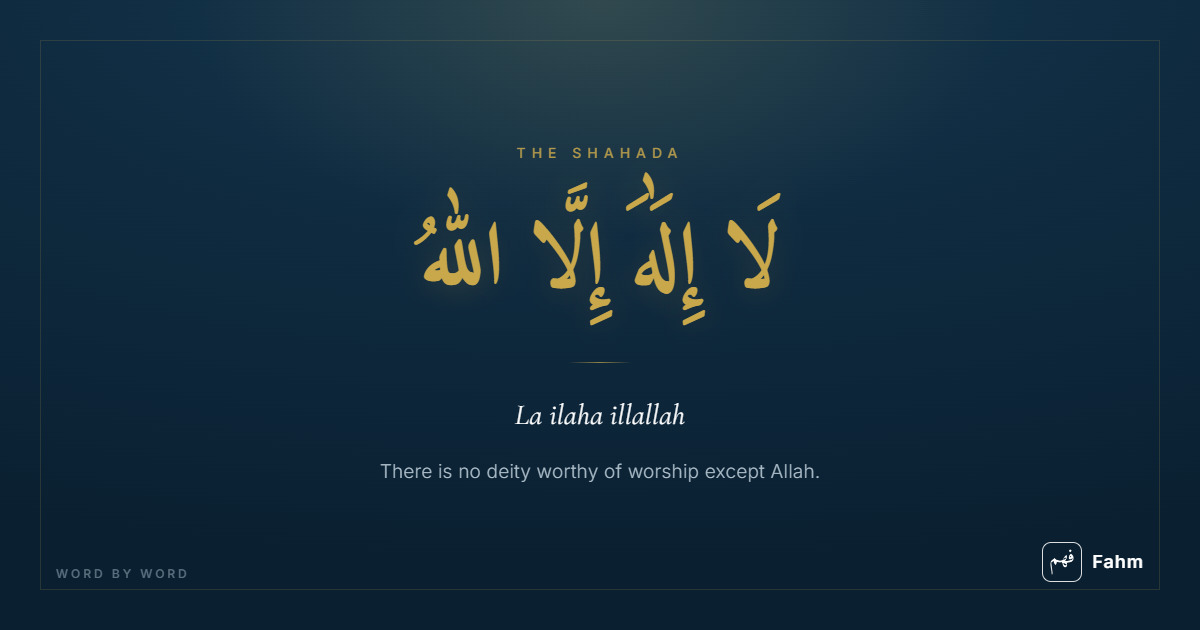
The Shahada (الشَّهَادَة) is the first pillar of Islam and the most repeated sentence in a Muslim's life. It is the declaration that makes someone Muslim, the testimony embedded in every Adhan calling you to prayer, the statement recited in the Tashahhud of every Salah, and — the Prophet ﷺ said — the best dhikr a believer can make. [Source: Jami' al-Tirmidhi, 3383 — graded Sahih]
This post is the complete Shahada meaning, word by word — every Arabic term unpacked, etymologically grounded, and explained with scholarly depth. By the end, the next time you say it, it will mean something different.
What Is the Shahada?
Al-Shahada (الشَّهَادَة) means "the testimony" or "the witness-bearing." It comes from the root sh-h-d (ش-ه-د), which carries the meaning of witnessing, testifying, being present, and bearing formal evidence. A shahid is a witness in a legal proceeding — someone who makes a formal, binding declaration of what they know to be true. A shahid is also the Arabic word for a martyr — one who witnesses to the truth with their life.
The Shahada consists of two connected testimonies — called in Arabic the Shahadatayn (الشَّهَادَتَيْن) — the Two Testimonies or the Two Declarations:
- The First Shahada: Ash-hadu alla ilaha illallah — I bear witness that there is no deity worthy of worship except Allah
- The Second Shahada: Wa ash-hadu anna Muhammadan abduhu wa rasuluh — And I bear witness that Muhammad is His servant and His messenger
Together they form the complete declaration. The Prophet ﷺ said: "Islam is built upon five: the testimony that there is no deity worthy of worship except Allah and that Muhammad is the Messenger of Allah..." [Source: Sahih al-Bukhari (8); Sahih Muslim (16)]
The Full Shahada: Arabic, Transliteration, and Translation
Arabic:
أَشْهَدُ أَنْ لَا إِلَٰهَ إِلَّا اللهُ وَأَشْهَدُ أَنَّ مُحَمَّدًا عَبْدُهُ وَرَسُولُهُ
Transliteration:
Ash-hadu alla ilaha illallah wa ash-hadu anna Muhammadan abduhu wa rasuluh.
Translation:
I bear witness that there is no deity worthy of worship except Allah, and I bear witness that Muhammad is His servant and His messenger.
Now let's go inside every word.
The First Shahada: Ash-hadu Alla Ilaha Illallah
أَشْهَدُ أَنْ لَا إِلَٰهَ إِلَّا اللهُ
"I bear witness that there is no deity worthy of worship except Allah"
Word 1: أَشْهَدُ — Ash-hadu
| Arabic | Transliteration | Meaning |
|---|---|---|
| أَشْهَدُ | Ash-hadu | I bear witness / I testify |
Ash-hadu is the first person singular present tense of the verb shahida (شَهِدَ) — to witness, to testify, to be present. The present tense is critical: this is not "I once testified" or "I have testified." It is I am testifying, right now, in this moment.
In classical Arabic legal tradition, a shahid (witness) carries the highest standard of personal certainty. You cannot testify to what you merely suspect, or what you believe on hearsay. A witness testifies to what they know — with personal certainty, with conviction, with direct knowledge.
According to Tafseer Ibn Kathir, the phrase Ash-hadu signifies certainty, conviction, and personal accountability. It is not merely spoken by the tongue but affirmed by the heart. [Source: Urdu-Point.com, Kalima Shahadat, citing Tafseer Ibn Kathir] The scholars of Tafsir have consistently noted that the word functions as both a legal declaration and a spiritual commitment simultaneously — you are entering the stand as a witness, and what you are testifying to is the most consequential truth in existence.
Every time you say Ash-hadu, you are not reciting a formula. You are taking the stand.
Word 2: أَنْ — An
| Arabic | Transliteration | Meaning |
|---|---|---|
| أَنْ | An | That (introducing the content of testimony) |
An is a subordinating particle — it introduces the content of what is being testified. Ash-hadu an = I testify that... It is a grammatical hinge connecting the act of witnessing to its content. Simple but essential: it makes what follows the object of the testimony.
Word 3: لَا — La
| Arabic | Transliteration | Meaning |
|---|---|---|
| لَا | La | No / There is no (absolute negation) |
La is the particle of absolute negation in Arabic. Before any affirmation is made — before anything is stated positively about Allah — the Shahada begins with a sweeping negation. La does not merely doubt; it categorically denies.
This sequencing is deliberate and theologically significant. Ibn Kathir emphasizes that La ilaha — the negation — must come before illallah — the affirmation. You must first empty the heart of every false object of worship before you fill it with the truth. The same structure appears in Ayat Al-Kursi: La ilaha illa Huwa — no deity, except Him. [Source: Tafsir Ibn Kathir, commentary on Tawheed and the Shahada; CurrentIslam.com citing Ibn Kathir]
The scholars of Tafsir describe this as the nafi (negation) followed by the ithbat (affirmation) — Islam's formula for establishing absolute monotheism. You cannot affirm Allah without first rejecting everything that is not Allah.
Word 4: إِلَٰهَ — Ilaha
| Arabic | Transliteration | Meaning |
|---|---|---|
| إِلَٰهَ | Ilaha | A deity worthy of worship / a god |
Ilaha comes from the root a-l-h (أ-ل-ه), meaning to worship with love and submission, to be in a state of awe and reverence. An ilah is not simply a god in the sense of a powerful being — it is a being to whom worship (ibadah) is directed: love, fear, hope, reverence, obedience, reliance.
This distinction matters enormously. The Shahada does not say La Rabba illallah (there is no Lord except Allah) — it says La ilaha illallah (there is no ilah except Allah). The distinction is between Rububiyyah (Lordship — that Allah creates and sustains) and Uluhiyyah (Divinity — that Allah alone deserves worship).
The Arab polytheists at the time of the Prophet ﷺ largely accepted that Allah was the Creator and Lord — Rububiyyah was not their problem. Their problem was Uluhiyyah: they directed worship, supplication, reverence, and hope toward idols alongside Allah. The Shahada addresses this directly: there is no ilah — no being worthy of worship — except Allah. [Source: Masjid As-Sunnah, Conditions of Ash-Shahada; IMSJeddah.com, Shahada explanation]
Word 5: إِلَّا — Illa
| Arabic | Transliteration | Meaning |
|---|---|---|
| إِلَّا | Illa | Except / but |
Illa is the exception particle — it makes what follows the single, exclusive exception to the negation that preceded it. La ilaha illallah: no deity worthy of worship except Allah. The negation (la ilaha) + the exception (illa) + the affirmation (Allah) together constitute the complete formula of Islamic Tawheed.
Wahb ibn Munabbih (a companion-era scholar) was once asked: "Is not La ilaha illa Allah the key to Paradise?" He replied: "Yes. But every key has teeth — if you bring a key with teeth, it will open for you. Otherwise it will not." [Source: Masjid As-Sunnah, Conditions of Ash-Shahada; confirmed in Kalamullah.com]
The illa makes the Shahada exclusive: not Allah as one of many, not Allah as primary among many — Allah as the only exception to the total negation of divine worship. The word admits no partial monotheism.
Word 6: اللهُ — Allah
| Arabic | Transliteration | Meaning |
|---|---|---|
| اللهُ | Allahu | Allah — the proper, personal name of God |
Allah (اللَّه) is the proper, personal name of the Divine — not a title, not a description, not a category. As we established in the Surah Al-Ikhlas post, this name is unique in Arabic: it cannot be made plural, cannot be made feminine, cannot be possessed by or attributed to any created being. It is the ism al-dhat — the name of the Essence itself.
Ibn al-Qayyim wrote that this name encompasses all other divine names and attributes: it implies Al-Hayy (Ever-Living), Al-Qayyum (Self-Sustaining), Al-'Alim (All-Knowing), Al-Qadir (All-Powerful) — every attribute of perfection is implicit in this one name. [Source: Ibn al-Qayyim, Madarij al-Salikin, Vol. 1]
The full theological weight of la ilaha illallah is therefore: there is no being worthy of worship — and the only exception to that total negation is the One who carries every attribute of perfection and every right to be worshipped.
The Second Shahada: Wa Ash-hadu Anna Muhammadan Abduhu Wa Rasuluh
وَأَشْهَدُ أَنَّ مُحَمَّدًا عَبْدُهُ وَرَسُولُهُ
"And I bear witness that Muhammad is His servant and His messenger"
Word 7: وَأَشْهَدُ — Wa Ash-hadu
| Arabic | Transliteration | Meaning |
|---|---|---|
| وَ | Wa | And |
| أَشْهَدُ | Ash-hadu | I bear witness |
The second testimony opens with wa (and) — connecting it inseparably to the first. These are not two independent statements that can be accepted separately. The conjunction wa makes them a single, unified declaration: you cannot accept Allah's oneness while rejecting the Prophet's ﷺ messengership, and you cannot claim to follow the Prophet ﷺ while associating partners with Allah. One Shahada — two parts, one package.
Ash-hadu repeats with the same present-tense certainty: I am witnessing, right now, in this moment, that Muhammad ﷺ is His servant and His messenger.
Word 8: أَنَّ — Anna
| Arabic | Transliteration | Meaning |
|---|---|---|
| أَنَّ | Anna | That (emphatic form — stronger than an) |
Anna (أَنَّ) is the emphatic form of an (أَنْ). Both mean "that," but anna carries a stronger assertion. In Arabic grammar, anna is used when the speaker wants to affirm the factual reality of what follows — not merely introducing it but asserting it. The choice of anna in the second Shahada rather than an signals: this is not just content being introduced; it is being asserted as certain, established fact. [Source: Classical Arabic grammar — mentioned in Maarif ul-Quran commentary on the Tashahhud]
Word 9: مُحَمَّدًا — Muhammadan
| Arabic | Transliteration | Meaning |
|---|---|---|
| مُحَمَّدًا | Muhammadan | Muhammad (the Prophet ﷺ) |
Muhammad (مُحَمَّد) — from the root h-m-d (ح-م-د), the same root as hamd (praise), Alhamdulillah, and the divine name Al-Hamid (The Praiseworthy). The name Muhammad is a passive participle in the intensive form — the one who is repeatedly praised, the most praised. It is not merely "praised" but muhammadan — deserving of praise abundantly, from multiple directions, repeatedly.
The Prophet ﷺ said of himself: "I am Muhammad and I am Ahmad (the most praised) — I am Al-Mahi, through whom Allah will erase disbelief — I am Al-Hashir, after whom people will be gathered — and I am Al-'Aqib, after whom there is no prophet." [Source: Sahih al-Bukhari (3532), Sahih Muslim (2354)]
In the Shahada, the Prophet's ﷺ name appears in the accusative case (Muhammadan with tanwin) — the grammatical form appropriate for someone being testified about. He is the subject of the second testimony.
Word 10: عَبْدُهُ — Abduhu
| Arabic | Transliteration | Meaning |
|---|---|---|
| عَبْدُ | Abdu | Servant / slave |
| هُ | hu | His (possessive — referring back to Allah) |
Abduhu — His servant. This is the word that most Muslims pass over quickly, but it is the most theologically deliberate word in the second Shahada.
Abd (عَبْد) means servant, or slave — complete submission and belonging. In Arabic, the highest honor a human being can receive is to be called 'abd of Allah. It signifies total devotion, total submission, total belonging to Allah — no independent claim to divinity, no self-sufficiency, no elevation above the human condition.
Why does abduhu (servant) come before rasuluh (messenger)?
This sequence is intentional and protective, as we noted in the Tashahhud post. The Prophet ﷺ is first and foremost a servant — abd — before he is a messenger. By stating his servanthood before his prophethood, the Shahada protects against two opposite errors:
-
The error of exaggeration — elevating the Prophet ﷺ to divine status, as was done with Jesus (عليه السلام) after his prophethood. The word abd establishes: he is fully, completely human. He is not divine. He is not to be worshipped.
-
The error of diminishment — treating the Prophet ﷺ as merely a historical figure whose message can be taken or left. The word rasul (messenger) establishes that he carries a mission from Allah that must be followed.
Ibn Kathir explains that this dual description — abduhu wa rasuluh — "protects Muslims from both denial and exaggeration." [Source: Urdu-Point.com, Kalima Shahadat, citing Tafseer Ibn Kathir; confirmed in AbuKhadeejah.com] Servanthood first, then prophethood — the order is a theological safeguard.
The possessive pronoun -hu (his) in abduhu refers back to Allah: he is Allah's servant. Not humanity's possession. Not a cultural figure. Allah's — entirely and specifically.
Word 11: وَرَسُولُهُ — Wa Rasuluh
| Arabic | Transliteration | Meaning |
|---|---|---|
| وَ | Wa | And |
| رَسُولُ | Rasulu | Messenger / one who is sent with a mission |
| هُ | hu | His (possessive — referring to Allah) |
Rasul (رَسُول) comes from the root r-s-l (ر-س-ل), meaning to send, to dispatch with a mission. A rasul is a messenger — specifically one sent with a revealed book and a divine law. This is theologically distinct from a nabi (prophet) in classical Islamic scholarship: every rasul is a nabi, but not every nabi is a rasul. A rasul carries a new revealed message with binding legislation; Muhammad ﷺ was both — the final nabi and the final rasul.
Rasuluh — Allah's messenger. The possessive pronoun connects back to Allah: this messenger's authority derives entirely from the One who sent him. He does not speak from his own desires — "He does not speak from his own desire — it is only revelation revealed." (Surah An-Najm, 53:3-4)
By accepting rasuluh, the believer commits to following the Prophet's ﷺ guidance as divine instruction — not merely as one voice among many, not as cultural tradition, but as the binding, authenticated word of Allah transmitted through His chosen messenger.
The Complete Theological Picture: What the Two Shahadas Establish Together
When you say the complete Shahada, you are simultaneously:
Establishing Tawheed al-Uluhiyyah (the oneness of Allah in worship): Only Allah is ilah — only He receives worship, supplication, love, fear, and hope. No saint, no prophet, no intercessor is worshipped alongside Him.
Establishing Tawheed al-Rububiyyah (implied): If there is only one ilah, then there can only be one Lord, one Creator, one Sustainer. The first Shahada implies complete monotheism in all its dimensions.
Establishing the authority of revelation: By accepting Muhammad ﷺ as rasuluh, you accept that the Quran and the authentic Sunnah are the binding sources of guidance for your life. You cannot accept the Shahada while rejecting the Sunnah — accepting the messenger means accepting what he was sent with.
Protecting from both extremes: Abduhu prevents deifying the Prophet ﷺ. Rasuluh prevents dismissing him. The two words together establish his precise, protected theological position.
The Seven Conditions of the Shahada
Classical scholars of Islam, drawing from Quranic verses and authentic hadith, established that the Shahada is not valid by pronunciation alone — it requires seven conditions of the heart and mind. Wahb ibn Munabbih's famous comparison stands: La ilaha illallah is the key to Paradise, but every key needs teeth to open the lock.
The seven conditions (shurut al-Shahada):
1. Al-'Ilm (العِلْم) — Knowledge: Understanding what the Shahada affirms and what it negates — knowing what an ilah is, why there is no ilah except Allah, and what it means that Muhammad ﷺ is His messenger. The opposite of knowledge is ignorance.
2. Al-Yaqeen (اليَقِين) — Certainty: Perfect, doubt-free conviction in the truth of what is being testified. The Quran describes true believers as those who "believed and never doubted." (Surah Al-Hujurat, 49:15) The opposite is doubt.
3. Al-Ikhlas (الإخْلَاص) — Sincerity: The testimony must be made for Allah alone — not for social acceptance, not for marriage eligibility, not for any worldly benefit. The opposite is shirk — associating other motives with the worship of Allah.
4. Al-Sidq (الصِّدْق) — Truthfulness: The tongue must declare what the heart genuinely believes. The Quran condemns the hypocrites (munafiqun) specifically because they said the Shahada with their tongues while their hearts rejected it. The opposite is hypocrisy (nifaq).
5. Al-Mahabbah (المَحَبَّة) — Love: Genuine love for this testimony, for what it means, and for its implications — loving the oneness of Allah and loving to live by it. The opposite is hatred or resentment of what the Shahada demands.
6. Al-Inqiad (الانْقِيَاد) — Submission: Acting upon the Shahada — submitting to its requirements in practice, not just acknowledging them intellectually. Knowledge without action is incomplete. The opposite is arrogance or refusal.
7. Al-Qubool (القَبُول) — Acceptance: Wholehearted acceptance of the Shahada and all it entails — including accepting Allah's judgment, accepting the Prophet's ﷺ authority, accepting the obligations of Islam. The opposite is rejection.
[Source: IMSJeddah.com, Shahada and Its Conditions; Masjid As-Sunnah, Conditions of Ash-Shahada; Kalamullah.com, Conditions of La Ilaha illallah]
Imam Al-Hasan Al-Basri summarized: "Whoever says La ilaha illallah and fulfills its rights and obligations will enter Paradise." [Source: Masjid As-Sunnah, citing Imam Al-Hasan Al-Basri]
Where the Shahada Appears in Your Daily Life
The Shahada is not a one-time declaration. It is woven into the fabric of Islamic daily practice:
The Adhan and Iqamah: Recited twice in the Adhan and once in the Iqamah — every call to prayer includes the Shahada, calling believers to affirm their testimony before they pray.
The Tashahhud: Embedded in the sitting position of every Salah — minimum twice daily in Fajr, and at least once more in each multi-rak'ah prayer. We covered the full Tashahhud word by word in a dedicated post.
Upon entering Islam: The formal recitation of the Shahada — with understanding, certainty, sincerity, truthfulness, love, submission, and acceptance — marks the beginning of a person's Islam.
At death: The Prophet ﷺ said: "Prompt your dying ones to say La ilaha illallah." [Source: Sahih Muslim (916)] To die with the Shahada on one's lips is among the most beloved endings a believer can have.
As dhikr: The Prophet ﷺ said: "The best dhikr is La ilaha illallah." [Source: Jami' al-Tirmidhi (3383) — graded Sahih]
After Wudu: "Whoever performs Wudu well then says: Ash-hadu alla ilaha illallah wa ash-hadu anna Muhammadan abduhu wa rasuluh — the eight gates of Paradise will be opened for him and he may enter through whichever he wishes." [Source: Sunan al-Nasa'i (148); Sunan Ibn Majah (470) — graded Sahih]
The Shahada and the Tashahhud: Two Testimonies in Every Prayer
If you read our word-by-word breakdown of the Tashahhud, you will recognize that the Shahada is embedded within it:
"Ash-hadu alla ilaha illallah wa ash-hadu anna Muhammadan abduhu wa rasuluh"
This is the closing of the Tashahhud — word for word identical to the Shahada. Every time you sit in Salah and recite the Tashahhud, you are re-entering the stand and re-giving your testimony. Not once in your life, not once a day — at minimum nine times every day, in every sitting position of every prayer.
The finger raised during this moment is itself a physical enactment of the Shahada: pointing upward toward the One — affirming La ilaha illallah with the body while the tongue declares it.
Frequently Asked Questions
What is the meaning of the Shahada in English? The Shahada (also called Shahadah, Kalima Shahada, or the Islamic declaration of faith) means: "I bear witness that there is no deity worthy of worship except Allah, and I bear witness that Muhammad is His servant and His messenger." It is the first pillar of Islam and the most repeated declaration in a Muslim's daily life.
What does La ilaha illallah mean word by word? La — No / there is no. Ilaha — deity worthy of worship. Illa — except. Allah — Allah (the proper name of God). Together: "There is no deity worthy of worship except Allah." The formula begins with absolute negation (La ilaha) before affirming the only exception (illallah).
What does Ash-hadu mean? Ash-hadu means "I bear witness" or "I testify" — first person singular, present tense, from the root sh-h-d. It carries the weight of formal legal testimony: the speaker is declaring with personal certainty what they know to be true, not merely repeating a formula.
Why does Abduhu come before Rasuluh in the Shahada? Because servanthood (abd) precedes prophethood (rasul) to protect against two errors: exaggerating the Prophet ﷺ to divine status (as happened with other prophets), and dismissing him as merely a historical figure. Abduhu establishes he is fully human. Rasuluh establishes his divine authority must be followed. The order is a theological safeguard — Ibn Kathir explains it protects from both denial and exaggeration.
What is the difference between ilah and Allah? Ilah (إِلَٰه) is the common noun meaning "a deity worthy of worship" — the category. Allah (اللَّه) is the proper personal name of God — unique, unalterable, not shared with any created being. The Shahada uses both: it negates every ilah then specifies the only exception is Allah specifically.
What are the seven conditions of the Shahada? Knowledge ('ilm), Certainty (yaqeen), Sincerity (ikhlas), Truthfulness (sidq), Love (mahabbah), Submission (inqiad), and Acceptance (qubool). Classical scholars established these conditions to clarify that the Shahada is not valid by pronunciation alone — it requires the heart, the mind, and the will to be aligned with what the tongue declares.
What is the Shahadatayn? Shahadatayn (الشَّهَادَتَيْن) means "the two testimonies" or "the two Shahadas." It refers to the Shahada's two parts — the testimony about Allah (La ilaha illallah) and the testimony about the Prophet ﷺ (Muhammadan abduhu wa rasuluh) — as an inseparable pair.
How many times is the Shahada said in daily prayers? At minimum 18 times in the five obligatory prayers (twice in each rak'ah during Tashahhud recitation), plus additional recitations in the Adhan and Iqamah before each prayer. With Sunnah prayers, the number rises significantly.
How the Shahada Connects to Fahm's Curriculum
Every key word in the Shahada appears throughout the Quran and throughout your daily prayer:
- Allah (اللَّه) — the name in every Bismillah, every Alhamdulillah, every Takbeer
- Ilaha (إِلَٰه) — root appears in Surah Al-Ikhlas (Allahu Ahad), Surah An-Nas (Ilahin-Nas), Ayat Al-Kursi (La ilaha illa Huwa)
- Ash-hadu (أَشْهَدُ) — root sh-h-d appears in the word Shahada itself and in Shahid (witness/martyr) throughout the Quran
- Abduhu (عَبْدُهُ) — root '-b-d appears in ibadah (worship), 'ibad (servants) in Al-Fatiha's sirata alladhina an'amta 'alayhim, and in Ayat Al-Kursi
- Rasuluh (رَسُولُهُ) — root r-s-l appears in irsaal (sending), mursal (sent), throughout the Quranic narratives of the prophets
- Muhammad (مُحَمَّد) — root h-m-d appears in hamd (praise), Alhamdulillah, Al-Hamid — the same root you say in the opening of Al-Fatiha
The vocabulary of the Shahada is the vocabulary of the Quran. When Fahm's curriculum sequences Salah vocabulary in Phase A — before any unfamiliar verse — it is building exactly this: the foundational layer of roots and words that makes the rest of the Book comprehensible.
Barakallahu Feekum. May the next time you say Ash-hadu alla ilaha illallah be a moment of real testimony — not a recited formula, but a deliberate, knowing, loving declaration of what you know to be true.
Start learning the words of your prayer today.
Sources
- Sahih al-Bukhari, Hadith 8 (the five pillars, including the Shahada)
- Sahih al-Bukhari, Hadith 3532 (the Prophet's ﷺ names including Muhammad and Ahmad)
- Sahih Muslim, Hadith 16 (the five pillars)
- Sahih Muslim, Hadith 916 (prompting the dying to say La ilaha illallah)
- Sahih Muslim, Hadith 2354 (the Prophet's ﷺ names)
- Sunan al-Nasa'i, Hadith 148 (eight gates of Paradise after Wudu with Shahada)
- Sunan Ibn Majah, Hadith 470 (same hadith, parallel chain — graded Sahih)
- Jami' al-Tirmidhi, Hadith 3383 (best dhikr is La ilaha illallah — graded Sahih)
- Surah An-Najm (53:3-4) — the Prophet ﷺ does not speak from desire
- Surah Al-Hujurat (49:15) — believers who believe without doubting
- Tafsir Ibn Kathir — on Tawheed, the Shahada, and the dual description of the Prophet ﷺ (abduhu wa rasuluh)
- Ibn al-Qayyim al-Jawziyyah, Madarij al-Salikin, Vol. 1 — on the name Allah encompassing all divine attributes
- Maarif ul-Quran (Mufti Muhammad Shafi) — grammatical commentary on anna vs an in the Shahada
- IslamQA.info, Answer 9104 — What is the meaning of La ilaha illallah? (islamqa.info)
- Masjid As-Sunnah, Florida — Conditions of Ash-Shahada (masjidassunnah-fl.com)
- AbuKhadeejah.com — The Muslim Testimony of Faith: Shahada and its Conditions (abukhadeejah.com)
- Dorar.net — The Shahada: its meaning, conditions, and nullifiers (dorar.net)