Assalamualaikum wa rahmatullahi wa barakatuhu,
Abdullah ibn Abbas (رضي الله عنه) narrated:
"While the Messenger of Allah ﷺ was with Jibreel, he heard a noise from above. Jibreel lifted his sight to the sky and said: 'This is a door that was opened just now in heaven, and it was never opened before.' An angel came down through the door to the Prophet ﷺ and said: 'Receive the good news of two lights that you have been given and which no Prophet before you was given: the Opener of the Book (Al-Fatihah) and the last ayat of Surah Al-Baqarah. You will not read a letter of them but you will be granted its benefit.'" — Sahih Muslim (806); Sunan al-Nasa'i (912)
A door in heaven that had never been opened before. An angel who had never descended to earth before. Two lights given exclusively to the Prophet Muhammad ﷺ — not to Ibrahim, not to Musa, not to Isa (عليهم السلام) — to him alone, and through him to his Ummah.
The last two ayat of Surah Al-Baqarah — verses 285 and 286 — are among the most beloved and most recited verses in the Quran. They are read before sleep across the Muslim world, memorized by millions, cited in countless khutbahs. And like so much of what Muslims recite constantly, they are understood vaguely at best — word by word, almost never.
This post is the complete word by word meaning of the last two ayat of Surah Al-Baqarah — every Arabic phrase broken down, transliterated, and explained with tafsir from Imam Ibn Kathir. By the end, you will understand not only what these two verses say, but why they were described as a treasure from beneath Allah's Throne.
The Story of Their Revelation: A Night Unlike Any Other
The occasion of the revelation of these two ayat is one of the most remarkable in the entire Seerah. Abdullah ibn Mas'ud (رضي الله عنه) narrated in Sahih Muslim:
"When the Messenger of Allah ﷺ went on the Isra journey, he ascended to the Sidrat Al-Muntaha — in the sixth heaven, where whatever ascends from the earth ends, and whatever descends from above ends. The Messenger of Allah ﷺ was then given three things: the five prayers, the last ayat of Surah Al-Baqarah, and forgiveness for whoever from his Ummah did not associate anything with Allah." — Sahih Muslim (173)
Three gifts, given at the Sidrat Al-Muntaha — the Lote Tree at the furthest boundary, the threshold between the created world and what lies beyond it. Two of those three gifts were the prayers (the five Salah) and these two ayat. They were given on the same night. They are inseparable.
And unlike virtually every other verse in the Quran — which was transmitted through the angel Jibreel (عليه السلام) — these verses, along with Surah Al-Fatihah, were given directly, as noor (light), from the Throne of Allah. Ibn Kathir records the narration of Ibn Abbas: the angel announced them as "two lights" granted to no prophet before. [Source: Tafsir Ibn Kathir, 2:285-286; Sahih Muslim 806]
The Prophet ﷺ himself described them in these terms:
"Allah has concluded Surah Al-Baqarah with two verses which were given to me from His treasure that is beneath the Throne. Learn them and teach your wives and children. They are prayer, Quran, and supplication." — Al-Hakim, Mustadrak (1/562); recorded in Tafsir Ibn Kathir, 2:285-286
Three descriptions in one: prayer (Salah), Quran, and supplication (dua'). They are all three simultaneously.
The Full Text: Arabic, Transliteration, and Translation
Arabic:
آمَنَ الرَّسُولُ بِمَا أُنزِلَ إِلَيْهِ مِن رَّبِّهِ وَالْمُؤْمِنُونَ ۚ كُلٌّ آمَنَ بِاللَّهِ وَمَلَائِكَتِهِ وَكُتُبِهِ وَرُسُلِهِ لَا نُفَرِّقُ بَيْنَ أَحَدٍ مِّن رُّسُلِهِ ۚ وَقَالُوا سَمِعْنَا وَأَطَعْنَا ۖ غُفْرَانَكَ رَبَّنَا وَإِلَيْكَ الْمَصِيرُ ﴿٢٨٥﴾ لَا يُكَلِّفُ اللَّهُ نَفْسًا إِلَّا وُسْعَهَا ۚ لَهَا مَا كَسَبَتْ وَعَلَيْهَا مَا اكْتَسَبَتْ ۗ رَبَّنَا لَا تُؤَاخِذْنَا إِن نَّسِينَا أَوْ أَخْطَأْنَا ۚ رَبَّنَا وَلَا تَحْمِلْ عَلَيْنَا إِصْرًا كَمَا حَمَلْتَهُ عَلَى الَّذِينَ مِن قَبْلِنَا ۚ رَبَّنَا وَلَا تُحَمِّلْنَا مَا لَا طَاقَةَ لَنَا بِهِ ۖ وَاعْفُ عَنَّا وَاغْفِرْ لَنَا وَارْحَمْنَا ۚ أَنتَ مَوْلَانَا فَانصُرْنَا عَلَى الْقَوْمِ الْكَافِرِينَ ﴿٢٨٦﴾
Transliteration:
Ayah 285:
Aamanar-rasulu bima unzila ilayhi mir-rabbihi wal-mu'minun. Kullun amana billahi wa mala'ikatihi wa kutubihi wa rusulihi la nufarriqu bayna ahadin mir-rusulihi wa qalu sami'na wa ata'na ghufranaka Rabbana wa ilaykal-masir.
Ayah 286:
La yukallifullahu nafsan illa wus'aha. Laha ma kasabat wa 'alayha maktasabat. Rabbana la tu'akhidhna in nasina aw akhta'na. Rabbana wa la tahmil 'alayna isran kama hamaltahu 'alal-ladhina min qablina. Rabbana wa la tuhammilna ma la taqata lana bih. Wa'fu 'anna waghfir lana warhamna. Anta mawlana fansurna 'alal qawmil kafirin.
Translation:
Ayah 285:
The Messenger has believed in what was revealed to him from his Lord, and so have the believers. All of them have believed in Allah, His angels, His books, and His messengers — saying: "We make no distinction between any of His messengers." And they say: "We hear and we obey. Your forgiveness, our Lord, and to You is the final destination."
Ayah 286:
Allah does not burden a soul beyond that it can bear. For it is what it has earned, and against it is what it has earned. "Our Lord, do not impose blame upon us if we have forgotten or erred. Our Lord, and lay not upon us a burden like that which You laid upon those before us. Our Lord, and burden us not with that which we have no ability to bear. And pardon us, and forgive us, and have mercy upon us. You are our protector, so give us victory over the disbelieving people."
Ayah 285: Word by Word
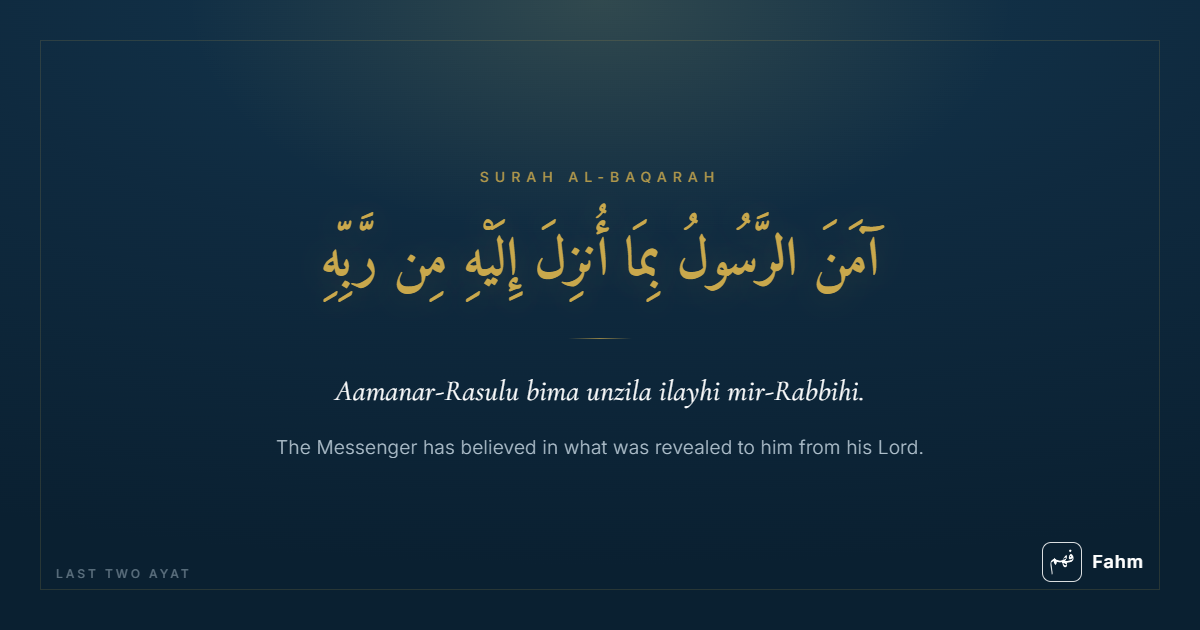
آمَنَ الرَّسُولُ بِمَا أُنزِلَ إِلَيْهِ مِن رَّبِّهِ
Aamanar-rasulu bima unzila ilayhi mir-rabbihi "The Messenger has believed in what was revealed to him from his Lord"
| Arabic | Transliteration | Meaning |
|---|---|---|
| آمَنَ | Aamana | Has believed / believed (past tense — completed act) |
| الرَّسُولُ | Ar-rasulu | The Messenger |
| بِمَا | Bima | In what / in that which |
| أُنزِلَ | Unzila | Was revealed (passive — from Allah) |
| إِلَيْهِ | Ilayhi | To him |
| مِن رَّبِّهِ | Mir-rabbihi | From his Lord |
Aamana — past tense in Arabic, indicating a completed, established act. The Messenger's belief is not conditional, not partial, not in progress — it is done, settled, real.
Ar-Rasul — the Messenger — with the definite article al-: not "a" messenger but the Messenger — the one specific individual who received what was revealed. Ibn Kathir notes this opening is significant: before the believers are mentioned, the Prophet ﷺ himself is declared the first and primary believer. He received the revelation and he believed in it completely, with no hesitation. [Source: Tafsir Ibn Kathir, 2:285]
Bima unzila ilayhi mir-rabbihi — in what was revealed to him from his Lord. The word unzila (was revealed) is passive — it comes from Allah, directed to the Prophet ﷺ. And the source is rabbihi — his Lord, using the possessive. The revelation is intimately connected to the relationship between the Messenger and His Lord.
وَالْمُؤْمِنُونَ
Wal-mu'minun "And the believers"
| Arabic | Transliteration | Meaning |
|---|---|---|
| وَ | Wa | And |
| الْمُؤْمِنُونَ | Al-mu'minun | The believers |
The conjunction wa connects the Messenger's belief to the believers' belief — they are grammatically joined. The Prophet ﷺ believed, and the believers followed his belief. Ibn Kathir notes this connection is intentional: the believers' iman is an extension of and response to the Prophet's ﷺ iman. [Source: Tafsir Ibn Kathir, 2:285]
كُلٌّ آمَنَ بِاللَّهِ وَمَلَائِكَتِهِ وَكُتُبِهِ وَرُسُلِهِ
Kullun amana billahi wa mala'ikatihi wa kutubihi wa rusulihi "All of them have believed in Allah, His angels, His books, and His messengers"
| Arabic | Transliteration | Meaning |
|---|---|---|
| كُلٌّ | Kullun | All of them / each one |
| آمَنَ | Amana | Has believed |
| بِاللَّهِ | Billahi | In Allah |
| وَمَلَائِكَتِهِ | Wa mala'ikatihi | And His angels |
| وَكُتُبِهِ | Wa kutubihi | And His books |
| وَرُسُلِهِ | Wa rusulihi | And His messengers |
This sentence establishes the four pillars of belief that both the Messenger ﷺ and the believers hold:
Billahi — in Allah. Belief in His existence, His oneness, His names and attributes.
Wa mala'ikatihi — and His angels. The angels are real created beings of light, servants of Allah who carry out His commands. Belief in them is a pillar of iman.
Wa kutubihi — and His books. Kutub is the plural of kitab (book). This includes the Tawrah (Torah), the Injeel (Gospel), the Zabur (Psalms), and the Quran — all as divine revelation, though only the Quran remains in its original preserved form.
Wa rusulihi — and His messengers. All of them, without distinction. This leads directly into the next phrase.
لَا نُفَرِّقُ بَيْنَ أَحَدٍ مِّن رُّسُلِهِ
La nufarriqu bayna ahadin mir-rusulihi "We make no distinction between any of His messengers"
| Arabic | Transliteration | Meaning |
|---|---|---|
| لَا نُفَرِّقُ | La nufarriqu | We do not differentiate / we make no distinction |
| بَيْنَ أَحَدٍ | Bayna ahadin | Between any one |
| مِّن رُّسُلِهِ | Mir-rusulihi | Of His messengers |
This is one of the defining characteristics of Islamic belief that distinguishes it from other Abrahamic traditions. The Muslim does not accept some prophets while rejecting others. Every messenger Allah sent — from Adam to Ibrahim, from Musa to Isa to Muhammad (عليهم السلام) — is believed in, honored, and not distinguished from in terms of prophethood.
This does not mean all prophets are equal in rank — the Quran explicitly says some prophets were given higher stations (Surah Al-Baqarah, 2:253). It means no prophet is rejected, dismissed, or excluded from the circle of belief. [Source: Tafsir Ibn Kathir, 2:285; Maududi, Tafheem ul-Quran, 2:285]
وَقَالُوا سَمِعْنَا وَأَطَعْنَا
Wa qalu sami'na wa ata'na "And they say: 'We hear and we obey'"
| Arabic | Transliteration | Meaning |
|---|---|---|
| وَقَالُوا | Wa qalu | And they say |
| سَمِعْنَا | Sami'na | We have heard / we hear |
| وَأَطَعْنَا | Wa ata'na | And we have obeyed / and we obey |
This two-word declaration — sami'na wa ata'na — is one of the most important phrases in the Quran, because it contrasts directly with what the Children of Israel said at Mount Sinai. When they received the Torah, they said: sami'na wa 'asayna — "We hear and we disobey." (Surah Al-Baqarah, 2:93)
The believers say the exact opposite: We hear and we obey. Full submission. No negotiation. No conditional compliance. The revelation comes, and the response of the believer is: heard and obeyed.
Ibn Kathir explains this contrast explicitly, noting that these words represent the fundamental difference in disposition between the believing Ummah and those who rejected their prophets. The phrase became a declaration of the believers' identity: we are the people of sami'na wa ata'na. [Source: Tafsir Ibn Kathir, 2:285]
غُفْرَانَكَ رَبَّنَا وَإِلَيْكَ الْمَصِيرُ
Ghufranaka Rabbana wa ilaykal-masir "Your forgiveness, our Lord, and to You is the final destination"
| Arabic | Transliteration | Meaning |
|---|---|---|
| غُفْرَانَكَ | Ghufranaka | Your forgiveness (direct object — they are asking for it) |
| رَبَّنَا | Rabbana | Our Lord |
| وَإِلَيْكَ | Wa ilayka | And to You |
| الْمَصِيرُ | Al-masiru | The final destination / the return |
Ghufranaka — the word is in the accusative case, functioning as a direct object of an implied verb: "we ask for Your forgiveness." The root is gh-f-r — the same root as Astaghfirullah, as Al-Ghafur, as Maghfirah. After declaring belief and submission, the believer immediately turns to ask for forgiveness — recognizing that even perfect belief and declared obedience are accompanied by inevitable human shortfall.
Rabbana — Our Lord. The first of four Rabbana duas in Ayah 286 that follow. The word Rabb here draws on its full meaning: You who created us, sustain us, and nurture us — You are the One we ask.
Wa ilaykal-masir — and to You is the final destination. Al-masir from the root s-y-r (to travel, to journey) — the final journey ends with Allah. This closing phrase frames all of human existence: we hear, we obey, we seek forgiveness, and we return to You. The entire arc of a believer's life in one sentence.
Ayah 286: Word by Word
لَا يُكَلِّفُ اللَّهُ نَفْسًا إِلَّا وُسْعَهَا
La yukallifullahu nafsan illa wus'aha "Allah does not burden a soul beyond that it can bear"
| Arabic | Transliteration | Meaning |
|---|---|---|
| لَا يُكَلِّفُ | La yukallif | Does not burden / does not charge |
| اللَّهُ | Allahu | Allah |
| نَفْسًا | Nafsan | A soul / any soul |
| إِلَّا | Illa | Except |
| وُسْعَهَا | Wus'aha | Its capacity / what it can bear |
This is perhaps the single most memorized and shared sentence in the Quran among English-speaking Muslims — and one of the most frequently misapplied.
Yukallif — from the root k-l-f (ك-ل-ف), meaning to assign a burden, to charge with responsibility. The word carries the sense of legal or moral obligation — Allah does not assign any soul a religious obligation or moral responsibility that exceeds what that soul can carry.
Nafsan — a soul, any soul. The indefinite form makes this universal: not just the strong soul, not just the righteous soul — any soul.
Wus'aha — its wus'ah, from the root *w-s-' * (و-س-ع) meaning spaciousness, capacity, ability. The same root appears in Ayat Al-Kursi: wasi'a kursiyyuhus-samawati wal-ard — His Kursi is spacious enough for the heavens and the earth. Wus'ah is the capacity that belongs specifically to that soul — not a general average, but what that particular person can bear.
What does this verse actually mean? Ibn Kathir explains: Allah does not impose on any person an obligation in their din that exceeds their capacity to fulfill it. This is the theological basis of Islamic jurisprudence's principle of yusr (ease): the Sharia was designed to be within human capacity. When someone is ill, they are exempt from fasting. When there is no water, tayammum replaces wudu. When someone cannot stand, they pray sitting. The religion bends to human limitation — because Allah designed it that way from the beginning. [Source: Tafsir Ibn Kathir, 2:286] This same divine principle of ease is the entire subject of Surah Al-Inshirah, where Allah promises the believer that with every hardship comes ease — not once, but twice.
What this verse does NOT mean: it is frequently misread as a promise that Allah will never allow painful or difficult circumstances to happen to a person. Life brings suffering, loss, grief, and hardship that can feel unbearable. This verse is about religious obligation — not about the trials of life. Surah Al-Baqarah (2:155) establishes separately: "We will certainly test you with fear, hunger, loss of wealth, lives, and crops" — tests come. The promise of 2:286 is that whatever Allah obliges you to do is within your reach. [Source: Maududi, Tafheem ul-Quran, 2:286]
لَهَا مَا كَسَبَتْ وَعَلَيْهَا مَا اكْتَسَبَتْ
Laha ma kasabat wa 'alayha maktasabat "For it is what it has earned, and against it is what it has earned"
| Arabic | Transliteration | Meaning |
|---|---|---|
| لَهَا | Laha | For it / in its favor |
| مَا كَسَبَتْ | Ma kasabat | What it has earned (good deeds) |
| وَعَلَيْهَا | Wa 'alayha | And against it |
| مَا اكْتَسَبَتْ | Ma iktasabat | What it has earned (evil deeds) |
Two verbs for "earning" — and they are deliberately different in Arabic:
Kasabat — earned, acquired naturally, with ease. The scholars of tafsir explain this is used for good deeds: they come to the believer naturally, without great struggle, because the fitra (natural disposition) inclines toward good.
Iktasabat — the ifta'ala pattern adds intensity: earned with effort, with deliberate exertion. This is used for evil deeds: evil requires more effort, requires overriding the fitra, requires the self to work against its natural inclination. [Source: Tafsir Ibn Kathir, 2:286; classical Arabic grammar commentaries on kasaba vs. iktasaba]
The implication: good comes naturally to the believing soul; evil is an effortful choice. The accounting is exact and fair — every soul receives the benefit of its own good and bears the consequence of its own evil. No one else's sin falls on you. No one else's good is taken from you.
The Four Rabbana Duas of Ayah 286
After the declaration of Allah's justice (la yukallif) and the principle of individual accountability (laha ma kasabat), Ayah 286 shifts into direct supplication. Four Rabbana (Our Lord) duas follow — each addressing a specific dimension of human vulnerability. These are not just theological statements. They are prayers taught by Allah Himself.
Ibn Kathir records that when the Prophet ﷺ first received these verses on the night of the Isra, he was told: "You will not read a letter of them but you will be granted its benefit." [Source: Tafsir Ibn Kathir, 2:285-286; Sahih Muslim 806] Every letter. Every word of these duas carries guaranteed benefit.
Rabbana Dua 1: لَا تُؤَاخِذْنَا إِن نَّسِينَا أَوْ أَخْطَأْنَا
Rabbana la tu'akhidhna in nasina aw akhta'na "Our Lord, do not impose blame upon us if we have forgotten or erred"
| Arabic | Transliteration | Meaning |
|---|---|---|
| رَبَّنَا | Rabbana | Our Lord |
| لَا تُؤَاخِذْنَا | La tu'akhidhna | Do not take us to account / do not impose blame |
| إِن نَّسِينَا | In nasina | If we have forgotten |
| أَوْ أَخْطَأْنَا | Aw akhta'na | Or if we have erred / made a mistake |
La tu'akhidhna — from akhadha (to take, to seize) — do not seize us in accountability. The imagery is of someone being taken by the hand and held responsible.
Nasina — we forgot. Forgetting is not a sin in Islamic jurisprudence — the Prophet ﷺ said: "Allah has forgiven my Ummah for mistakes, forgetfulness, and what they are coerced into doing." [Source: Sunan Ibn Majah (2043) — graded Sahih by al-Albani] But we ask Allah not to hold against us the consequences of what we did while forgetting.
Akhta'na — we erred. Khata' is an unintentional mistake — acting on a wrong understanding, making an error in judgment. Not deliberate sin (dhanb) but honest mistake. Again, Islamic jurisprudence does not hold unintentional mistakes against a person — this dua asks Allah to extend that mercy fully.
Ibn Kathir records that when this dua was revealed, Allah responded: "I have done so." [Source: Tafsir Ibn Kathir, 2:286; Sahih Muslim 125 — the hadith of the descent of these verses and Allah's response]
Rabbana Dua 2: وَلَا تَحْمِلْ عَلَيْنَا إِصْرًا كَمَا حَمَلْتَهُ عَلَى الَّذِينَ مِن قَبْلِنَا
Rabbana wa la tahmil 'alayna isran kama hamaltahu 'alal-ladhina min qablina "Our Lord, and lay not upon us a burden like that which You laid upon those before us"
| Arabic | Transliteration | Meaning |
|---|---|---|
| وَلَا تَحْمِلْ عَلَيْنَا | Wa la tahmil 'alayna | And do not place upon us |
| إِصْرًا | Isran | A heavy burden / a yoke |
| كَمَا حَمَلْتَهُ | Kama hamaltahu | Like that which You placed |
| عَلَى الَّذِينَ مِن قَبْلِنَا | 'Alal-ladhina min qablina | Upon those before us |
Isran — a heavy yoke, a burden that restricts movement. The word is used for a heavy load placed on an animal that prevents it from moving freely.
The reference to "those before us" points to the previous communities — specifically Bani Israel — who were given laws of great strictness as consequences of their disobedience. Killing of an animal in sacrifice had to be done with exact precision. Repentance required physical punishment in some forms. The Sabbath imposed severe restrictions. These were burdens given in response to the transgressions of those nations.
This dua asks: do not give us those same heavy restrictions. And Allah answered this prayer — the Sharia of Muhammad ﷺ was explicitly designed with yusr (ease): "Allah intends ease for you and does not intend hardship." (Surah Al-Baqarah, 2:185) [Source: Tafsir Ibn Kathir, 2:286; Maududi, Tafheem ul-Quran]
Rabbana Dua 3: وَلَا تُحَمِّلْنَا مَا لَا طَاقَةَ لَنَا بِهِ
Rabbana wa la tuhammilna ma la taqata lana bih "Our Lord, and burden us not with that which we have no ability to bear"
| Arabic | Transliteration | Meaning |
|---|---|---|
| وَلَا تُحَمِّلْنَا | Wa la tuhammilna | And do not load upon us |
| مَا لَا طَاقَةَ لَنَا بِهِ | Ma la taqata lana bih | What we have no power to bear |
This dua is distinct from the first (la yukallif) and from Dua 2. Where la yukallif establishes that Allah does not impose unbearable religious obligations, and Dua 2 asks to be spared the heavy laws given to previous nations — Dua 3 asks to be spared trials and afflictions beyond the believer's endurance.
La taqata lana bih — what we have no taqah (power, strength, energy) to bear. Taqah comes from the root meaning ability and energy. The scholars explain this dua refers to tests, trials, and punishments — not asking to be spared all difficulty, but asking to be spared what would break a person completely. [Source: Tafsir Ibn Kathir, 2:286]
Again, Ibn Kathir records that Allah responded: "I have done so." The three responses Allah gave when these verses were revealed — to Duas 1, 2, and 3 — are recorded in Sahih Muslim (125) as among the most extraordinary divine responses in the entire hadith corpus.
Rabbana Dua 4: وَاعْفُ عَنَّا وَاغْفِرْ لَنَا وَارْحَمْنَا
Wa'fu 'anna waghfir lana warhamna "And pardon us, and forgive us, and have mercy upon us"
| Arabic | Transliteration | Meaning |
|---|---|---|
| وَاعْفُ عَنَّا | Wa'fu 'anna | And pardon us / overlook our faults |
| وَاغْفِرْ لَنَا | Waghfir lana | And forgive us |
| وَارْحَمْنَا | Warhamna | And have mercy upon us |
Three requests in ascending depth, each distinct:
'Afwa — pardon, overlooking. 'Afw (عَفْو) means to erase, to wipe clean, to overlook without even recording. It is more complete than forgiveness — it is as if the sin never happened in the first place. One of Allah's names is Al-'Afuww (the Pardoner). Asking for 'afw is asking for the sin to be completely erased from the record.
Maghfirah — forgiveness. Gh-f-r again — to cover the sin with Allah's mercy. Even if it is recorded, cover it. Protect me from its consequences. We covered this root fully in the Astaghfirullah post.
Rahmah — mercy. Beyond pardoning and forgiving — grant mercy. Go further than erasing what was wrong; actively shower blessing and care. Rahmah is the attribute of the mother's love for her child — encompassing, unconditional, protective.
Ibn Kathir explains the ascending order: first erase the sin ('afw), then cover its trace (ghufran), then grant positive mercy beyond the erasure (rahmah). [Source: Tafsir Ibn Kathir, 2:286]
أَنتَ مَوْلَانَا فَانصُرْنَا عَلَى الْقَوْمِ الْكَافِرِينَ
Anta mawlana fansurna 'alal qawmil kafirin "You are our protector, so give us victory over the disbelieving people"
| Arabic | Transliteration | Meaning |
|---|---|---|
| أَنتَ مَوْلَانَا | Anta mawlana | You are our Mawla — our protector, guardian, ally |
| فَانصُرْنَا | Fansurna | So give us victory / support us |
| عَلَى الْقَوْمِ | 'Alal qawm | Over the people |
| الْكَافِرِينَ | Al-kafirin | The disbelievers |
Mawlana — from the root w-l-y (و-ل-ي), meaning closeness, guardianship, allegiance, and protection. The Mawla is the one who is closest to you, who has your back, who is your ultimate patron and ally. By saying Anta mawlana — You are our Mawla — the believers declare their complete allegiance to Allah and their recognition that He alone is their ultimate guardian.
Fansurna — so give us nasr (victory, support). The fa (so/therefore) connects the two: because You are our Mawla, therefore give us victory. The request flows logically from the relationship.
'Alal qawmil kafirin — over the disbelieving people. Maududi notes this refers not to personal hatred of disbelievers but to the ultimate victory of truth over falsehood, of belief over rejection. It is the dua of every oppressed community that holds to truth — asking Allah, their Mawla, to vindicate their belief against those who denied it. [Source: Maududi, Tafheem ul-Quran, 2:286; Tafsir Ibn Kathir, 2:286]
This closing sentence is the bookend to the surah's opening: Surah Al-Baqarah began with the description of the believers and the disbelievers. It ends with the believers turning to their Mawla and asking for His support. The circle is complete.
The Three Gifts of the Isra: Why These Ayat Matter
The hadith of Sahih Muslim (173) records that at the Sidrat Al-Muntaha, on the night of the Isra wal-Mi'raj, the Prophet ﷺ was given three gifts:
1. The Five Daily Prayers — Salah, the pillar of Islamic practice.
2. The Last Ayat of Surah Al-Baqarah — the verses we have just studied.
3. Forgiveness for the major sinners of his Ummah — those who did not associate anything with Allah.
Consider the company these ayat keep. They were given in the same moment as the Salah — the foundation of Muslim worship. They were given as a mercy specifically for this Ummah. And they were described by an angel as two lights given to no prophet before.
The Quran contains 6,236 ayat. These two are among the approximately 220 ayat revealed on the night of the Isra. But of those, these are the ones specifically described as a gift unlike anything given to any previous prophet.
The Virtue of Reciting Them at Night
They will suffice him: Abu Mas'ud al-Ansari (رضي الله عنه) narrated that the Prophet ﷺ said:
"Whoever recites the last two ayat of Surah Al-Baqarah at night, they will suffice him." — Sahih al-Bukhari (4008); Sahih Muslim (807); narrated by Abu Mas'ud al-Ansari
What does "suffice" mean here? Ibn Kathir records the scholars' explanations: it suffices him from praying tahajjud that night, or suffices him as a protection against Shaytan, or suffices him as a means of earning reward equivalent to night prayer — or all three simultaneously. The word kafatahu (will suffice him) is deliberately broad, and the scholars have accepted all these meanings. [Source: Tafsir Ibn Kathir, 2:285-286]
A treasure from beneath the Throne: The Prophet ﷺ called them part of the treasures given to him from beneath Allah's Throne. [Source: Al-Hakim, Mustadrak; Tafsir Ibn Kathir, 2:285-286] They are not merely verses — they are a gift, a treasure, extended from the highest point of creation to this Ummah.
Every letter guaranteed: The angel's words to the Prophet ﷺ — "you will not read a letter of them but you will be granted its benefit" [Sahih Muslim 806] — are among the most extraordinary promises attached to any Quranic recitation. Not the whole verse, not the whole ayah — every letter. Letter by letter, the benefit is guaranteed for the one who recites with belief.
Allah's Responses to the Duas
One of the most remarkable aspects of these ayat is recorded in Sahih Muslim (125) — when the Prophet ﷺ received these verses, after each dua, Allah responded. Abdullah ibn Abbas (رضي الله عنه) narrated that after each request in Ayah 286, Allah said: "Qad fa'altu" — "I have done so."
To Dua 1 (do not punish us for forgetting or erring): I have done so. To Dua 2 (do not burden us like those before): I have done so. To Dua 3 (do not burden us with what we cannot bear): I have done so.
These are not petitions awaiting response — they are petitions that have already been answered, at the moment of revelation, for this entire Ummah. Every Muslim who recites these words is reciting duas that Allah has already accepted, en masse, for the believers. [Source: Sahih Muslim (125); Tafsir Ibn Kathir, 2:285-286]
Frequently Asked Questions
What are the last two ayat of Surah Al-Baqarah? They are Ayah 285 and Ayah 286 of Surah Al-Baqarah (chapter 2 of the Quran). Ayah 285 begins with Aamanar-Rasulu (The Messenger has believed) and declares the belief of the Prophet ﷺ and the believers in Allah, His angels, His books, and His messengers. Ayah 286 begins with La yukallifullahu nafsan illa wus'aha (Allah does not burden a soul beyond what it can bear) and contains four Rabbana duas.
What does "La yukallifullahu nafsan illa wus'aha" mean? It means "Allah does not burden a soul beyond what it can bear." Yukallif means to assign a religious obligation or burden. Nafsan means a soul. Wus'aha means its capacity. This verse establishes that every religious obligation in Islam is within human capacity — not that life will never bring hardship beyond what a person feels they can handle, but that Allah's commands are always within reach.
Why are the last two ayat of Surah Al-Baqarah recommended before sleep? Because the Prophet ﷺ said: "Whoever recites the last two ayat of Surah Al-Baqarah at night, they will suffice him." (Sahih al-Bukhari 4008; Sahih Muslim 807) The scholars explain this sufficiency as protection from Shaytan, substitution for tahajjud, or general divine care — or all three.
What is the virtue of the last two ayat of Surah Al-Baqarah? They were given to the Prophet ﷺ on the night of the Isra wal-Mi'raj at the Sidrat Al-Muntaha — the same night the five prayers were given. An angel described them as two lights given to no prophet before. The Prophet ﷺ called them a treasure from beneath Allah's Throne. Every letter carries a guaranteed benefit [Sahih Muslim 806]. And Allah has already accepted the Rabbana duas within them for the believing Ummah [Sahih Muslim 125].
Are these ayat the same as Ayat Al-Kursi? No. Ayat Al-Kursi is verse 255 of Surah Al-Baqarah. The last two ayat are verses 285 and 286 — at the very end of the surah. They are different verses with different content, though both are among the most virtuous in Surah Al-Baqarah.
What is the difference between 'afw, ghufran, and rahmah in the closing dua? 'Afw (pardon) means to erase the sin completely as if it never happened. Ghufran (forgiveness from gh-f-r) means to cover the sin with mercy and protect from its consequences. Rahmah (mercy) goes beyond erasure — it is the positive gift of Allah's care and blessing. The three are in ascending depth: erase, cover, and then shower with mercy.
How These Ayat Connect to Fahm's Curriculum
The last two ayat of Surah Al-Baqarah are dense with vocabulary you have already encountered across this series:
- Rabbana — Our Lord — the same Rabb from Al-Fatiha, Al-Falaq, and An-Nas
- Ghufranaka / Waghfir lana — Your forgiveness / forgive us — root gh-f-r, fully explored in the Astaghfirullah post
- Warhamna — have mercy on us — root r-h-m, the same root as Ar-Rahman and Ar-Rahim from Al-Fatiha and the Bismillah
- Mawlana — our protector — root w-l-y, appears throughout the Quran
- Nasina / Akhta'na — we forgot / we erred — roots that appear in Quranic descriptions of human nature throughout
- Sami'na wa ata'na — we hear and we obey — a phrase that echoes through Islamic history as the defining declaration of the believer's submission
This is what Fahm is built for: the moment you have learned the roots of your Salah — r-h-m, gh-f-r, r-b-b, '-b-d, m-l-k — these longer verses open up. You are not encountering new words. You are meeting old friends in new contexts.
Barakallahu Feekum. May the last two ayat of Surah Al-Baqarah be your nightly companion, your treasure, and your intercession — and may you now recite them knowing what every word means.
Start learning the words of your prayer today.
Sources
- Sahih al-Bukhari, Hadith 4008 (Abu Mas'ud — whoever recites them at night they will suffice him)
- Sahih Muslim, Hadith 807 (same narration — parallel chain)
- Sahih Muslim, Hadith 173 (Ibn Mas'ud — the three gifts of the Isra: prayers, last ayat of Baqarah, forgiveness)
- Sahih Muslim, Hadith 806 (Ibn Abbas — the two lights given to no prophet before; every letter guaranteed)
- Sahih Muslim, Hadith 125 (Allah's response "Qad fa'altu" — I have done so — to each Rabbana dua)
- Sunan al-Nasa'i, Hadith 912 (Ibn Abbas — the two lights narration — parallel chain)
- Sunan Ibn Majah, Hadith 2043 (forgiveness for mistakes and forgetfulness — graded Sahih by al-Albani)
- Al-Hakim, Mustadrak, 1/562 (the Prophet ﷺ — treasure from beneath the Throne — recorded in Tafsir Ibn Kathir)
- Surah Al-Baqarah (2:93) — Bani Israel saying sami'na wa 'asayna
- Surah Al-Baqarah (2:155) — We will test you with fear, hunger, and loss
- Surah Al-Baqarah (2:185) — Allah intends ease and not hardship
- Tafsir Ibn Kathir, Surah Al-Baqarah, Ayahs 285-286 (Imam Ismail ibn Kathir, d. 774 AH)
- Tafheem ul-Quran (Syed Abu-al-A'la Maududi) — Surah Al-Baqarah, Ayahs 285-286
- IslamQA.info, Answer 9894 — Virtues of the last two ayat of Surah Al-Baqarah (islamqa.info)
- Dorar.net — Tafsir of Surah Al-Baqarah, Ayahs 285-286 (dorar.net)