Assalamualaikum wa rahmatullahi wa barakatuhu,
I want to start with something that gets said a lot in Muslim communities:
"I've been doing Duolingo Arabic for six months and I still don't understand anything in my prayer."
If you've said this, or felt this, you are not bad at languages. You are not lazy. You haven't failed.
You've been using the wrong tool for the job — and nobody told you why.
This post is the honest, complete explanation of what Duolingo Arabic actually teaches, why it doesn't help you understand your Salah or the Quran, and what actually works if that's your real goal. No marketing fluff. No exaggerated promises. Just the straightforward answer to a question millions of Muslims are asking.
What Duolingo Arabic Actually Teaches
Let's start with what Duolingo is, because it's genuinely a good product — just not for this specific goal.
Duolingo's Arabic course teaches Modern Standard Arabic (MSA) — the formal, standardized version of Arabic used in news broadcasts, academic writing, newspapers, government documents, and official communication across the Arab world. The course teaches Modern Standard Arabic (MSA), the formal version used in news broadcasts, literature, and official communication. It has attracted 6.99 million users, making it one of the platform's most popular offerings.
MSA is a real, living language form. It is genuinely useful for: reading Arabic newspapers, watching Al Jazeera, traveling in Arab countries at a formal level, studying at an Arab university, or preparing for standardized Arabic language exams.
Duolingo's Arabic course leaves most learners at a CEFR A1 level, with motivated finishers reaching low A2 — well below intermediate. The course teaches only Modern Standard Arabic, contains roughly a third the content of Duolingo's Spanish or French courses, and does not include Stories or Podcasts.
So even on its own terms — as an MSA course — Duolingo Arabic is limited. But that's not even the core issue for a Muslim learner.
The core issue is something different entirely.
The Difference Between Modern Standard Arabic and Quranic Arabic
This is the thing nobody explains clearly, and it's the reason so many Muslims spend months on Duolingo and walk away feeling like they've learned nothing useful for their prayer.
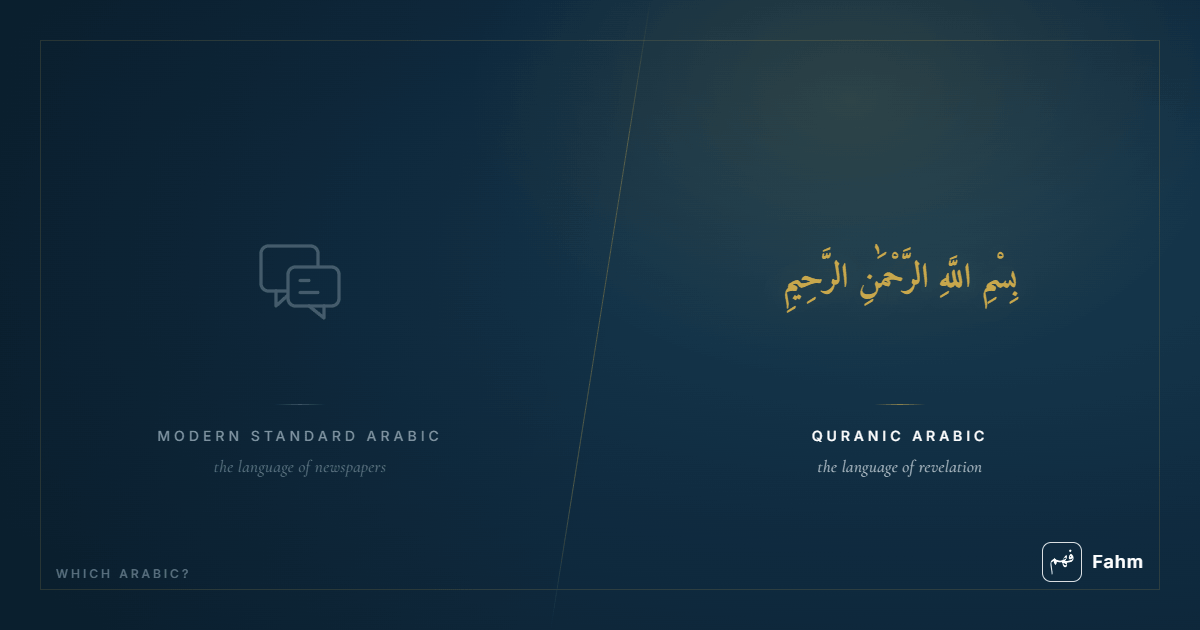
Modern Standard Arabic and Quranic Arabic are not the same language.
They share the same alphabet. They share most of their grammar structure. They share a significant portion of vocabulary. But they diverge in ways that matter enormously for a Muslim who wants to understand the Quran and Salah.
MSA and Quranic Arabic share the same alphabet, most of the grammar, and around 80% of the core vocabulary — but their goals are different. MSA is the working language of news, business, and modern literature. Quranic Arabic is the language of the Quran, the hadith, and the classical Islamic tradition.
Quranic Arabic is the form of Arabic in which the Quran is written, also called Classical Arabic. As the Quran was written as early as the 6th century AD, the language is slightly different from the Arabic of today. The groupings, context, and some of the words used are vastly different from Modern Standard Arabic. In Classical Quranic Arabic, special symbols are used to signify proper pronunciation and to give emphasis to words, such as pauses between words — these symbols are almost exclusively used in oral reciting of the Quran.
Here's a practical way to think about it: MSA is to Quranic Arabic roughly what modern English journalism is to Shakespeare. They're the same language family. A fluent reader of one can navigate the other — but the vocabulary, the style, the idioms, and the priorities are different enough that you need to learn them separately if you want to reach fluency in both.
The specific vocabulary gap is the real problem. Duolingo teaches you words like "restaurant," "airport," "family," and "job" — the vocabulary of modern daily life. The Quran's vocabulary is built around: rabb (Lord/Sustainer), rahmat (mercy), tawbah (repentance), yawm al-din (Day of Judgement), sirat (path), ibadah (worship), taqwa (God-consciousness). These words appear hundreds of times in the Quran and almost never in an MSA newspaper.
Quranic Arabic covers around 1,800 unique roots that account for 80% of the Quran, versus around 5,000 high-frequency MSA words needed for general Arabic fluency.
If your goal is to understand what you say in your prayer, Quranic vocabulary is a much smaller, more focused target than general MSA fluency. The 300 highest-frequency words in the Quran cover roughly 70% of the text. Duolingo doesn't teach those 300 words in that sequence — or at all.
Why This Matters Specifically for Salah
Al-Fatiha is recited at minimum 17 times a day in the five obligatory prayers. The Tashahhud is recited at least 9 times. Durood Ibrahim follows the Tashahhud in every final sitting. Ayat Al-Kursi is recited after every obligatory prayer as an established Sunnah.
These texts — the daily prayer you perform five times a day — are entirely Quranic Arabic. Not a single word in Al-Fatiha, the Tashahhud, Durood Ibrahim, or Ayat Al-Kursi appears in Duolingo's Arabic curriculum in a meaningful Salah context. No app can listen to you recite Al-Fatiha and tell you that your 'ayn sound is wrong. No app can explain why Rabb carries a different emotional weight than Malik (King), and why both names of Allah appear in Al-Fatiha for specific reasons.
The first word of Al-Fatiha after Bismillah is Alhamdulillah — all praise belongs to Allah. Duolingo does not teach this word. The fifth ayah of Al-Fatiha is Iyyaka na'budu wa iyyaka nasta'in — You alone we worship, You alone we ask for help. Duolingo does not teach na'budu or nasta'in in this context. The opening of Ayat Al-Kursi is Allahu la ilaha illa Huwa Al-Hayyul-Qayyum — Duolingo does not teach Al-Hayy or Al-Qayyum at all.
After six months of Duolingo Arabic, a dedicated learner can identify some letters, form basic sentences, and recognize a handful of common words. They cannot understand a single verse of Al-Fatiha any better than when they started. That's not a failure on their part. It's a category mismatch.
The Other Options: An Honest Assessment
Since this is a comparison post, I want to be honest about what else exists, because Fahm is not the only app in this space.
Kalaam is the most direct competitor and it's a good app built with genuine sincerity — the founder made it entirely free for religious reasons and runs it on community donations through the Madinah platform, having invested $80,000 of his own funds into development. It uses spaced repetition, covers Quranic vocabulary, and has been endorsed by scholars including Yasir Qadhi. For anyone who cannot afford a subscription, it is a legitimate option and worth downloading.
Where it differs from Fahm comes down to four specific things:
First, curriculum sequencing. Kalaam sequences vocabulary by general Quranic frequency — the words that appear most often across the entire Quran. Fahm sequences specifically so that Salah vocabulary comes first — Al-Fatiha, the Tashahhud, Durood Ibrahim, Ayat Al-Kursi. In practice this means Fahm users start understanding their prayer within the first 30 days; Kalaam users build toward broader Quranic comprehension from a different starting point.
Second, scholarly tafsir. Kalaam teaches word meanings in Quranic context with visual aids. Fahm's curriculum layers in classical scholarly commentary — Ibn Kathir's tafsir, authenticated hadith citations with hadith numbers, companion narrations — at every step. If scholarly grounding matters to you, that's a real difference.
Third, pronunciation. Kalaam has no pronunciation feature. Fahm's AI pronunciation tutor gives real-time feedback on the specific Arabic sounds English speakers struggle most with — the 'ayn (ع), the ghayn (غ), the qaf (ق), the emphatic letters that change meaning when mispronounced.
Fourth, sustainability. Kalaam is entirely donation-funded, which is admirable but means product development depends on fundraising cycles — grammar has been listed as "coming soon" for some time. Fahm's subscription model funds continuous development: new features, scholarly review, AI improvements, curriculum expansion. A sustainable business behind a product matters for users who want to know it will still be there and improving in three years.
Bayyinah TV / Dream Arabic — Ustadh Nouman Ali Khan's Bayyinah is the most academically rigorous Quranic Arabic program in English. It is also a full Arabic grammar course, not a vocabulary app. It requires significant time investment — hours per week, not minutes per day — and is better suited for someone who wants deep grammatical understanding rather than immediate Salah comprehension.
YouTube / free resources — There's no shortage of Quranic Arabic content on YouTube, and some of it is excellent. The problem is that passive watching without active recall and spaced repetition produces very poor long-term retention. The Ebbinghaus Forgetting Curve (which we've written about in detail) shows you lose 70% of new information within 24 hours without active review. Watching a YouTube video about Al-Fatiha's meaning is genuinely valuable — but without a system to reinforce it, most of it will be gone by Thursday.
Apps that "teach Quranic Arabic" via grammar — Several apps and courses lead with Arabic grammar: verb conjugation patterns, case endings, sentence structure. Grammar is important for deep Quranic comprehension. But starting with grammar is the equivalent of learning music theory before you've ever played a note. For most people's goals — understanding their prayer — you need vocabulary first. Grammar follows naturally as you accumulate enough words for patterns to become visible.
What Actually Works: The Three Non-Negotiables
Based on both the learning science and the specific goal of Salah comprehension, here's what any effective Quranic Arabic learning approach has to do:
1. Teach Quranic vocabulary specifically, not MSA or dialect. The target is a defined set of words. The Quran contains approximately 77,000 words but only around 1,800 unique roots. The 300 most frequent words account for 70% of the text. If your learning system is teaching you words that don't appear in those 300, it's not moving you toward your goal efficiently.
2. Use spaced repetition for retention. This is not optional — it's the only system proven to produce long-term vocabulary retention. The SM-2 algorithm (the same system used in Anki, used by medical students and competitive language learners) calculates exactly when you are about to forget a word and surfaces it at that moment. This is what converts short-term exposure into permanent memory. Watching, reading, or listening without active recall does not build retention.
3. Sequence the curriculum around Salah vocabulary first. If your goal is Salah comprehension, you should understand what you say in your prayer before you learn anything else. Al-Fatiha. The Tashahhud. Durood Ibrahim. Ayat Al-Kursi. These are the words you say more than any others in your life. They should come first — not after 200 lessons of general vocabulary.
This is the framework Fahm is built on. The 300-word curriculum is sequenced so that Phase A covers the language of your Salah — before you encounter any unfamiliar Quranic verse. The SM-2 algorithm ensures that what you learn on Day 1 is still with you on Day 90. And the AI pronunciation tutor gives real-time feedback on the specific sounds of Quranic Arabic that are hardest for English speakers: the 'ayn (ع), the ghayn (غ), the qaf (ق), the emphatic letters.
A Realistic Timeline: What to Expect
One of the frustrations with language learning apps in general — Duolingo included — is that they set unrealistic expectations. "Fluent in 3 months" headlines are marketing, not reality.
Here is an honest timeline for Salah comprehension specifically:
Days 1-30: You learn the core vocabulary of Al-Fatiha, the Tashahhud, and Durood Ibrahim. You start recognizing words in your prayer. The prayer doesn't feel like a foreign language anymore — it feels like something you're gradually reading rather than reciting by sound.
Days 30-90: You've completed Phase A and B of the Fahm curriculum — roughly 150 words. You understand the majority of what you say in every Salah. When you hear Ayat Al-Kursi recited, you catch specific words and their meanings in real time.
Days 90-180: You've covered the full 300-word foundation. You understand approximately 70% of the Quranic text by coverage — meaning 70% of the words that appear in the Quran are words you recognize. Not every sentence, not every nuance, but the core vocabulary of the Book.
This is not fluency in Arabic. It is Salah comprehension and foundational Quranic vocabulary — which is what most English-speaking Muslims actually want and what no app currently teaches with the sequencing and rigor it deserves.
The Specific Failure Mode to Avoid
The most common mistake I've seen Muslim learners make — and the one I made myself — is conflating "learning Arabic" with "understanding the Quran."
They're related but not the same goal. MSA fluency takes years of intense study. Conversational dialect fluency takes a different set of years. Quranic Arabic comprehension — specifically the vocabulary of the Quran and Salah — is a far more achievable target in a far shorter time, precisely because the vocabulary set is bounded and the words repeat constantly across the text.
A Muslim who learns even 300 to 400 common Quranic words begins to hear their Salah differently. The words that were sounds become meanings. Alhamdulillah is no longer a phrase you say — it is a statement: all praise belongs to Allah. That shift changes how you stand in prayer.
That shift — from sounds to meaning — is the actual goal. And it doesn't require becoming fluent in Arabic to get there.
Frequently Asked Questions
Does Duolingo teach Quranic Arabic? No. Duolingo's Arabic course teaches Modern Standard Arabic (MSA) — the formal, standardized Arabic used in news and official communication. MSA and Quranic Arabic share the same alphabet and most of their grammar, but their vocabulary priorities are significantly different. Duolingo does not teach the specific vocabulary of the Quran or the daily Salah.
Can Duolingo help me understand my prayer? Not directly. Because Duolingo teaches MSA vocabulary (words like "restaurant," "airport," "job") rather than Quranic vocabulary (rabb, rahmat, ibadah, tawbah), completing Duolingo's Arabic course will not give you meaningful comprehension of Al-Fatiha, the Tashahhud, or other Salah texts.
What is the difference between Modern Standard Arabic and Quranic Arabic? Both use the same Arabic script and share most of their grammar. The differences are in vocabulary priorities, style, and specific usage. MSA is optimized for modern communication — journalism, business, government. Quranic Arabic is the classical language of the Quran (6th century CE onwards), with a vocabulary centered on theological, spiritual, and legal concepts that appear throughout the Quran but rarely in modern MSA contexts.
What is the best app to learn Quranic Arabic? The best app depends on your specific goal. If you want immediate Salah comprehension — understanding what you say in your daily prayer — you need an app that teaches Quranic vocabulary with spaced repetition, sequenced to prioritize Salah words. Fahm is built specifically for this. Kalaam is another option that uses spaced repetition for Quranic vocabulary, with a different curriculum sequence. Bayyinah TV is the best option for deep grammatical understanding but requires significantly more time investment.
How long does it take to understand Salah in Arabic? With consistent 5-10 minute daily practice using a spaced repetition system focused on Quranic vocabulary, most learners begin recognizing words in their prayer within the first 30 days and reach meaningful Salah comprehension within 60-90 days. Full foundational Quranic vocabulary (300 words covering 70% of the text) is achievable in 90-180 days of consistent practice.
Is it worth learning Arabic just to understand prayer? Yes — and it's less daunting than it sounds. You don't need general Arabic fluency to understand your Salah. You need Quranic vocabulary, specifically the words that appear most frequently in the prayer texts. That's a bounded, achievable goal that most English-speaking Muslims can reach within three months of consistent daily practice.
What Arabic does Duolingo teach — MSA or dialect? Duolingo teaches Modern Standard Arabic (MSA) — not any spoken dialect (Egyptian, Levantine, Gulf, etc.) and not Quranic Arabic. MSA is the formal version used in news broadcasts, literature, and official communication across the Arab world.
Where to Start
If you have been doing Duolingo Arabic and wondering why it isn't clicking for your prayer — stop. You haven't failed. You've been trying to open a lock with the wrong key.
If you want to understand what you say in your Salah, the path is:
Step 1: Start with the words of Al-Fatiha — the surah you recite in every rak'ah of every prayer. We've written a complete word-by-word breakdown of Surah Al-Fatiha with tafsir from Ibn Kathir. Read it.
Step 2: Do the same with the Tashahhud — the testimony you recite in every sitting. Word-by-word breakdown here.
Step 3: Use a spaced repetition system to lock those words into long-term memory. Five minutes a day is enough if the system is right.
That's Fahm. That's what it's built for.
Barakallahu Feekum. May Allah make the words of your prayer a conversation rather than a recitation.
Start understanding your Salah today.
Sources
- DietAI / Kalam.gg — Does Duolingo Have Arabic? 6 Alternatives to Try in 2026 (kalam.gg/blog/does-duolingo-have-arabic)
- Clozemaster — Duolingo Intermediate Arabic: An Honest Look (clozemaster.com/blog/duolingo-intermediate-arabic)
- Arab Academy — Quranic Arabic Versus Modern Standard Arabic (arabacademy.com)
- Waraqa Arabic — MSA vs Quranic Arabic: Which Should You Learn First? (waraqaweb.com)
- eArabicLearning — Arabic for New Muslims (earabiclearning.com); Best Apps to Learn Arabic 2026 (earabiclearning.com)
- DeenUp — Arabic Course Guide: How to Learn Quranic Arabic (deenup.app)
- Kalaam App — App Store listing, feature description (apps.apple.com)
- Fahm Blog — The Science of Spaced Repetition; Surah Al-Fatiha Word by Word; The Tashahhud Word by Word