Assalamualaikum wa rahmatullahi wa barakatuhu,
We've all been there: You spend an hour on a Saturday memorizing 20 new Quranic words. You feel confident, maybe even inspired. But by Tuesday, those same words look like total strangers.
Most students conclude they "just aren't good at languages." But here is the reality: It's not a problem with your brain. It's a problem with your system.
The Leaky Bucket Problem
Every student of Arabic has felt this frustration. You review a vocabulary list for an hour, only to find that 48 hours later, half the words have vanished. This isn't a lack of talent — it is a biological certainty known as Synaptic Pruning.
Your brain is a high-efficiency machine designed to discard information it deems non-essential. When you cram dozens of new words in a single session, your brain treats them like background noise. Without a strategic intervention, those words are pruned to make room for the next day's data.
If you are reading new verses but not systematically reviewing the old ones, you are pouring water into a leaky bucket. It's the same reason apps built for general vocabulary drilling fall short here — a big part of why Duolingo won't help you understand your Salah is that rote repetition without a retention system leaks exactly like this.
The Ebbinghaus Forgetting Curve
In the late 19th century, psychologist Hermann Ebbinghaus discovered a mathematical formula for how we forget. He proved that humans lose roughly 70% of new information within 24 hours if no attempt is made to retain it — and up to 90% within a week.
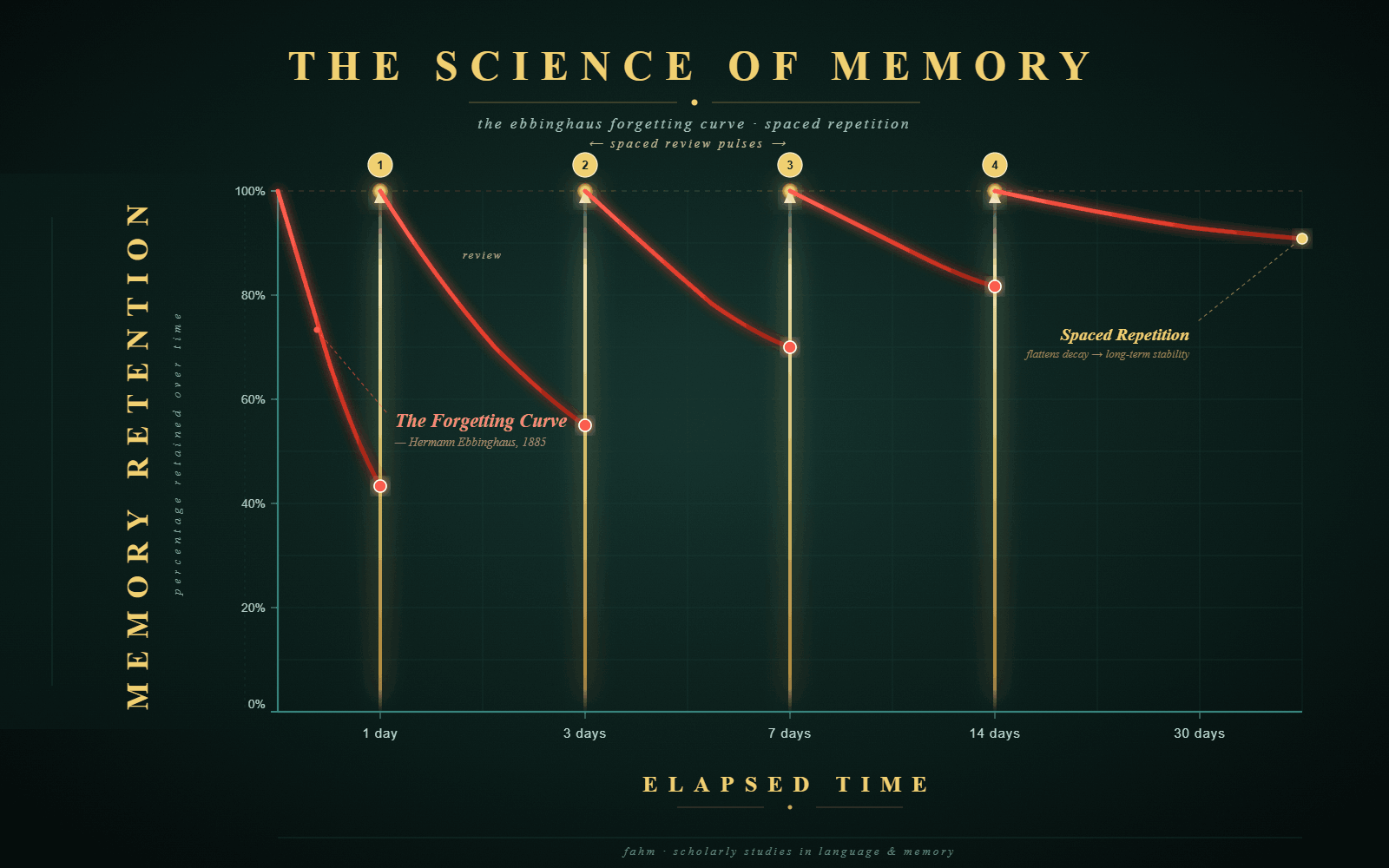
When you cram, you are fighting your own biology. To truly understand the Quran, you need a system that works with the brain, not against it.
Enter SM-2: The Brain's Best Friend
When I began building Fahm, I knew that identifying the 300 Foundation Words wasn't enough. I needed to ensure that once you learned a word, it stayed with you. That's why Fahm is powered by the SM-2 (SuperMemo-2) Spaced Repetition Algorithm.
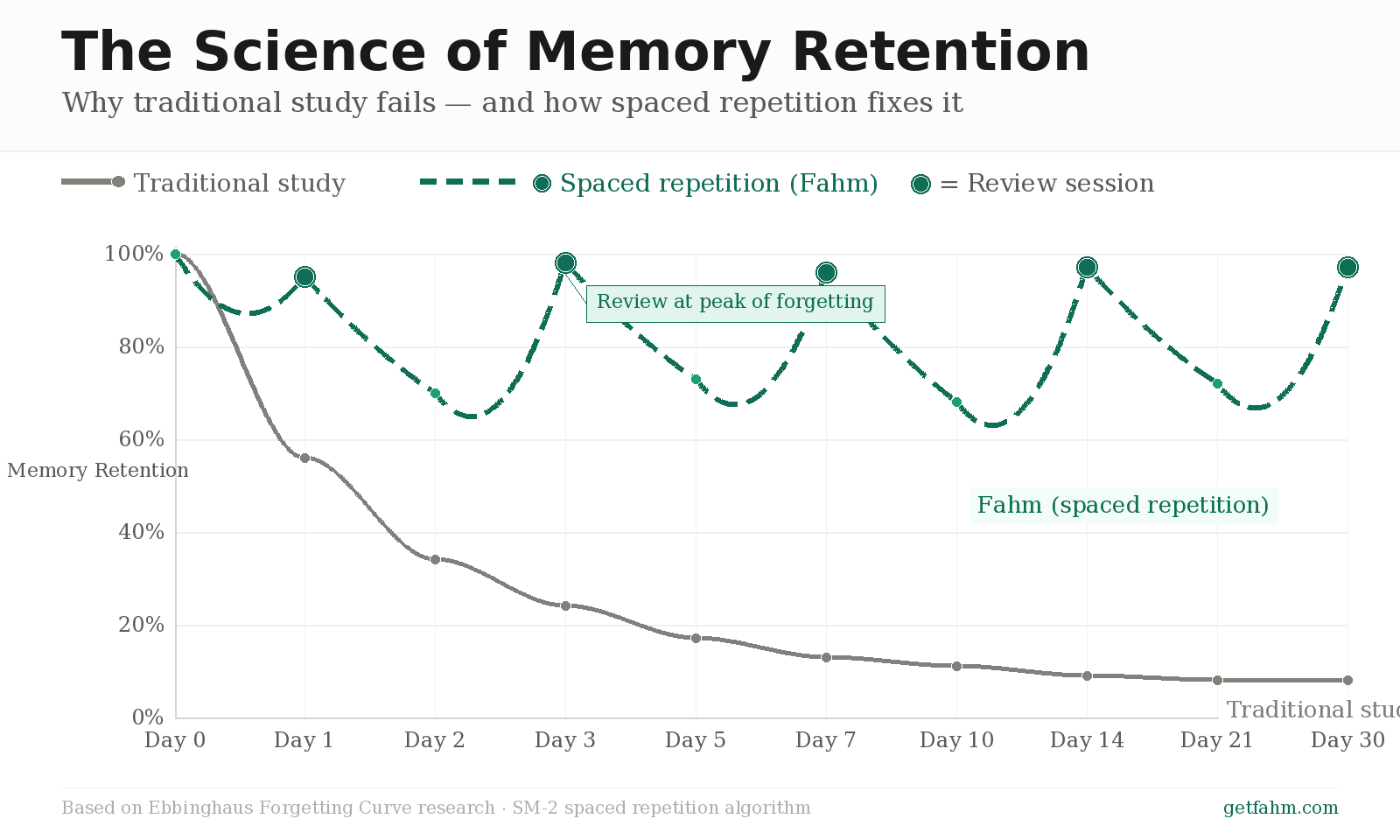
Instead of showing you every word every day, the algorithm tracks your performance on every single term. It calculates the exact moment your memory of a word is about to decay — the "threshold of forgetting" — and shows it to you then. This forces your brain to work harder to retrieve the word, which strengthens the neural pathway and moves it from fragile short-term memory into permanent long-term storage.
How it works in Fahm
- Initial Exposure: You learn a new word like Ar-Rahman.
- First Test: The app asks you again in 10 minutes.
- Expansion: If you get it right, the app waits 2 days. Then 5 days. Then 12. Then 30.
- Reset: If you forget, the algorithm shrinks the interval and brings it back into focus until it's locked in.
Your study time becomes surgical. You don't waste time on words you already know, and you never lose progress because you stopped reviewing.
Why 5 Minutes a Day Is Enough
I often get asked: "Can I really learn the Quran in just a few minutes a day?"
Yes — because of the Law of Compound Interest.
- Day 1: You know 5 words
- Day 30: You know 150 words
- Day 90: You've mastered the 300-word foundation, covering 70% of the Quranic text
By being consistent rather than intense, you build a memory foundation that doesn't crumble. That same 30-minute cramming session becomes 5–10 minutes of daily reviews — and your retention rate jumps from roughly 5% to nearly 95%.
Within three weeks, you aren't just remembering words. You are recognizing them instantly during Salah. The cognitive load of translating vanishes, leaving room for Khushu (devotion) and reflection.
The Frequency Matrix: Learning the Right Words First
Traditional methods treat every word as a new, isolated puzzle. Fahm treats vocabulary as a mathematical priority — focusing on roots that unlock entire families of meaning.
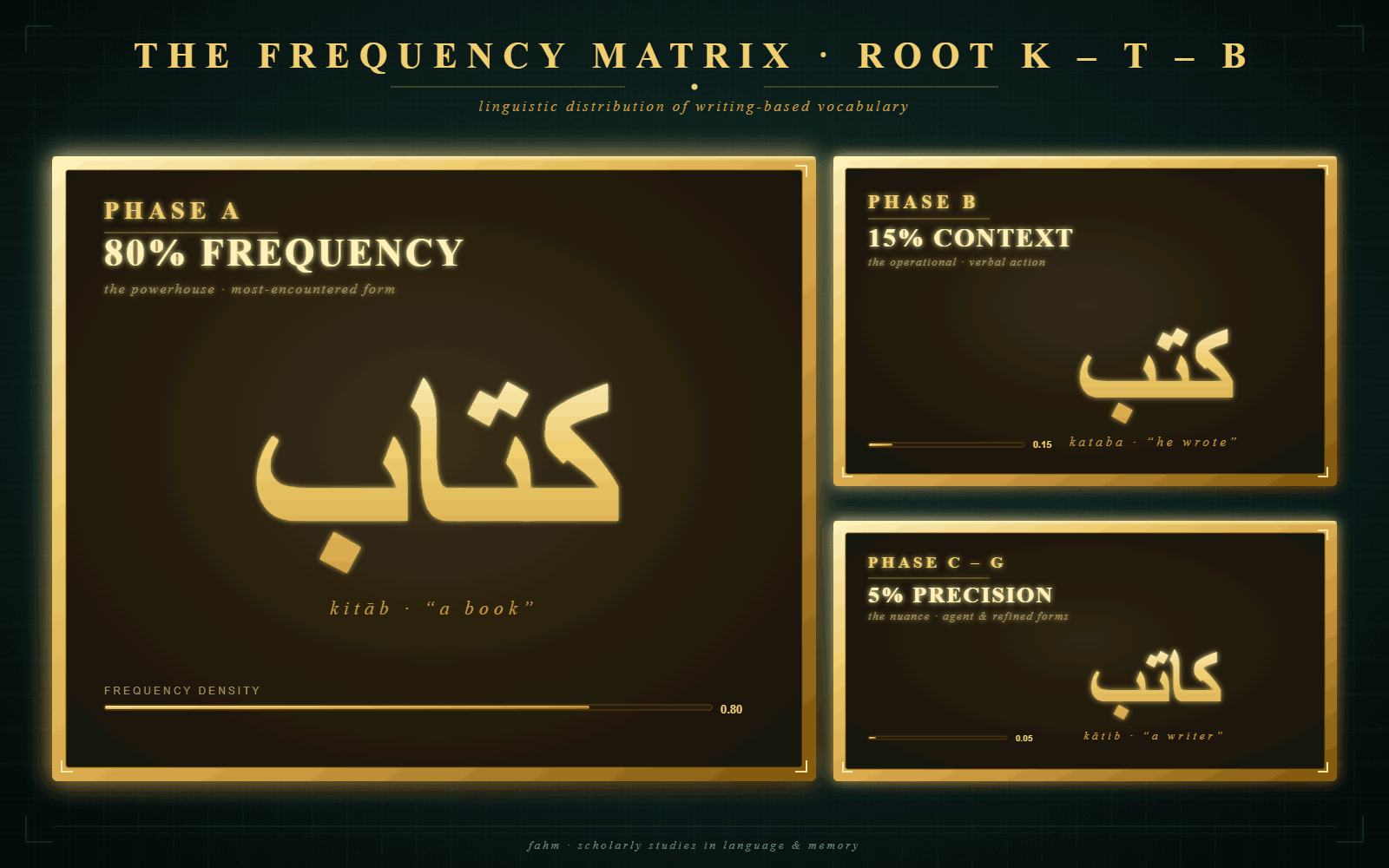
Consider the high-frequency root K-T-B:
| Vocabulary Layer | English Meaning | Frequency Impact |
|---|---|---|
| Foundation (Phase A) | The Book / Scripture | Appears in nearly every Juz |
| Operational (Phase B) | It is Prescribed | Essential for legal context |
| Descriptive (Phase C) | A Scribe / Writer | Found in commercial verses |
| Nuanced (Phase F) | They are Writing | High-level grammatical form |
The Fahm Curriculum: Phases A Through G
To prevent cognitive overload, Fahm maps the entire Quranic vocabulary into a structured staircase of 7 Phases — ensuring you always focus on the highest-impact words first.
- Phases A–B (The Connectors): Master the prepositions and pronouns that form the skeleton of every verse
- Phases C–E (The Narrative): High-frequency verbs and actions that drive the Quran's stories
- Phases F–G (The Eloquence): Specialized, nuanced terminology for deep scholarly understanding
To see how these phases connect to our broader approach, read The 300-Word Foundation.
Technology in Service of Revelation
My goal with Fahm is to take the best of modern learning science — the same tools used by medical students and high-stakes linguists — and apply them to the most important book in existence.
Memory is not a one-time purchase; it is a maintenance task. Fahm's system continuously tracks your performance across both Read Mode pronunciation and spaced repetition quizzes, updating your unique Memory Map so that the time you spend studying today is never wasted tomorrow.
When you master the vocabulary through a data-driven system, your relationship with the Quran changes. You stop just hearing the recitation and start following the message.
InshaAllah, this system will make your path to understanding smoother and more sustainable.
Ready to stop the decay? Start your journey with Fahm.
Barakallahu Feekum