Assalamualaikum wa rahmatullahi wa barakatuhu,
Abu Hurayrah (رضي الله عنه) narrated:
"By Allah, I seek the forgiveness of Allah and turn to Him in repentance more than seventy times a day." — Sahih al-Bukhari (6307) — narrated by the Prophet ﷺ about himself
The man speaking these words was the Prophet Muhammad ﷺ. The man already forgiven by Allah. The man guaranteed Paradise. The man about whom Allah said: "That Allah may forgive you what preceded of your sin and what is to follow." (Surah Al-Fath, 48:2)
And he said Astaghfirullah more than seventy times every single day.
If the one with nothing to fear from his past and nothing to fear for his future made istighfar his constant companion — what does that tell you about the nature of this phrase, and why most Muslims are wildly underusing it?
This post is the complete Astaghfirullah meaning, word by word — the Arabic root, the grammatical structure, the precise distinction between istighfar and tawbah, the full Sayyidul Istighfar broken down phrase by phrase, and the Quranic verses that make forgiveness the central theme of Allah's relationship with His servants. By the end, Astaghfirullah will mean something different every time you say it.
What Is Astaghfirullah?
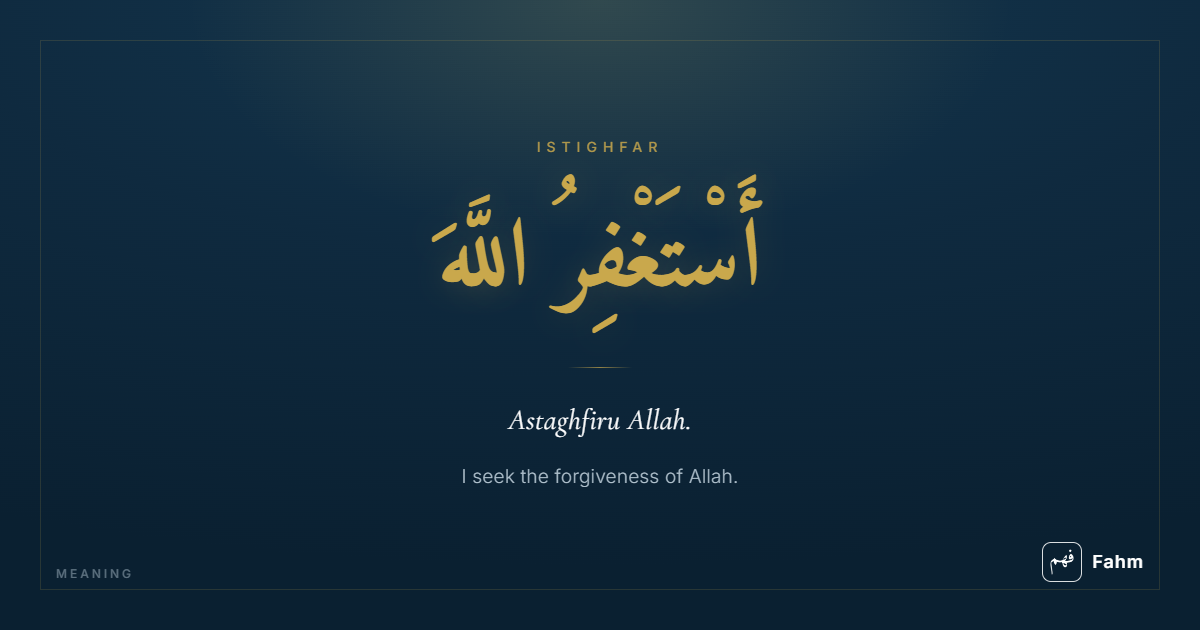
Astaghfirullah (أَسْتَغْفِرُ اللَّهَ) is an Arabic phrase meaning "I seek the forgiveness of Allah." It is the most common and most repeated form of istighfar — the act of seeking Allah's forgiveness — in Islamic practice.
It is said after every Salah (three times, as established Sunnah), in morning and evening adhkar, when witnessing or committing a sin, when feeling distant from Allah, and as continuous dhikr throughout the day. The Prophet ﷺ described it and demonstrated it as one of the most essential practices of a believer's life.
Word by Word: What Astaghfirullah Actually Means
Arabic: أَسْتَغْفِرُ اللَّهَ
Transliteration: Astaghfiru Allah
| Arabic | Transliteration | Meaning |
|---|---|---|
| أَسْتَغْفِرُ | Astaghfiru | I seek forgiveness / I request covering |
| اللَّهَ | Allah | Allah — the proper name of God |
Two words. But the first word — Astaghfiru — is where everything lives.
The Root: Gh-F-R (غ-ف-ر) — To Cover, To Shield, To Forgive
The entire weight of Astaghfirullah rests on three Arabic letters: غ-ف-ر (gh-f-r).
The root gh-f-r carries three interconnected meanings, all present simultaneously when Allah forgives:
To cover — a forgiven sin is not merely acknowledged and set aside. It is covered over, veiled, hidden from view. It is as if it never existed. The Arabic word for a helmet (mighfar) comes from the same root: a helmet covers and protects the head. When Allah forgives through gh-f-r, He covers the sin with His mercy and protects the servant from its consequences.
To shield — forgiveness is not just backward-looking (covering what was done) but forward-looking (shielding from the weight and punishment that the sin would have brought). When you ask for maghfirah, you are asking for both erasure and protection.
To set aright — the root also carries the meaning of correction, of restoring what was damaged. Sin damages the relationship between the servant and Allah. Maghfirah restores it.
This three-dimensional meaning is why scholars say no single English word — "forgiveness," "pardon," "mercy" — fully captures gh-f-r. You are asking Allah to cover your sin, shield you from its consequences, and restore your relationship with Him — all in one request. [Source: Al-Ghafur entry, Islamic scholarship on the 99 Names; Islamtics.com, Astaghfirullah Meaning, citing the root]
The word family built from gh-f-r:
- Al-Ghafur (الغَفُورُ) — The All-Forgiving: appears 91 times in the Quran
- Al-Ghaffar (الغَفَّارُ) — The Perpetually Forgiving (intensive form — forgives again and again): appears 5 times
- Maghfirah (مَغْفِرَة) — Forgiveness itself: the act of covering
- Ghafara (غَفَرَ) — He forgave: the verb in past tense
- Yaghfiru (يَغْفِرُ) — He forgives: the verb in present tense
These names alone — Al-Ghafur and Al-Ghaffar — appear 96 times in the Quran. Forgiveness is not a peripheral theme in the Quran. It is one of its defining, repeated declarations about who Allah is. [Source: Wikipedia, Al-Ghafur, occurrence count; Islamtics.com]
The Grammar: Why Astaghfiru Is a Request, Not a Statement
Astaghfiru is built on the Arabic grammatical pattern called istaf'ala (اِسْتَفْعَلَ). This pattern carries a specific meaning in Arabic: to seek or request the thing named by the root.
So:
- Root gh-f-r (covering/forgiveness) + istaf'ala pattern = istaghfara: to seek covering, to request forgiveness
- Root '-w-n (help/aid) + istaf'ala pattern = ista'ana: to seek help (the same word in iyyaka nasta'in from Al-Fatiha)
- Root w-j-d (finding) + istaf'ala pattern = istajwada: to seek to find
The istaf'ala pattern is grammatically a request — not a statement of fact, not a description. When you say Astaghfirullah, you are not saying "I have been forgiven." You are saying "I am asking to be forgiven." The act of saying it is itself the asking. [Source: Istighfarapp.com, Istighfar meaning, grammatical analysis of the istaf'ala pattern]
The first-person singular ending -u on Astaghfiru makes it: I seek — present tense, active, personal. Not "one seeks" or "believers seek." I, right now, am seeking.
And the One being asked: Allah — not a general word for deity (ilah) but the proper personal name of the divine — the One who is Al-Ghafur and Al-Ghaffar, the One whose forgiveness is His defining attribute, the One whose very nature is to cover, shield, and restore.
The Quranic Commands to Seek Istighfar
Seeking forgiveness is not optional in Islam — it is explicitly commanded by Allah in multiple Quranic verses:
Surah Nuh (71:10-12):
"Seek forgiveness from your Lord; indeed He is ever Forgiving. He will send rain upon you in abundance, and provide you with wealth and children, and grant you gardens and flowing rivers."
The Prophet Nuh (عليه السلام) told his people that istighfar would bring rain, wealth, children, and gardens. This is one of the most direct Quranic connections between seeking forgiveness and worldly provision — not as a transaction, but as a description of how Allah, in His wisdom, responds to the servant who keeps turning to Him. [Source: Kanzolquran.com citing Surah Nuh 71:10-12; IslamQA.info]
Surah Aal-Imran (3:135):
"And those who, when they commit an immorality or wrong themselves, remember Allah and seek forgiveness for their sins — and who can forgive sins except Allah? — and do not persist in what they have done while they know."
This ayah describes the defining characteristic of the people of Taqwa: not that they never sin, but that they do not persist in sin. They remember Allah. They seek forgiveness. They do not insist on wrongdoing. Ibn Kathir identifies this as one of the core descriptions of the muttaqun — the God-conscious — in Surah Aal-Imran. [Source: Tafsir Ibn Kathir, 3:135]
Surah Az-Zumar (39:53) — the most hope-giving verse in the Quran:
"Say: O My servants who have transgressed against themselves — do not despair of the mercy of Allah. Indeed, Allah forgives all sins. Indeed, it is He who is the Forgiving, the Merciful."
All sins. Not most. Not small ones. Not sins below a certain threshold. Jami'an — all sins together. This is the verse Ibn Kathir describes as carrying the widest scope of divine promise in the entire Quran. The only condition — sincere return to Allah — is embedded in the address: "O My servants." The word 'ibad (servants) here, scholars note, applies even to the greatest sinners who turn back: the moment you turn to Allah, you are His servant, and this promise covers you. [Source: Tafsir Ibn Kathir, 39:53]
Surah Al-Baqarah (2:222):
"Indeed, Allah loves those who are constantly repentant and loves those who purify themselves."
Allah loves the Tawwabeen — the ones who keep returning to Him. Not those who sinned once and repented. The ones who repeatedly return, repeatedly seek forgiveness, repeatedly turn back. The tafa'ul grammatical form (tawwabeen) indicates a habitual, repeated action — this is not a one-time event but a continuous way of being. [Source: Classical Arabic grammar; confirmed in multiple tafsir of 2:222]
Istighfar After Salah: The Established Sunnah
One of the most consistent and accessible Sunnahs of the Prophet ﷺ was saying Astaghfirullah three times immediately after completing the obligatory prayer — before moving to the rest of the post-Salah dhikr.
Thawban (رضي الله عنه) narrated:
"When the Messenger of Allah ﷺ finished his prayer, he would seek forgiveness three times and then say: 'Allahumma anta as-salam wa minka as-salam, tabarakta ya dhal-jalali wal-ikram.' (O Allah, You are Peace, and from You comes peace. Blessed are You, O Possessor of majesty and honor.)" — Sahih Muslim (591)
The scholars have explained the wisdom behind seeking forgiveness immediately after prayer: the prayer itself is an act of worship, and no act of worship from a human being is truly free of shortcomings — distraction, incomplete focus, slight errors in the heart or the form. The three Astaghfirullahs that follow are a recognition of those shortcomings and a request for Allah to accept the prayer despite them. [Source: IslamQA.info, Answer 104818; Sahih Muslim 591]
The Difference Between Istighfar and Tawbah
This distinction matters, and it is frequently confused.
Istighfar (اِسْتِغْفَار) — seeking forgiveness — is asking Allah to cover a sin. It can be said at any moment, in any state, for any sin. It is on the tongue and in the heart simultaneously. It does not require a specific commitment about the future — it is a request directed toward the past (cover what I have done).
Tawbah (تَوْبَة) — repentance — is turning away from sin. It involves a firm commitment to abandon what is wrong. It requires: recognizing the sin as wrong, genuine remorse, stopping the sin immediately, and a firm resolve not to return to it. If the sin involves the rights of another person, it also requires making amends to that person.
The relationship: Istighfar without Tawbah is incomplete for major sins. You can say Astaghfirullah a thousand times while planning to continue the sin — this is not sincere repentance. For major sins, istighfar must be accompanied by tawbah for the full promise of forgiveness to apply.
For minor sins and general shortcomings — the inevitable human imperfections of intention, attention, and action — istighfar said sincerely is sufficient. This is why the Prophet ﷺ said it constantly, not because he was committing major sins and needed tawbah repeatedly, but because he recognized the continuous human shortfall from the ideal of complete devotion to Allah.
Imam Ibn al-Qayyim al-Jawziyyah distinguishes the two precisely in Madarij al-Salikin: istighfar is the first movement, tawbah is the full turn. Together they constitute complete return to Allah. [Source: Ibn al-Qayyim, Madarij al-Salikin, Vol. 1, chapter on Tawbah and Istighfar]
The Variants of Astaghfirullah
The basic form:
أَسْتَغْفِرُ اللَّهَ Astaghfirullah "I seek the forgiveness of Allah"
This is the form that appears most consistently in authentic narrations, including the Prophet's ﷺ daily practice of 70-100 times. [Source: Sahih al-Bukhari 6307; Sahih Muslim 2702]
With repentance added:
أَسْتَغْفِرُ اللَّهَ وَأَتُوبُ إِلَيْهِ Astaghfirullah wa atubu ilayh "I seek the forgiveness of Allah and I turn to Him in repentance"
This is the form Ibn Umar (رضي الله عنه) reported counting the Prophet ﷺ saying 100 times in a single gathering. [Source: Sunan Abu Dawud (1516); Sunan al-Tirmidhi (3430) — graded Sahih by al-Albani]
With Al-Azeem added:
أَسْتَغْفِرُ اللَّهَ الْعَظِيمَ Astaghfirullah al-Azeem "I seek the forgiveness of Allah, the Most Great"
A widely used and valid form. Al-Azeem (الْعَظِيمَ) — the Most Great — is one of Allah's names, invoking His absolute greatness as the One being asked. [Source: Valid form, mentioned in multiple scholarly sources; Islamtics.com]
The complete daily form:
أَسْتَغْفِرُ اللَّهَ الَّذِي لَا إِلَهَ إِلَّا هُوَ الْحَيُّ الْقَيُّومُ وَأَتُوبُ إِلَيْهِ Astaghfirullah alladhi la ilaha illa Huwal-Hayyul-Qayyum wa atubu ilayh "I seek the forgiveness of Allah, besides Whom there is no deity — the Ever-Living, the Self-Sustaining — and I turn to Him in repentance"
The Prophet ﷺ said: "Whoever says this will be forgiven even if he had fled from battle." [Source: Sunan Abu Dawud (1517); Sunan al-Tirmidhi (3577) — graded Hasan]
Sayyidul Istighfar: The Master of Seeking Forgiveness
Beyond the short daily forms, the Prophet ﷺ taught his companions the most complete and comprehensive istighfar ever given — and he named it himself.
Shaddad ibn Aws (رضي الله عنه) narrated that the Prophet ﷺ said:
"The most superior form of seeking forgiveness is:"
Arabic:
اللَّهُمَّ أَنْتَ رَبِّي لَا إِلَهَ إِلَّا أَنْتَ، خَلَقْتَنِي وَأَنَا عَبْدُكَ، وَأَنَا عَلَى عَهْدِكَ وَوَعْدِكَ مَا اسْتَطَعْتُ، أَعُوذُ بِكَ مِنْ شَرِّ مَا صَنَعْتُ، أَبُوءُ لَكَ بِنِعْمَتِكَ عَلَيَّ، وَأَبُوءُ بِذَنْبِي فَاغْفِرْ لِي فَإِنَّهُ لَا يَغْفِرُ الذُّنُوبَ إِلَّا أَنْتَ
Transliteration:
Allahumma anta rabbi la ilaha illa anta, khalaqtani wa ana 'abduka, wa ana 'ala 'ahdika wa wa'dika mastata'tu, a'udhu bika min sharri ma sana'tu, abu'u laka bini'matika 'alayya, wa abu'u bidhanbi, faghfir li, fa innahu la yaghfirudh-dhunuba illa anta.
Translation:
"O Allah, You are my Lord. There is no deity worthy of worship except You. You created me and I am Your servant. I am committed to Your covenant and promise to the best of my ability. I seek refuge with You from the evil of what I have done. I acknowledge Your blessing upon me and I acknowledge my sin. So forgive me, for indeed no one forgives sins except You."
"Whoever says this during the day with firm belief in it, and dies that day before evening — he will be from the people of Paradise. And whoever says this at night with firm belief in it, and dies before the morning — he will be from the people of Paradise." — Sahih al-Bukhari (6306); narrated by Shaddad ibn Aws; also in Riyad as-Salihin (1875)
Sayyidul Istighfar: Phrase by Phrase
اللَّهُمَّ أَنْتَ رَبِّي لَا إِلَهَ إِلَّا أَنْتَ Allahumma anta rabbi la ilaha illa anta "O Allah, You are my Lord. There is no deity worthy of worship except You."
The dua opens with Tawheed — the declaration of Allah's absolute oneness. Before any request is made, before any confession is offered, the servant begins by declaring who Allah is. This is the theological foundation of all dua: you must know who you are speaking to before you speak. The Shahada embedded in the opening also establishes: I am asking the One who alone has the right to be asked.
خَلَقْتَنِي وَأَنَا عَبْدُكَ Khalaqtani wa ana 'abduka "You created me and I am Your servant."
The relationship is established: Creator and created, Lord and servant. Khalaqtani — You created me — is an acknowledgment that existence itself is a gift, not a right. Ana 'abduka — I am Your servant — is a declaration of complete belonging. Both together say: my existence came from You, and everything I am belongs to You.
وَأَنَا عَلَى عَهْدِكَ وَوَعْدِكَ مَا اسْتَطَعْتُ Wa ana 'ala 'ahdika wa wa'dika mastata'tu "And I am committed to Your covenant and promise to the best of my ability."
'Ahd — covenant: the primordial covenant of Surah Al-A'raf (7:172) where all souls testified to Allah's lordship before being born. Wa'd — promise: the believer's commitment to follow Allah's guidance. Mastata'tu — to the best of my ability — is a crucial qualification. The servant is not claiming perfection. He is claiming sincere effort within the limits of human capacity. This is itself a form of honesty that the dua requires. [Source: HadithAnswers.com, citing Tafsir of Sayyidul Istighfar]
أَعُوذُ بِكَ مِنْ شَرِّ مَا صَنَعْتُ A'udhu bika min sharri ma sana'tu "I seek refuge with You from the evil of what I have done."
A'udhu bika — I seek refuge with You — the same opening as the Mu'awwidhatayn. But here the thing sought refuge from is not external: it is ma sana'tu — what I myself have done. The evil of my own actions. The servant recognizes that his sins are a danger to himself and asks Allah to be the shield between him and their consequences.
أَبُوءُ لَكَ بِنِعْمَتِكَ عَلَيَّ وَأَبُوءُ بِذَنْبِي Abu'u laka bini'matika 'alayya wa abu'u bidhanbi "I acknowledge Your blessing upon me, and I acknowledge my sin."
Abu'u (أَبُوءُ) — I acknowledge, I confess, I return. This word is used for full, open, unambiguous acknowledgment. The servant acknowledges two things: the blessings (ni'mah) Allah has given him — which he has not fully appreciated or used as he should — and his dhanb (sin) — what he has done wrong. Both acknowledgments together create the complete picture of the human condition: blessed, and falling short. Grateful, and failing. Receiving, and transgressing. [Source: Islamtics.com, Sayyidul Istighfar breakdown; HadithAnswers.com]
فَاغْفِرْ لِي فَإِنَّهُ لَا يَغْفِرُ الذُّنُوبَ إِلَّا أَنْتَ Faghfir li, fa innahu la yaghfirudh-dhunuba illa anta "So forgive me, for indeed no one forgives sins except You."
The request. After Tawheed, after establishing the relationship, after seeking refuge from his own evil, after acknowledging blessings and sins — the servant finally asks: forgive me. And closes with the reason Allah can fulfill this request and no one else can: la yaghfirudh-dhunuba illa anta — no one forgives sins except You. The same exclusivity that opens the Shahada (la ilaha illallah) closes this dua: the One who forgives is the same One there is no god except.
This is why the scholars called it Sayyidul Istighfar — the master. In a few lines it contains Tawheed, acknowledgment of creation and servanthood, commitment to the covenant, seeking refuge from one's own evil, confession of both blessing and sin, and the request for forgiveness — sealed with the declaration that only Allah can grant it. No other istighfar contains all of this. [Source: DeenUp.app, Sayyidul Istighfar breakdown; HadithAnswers.com citing Shaddad ibn Aws narration, Sahih al-Bukhari 6306]
Why the Prophet ﷺ Said It 70-100 Times Daily: The Real Reason
This is the question most Muslims don't ask clearly: why would the man already forgiven by Allah, the Seal of Prophets, the most beloved of creation — why would he seek forgiveness more than seventy times every day?
The scholars offer several complementary explanations:
First: To teach his Ummah. The Prophet ﷺ was the living example for every Muslim until the Day of Judgement. If he made istighfar his constant practice, it becomes the model for every believer — regardless of their level of piety.
Second: Istighfar is itself a form of worship, not just a response to sin. Seeking forgiveness is an act of humility before Allah, an acknowledgment of human dependency, an expression of love for Allah's attribute of forgiveness. The Prophet ﷺ engaged in it constantly because remembering Allah in this specific mode was itself beloved to him — not because he had a specific sin to confess each time.
Third: The human condition always falls short of the ideal. Even the Prophet ﷺ — the most complete human being — recognized that complete devotion to Allah, in every thought and every moment, is beyond human capacity. Mastata'tu — to the best of my ability — is always less than the ideal. The gap between human effort and divine perfection is always present, even in the prophets.
Fourth: Shukr — gratitude. Some scholars note that istighfar also functions as a recognition of Allah's blessings: you have given me so much, and I have fallen short of using it all in Your worship. This reading connects istighfar to shukr (gratitude) rather than to sin specifically. [Source: IslamQA.info, Answer 104818; Hidayahquran.com, Astaghfirullah meaning and benefits]
The Benefits of Istighfar in Authentic Hadith
Relief from every worry and distress:
"Whoever makes istighfar constantly, Allah will make for him a way out of every difficulty, and relief from every worry, and will provide for him from where he did not expect." — Sunan Abu Dawud (1518); graded authentic
The promise of Surah Nuh — rain, wealth, children: Surah Nuh (71:10-12) directly connects sincere istighfar to worldly provision. This is not a mechanical transaction — it is a description of how Allah, in His wisdom and generosity, responds to the servant who keeps returning to Him. [Source: Quran 71:10-12; cited in Tafsir Ibn Kathir, Surah Nuh]
All sins forgiven — even if like the foam of the sea:
"Whoever says: 'Astaghfirullaha al-Azim alladhi la ilaha illa Huwal-Hayyul-Qayyum wa atubu ilayh' — will be forgiven even if he had fled from battle." [Source: Sunan Abu Dawud (1517); Sunan al-Tirmidhi (3577) — graded Hasan]
Sayyidul Istighfar — Paradise promised: As established in Sahih al-Bukhari (6306): whoever says it in the morning with firm belief and dies before evening is from the people of Paradise. Whoever says it at night with firm belief and dies before morning is from the people of Paradise.
The key condition in all of these: sincerity. The narrations consistently specify muqinan biha (with firm conviction), wa atubu ilayh (and I turn to Him in repentance), sincerely. Istighfar recited as a habit without engagement of the heart carries less weight than one conscious, sincere utterance. [Source: Sahih al-Bukhari 6306; Hidayahquran.com citing authentic hadith collections]
Sayyidul Istighfar at night is often recited alongside the other great nightly practice of the Ummah: the last two ayat of Surah Al-Baqarah, which the Prophet ﷺ said would suffice whoever recites them before sleep. Together they form a fitting close to the day — one a confession of shortcoming, the other a declaration of faith and reliance.
When to Say Astaghfirullah
After every fard Salah — three times: The most consistent Sunnah, recorded in Sahih Muslim (591) from Thawban. Three times immediately upon completing the prayer, before the rest of the post-Salah dhikr. This is the single most established Sunnah around istighfar in daily practice.
Morning and evening — Sayyidul Istighfar: Once each in the morning (after Fajr) and evening (after Asr) as part of the adhkar — carrying the extraordinary promise of Sahih al-Bukhari 6306.
When committing or witnessing a sin: An immediate Astaghfirullah upon recognizing a sin or witnessing wrongdoing.
As continuous dhikr throughout the day: Following the Prophet's ﷺ example of 70-100 times daily — building it into every pocket of time: walking, waiting, between tasks.
At the end of good deeds: The Quran commands seeking forgiveness at the end of Hajj (Surah Al-Baqarah, 2:199) and the Prophet ﷺ taught it after completing prayers. Good deeds done by imperfect human beings always have shortcomings — istighfar acknowledges that.
The Word That Connects Everything
You have seen the root gh-f-r throughout this series without necessarily knowing it:
In Surah Al-Fatiha: "Ar-Rahmanir-Rahim" — the Most Merciful, whose mercy is the context in which forgiveness is possible.
In the Tashahhud: "wa Huwal-'Azizul-Ghafur" — and He is the Almighty, the All-Forgiving — closing Ayah 2 of Surah Al-Mulk, which we covered in the Surah Al-Mulk word-by-word post.
In Surah Al-Ikhlas: the declaration of Allah's absolute oneness that makes istighfar meaningful — you are asking the One, the only One, who can actually grant what you are asking.
In Surah Al-Kahf, Surah Az-Zumar, Surah Aal-Imran — the Quran returns to gh-f-r hundreds of times because forgiveness is not a sub-theme of the Quran. It is one of its central messages: Allah is Al-Ghafur, Al-Ghaffar, the One who covers sins with His mercy, and He wants His servants to keep returning to Him.
Fahm's curriculum sequences the gh-f-r root in Phase A — among the first words taught — because it appears 96 times in the Quran just in Allah's names alone, and many more times in Quranic verses. When you know this root, you recognize Ghafur, Ghaffar, Maghfirah, Yaghfiru, and Astaghfirullah as all variations of the same family, the same divine attribute, the same invitation.
Barakallahu Feekum. May every Astaghfirullah from this day forward be a conscious conversation with the One who named Himself Al-Ghaffar — the One who forgives, again and again, for those who keep coming back.
Start learning the words of your prayer today.
Frequently Asked Questions
What does Astaghfirullah mean in English? Astaghfirullah (أَسْتَغْفِرُ اللَّهَ) means "I seek the forgiveness of Allah." It comes from the Arabic root gh-f-r, which carries three simultaneous meanings: to cover, to shield, and to set aright. When you say Astaghfirullah, you are asking Allah to cover your sin with His mercy, shield you from its consequences, and restore your relationship with Him.
What is the difference between Astaghfirullah and Istighfar? Istighfar is the noun — the act of seeking forgiveness. Astaghfirullah is one specific phrase of istighfar — the most common and most frequently used form. Saying Astaghfirullah is performing istighfar. Other forms of istighfar include Sayyidul Istighfar (the most complete form) and Astaghfirullah wa atubu ilayh.
How many times should Astaghfirullah be said daily? The established Sunnah is three times after every fard Salah (Sahih Muslim 591). The Prophet ﷺ personally said it more than 70 times (Sahih al-Bukhari 6307) and in another narration 100 times (Sahih Muslim 2702) daily. These narrations describe the plain Astaghfirullah, not Sayyidul Istighfar specifically (which is said once each morning and evening). Following the Prophet's ﷺ example, building up to 70-100 times daily is the highest Sunnah practice.
What is Sayyidul Istighfar? Sayyidul Istighfar (سَيِّدُ الاِسْتِغْفَار) means "the Master of Seeking Forgiveness." It is the most complete form of istighfar, taught by the Prophet ﷺ himself and recorded in Sahih al-Bukhari (6306). It contains Tawheed, acknowledgment of creation and servanthood, commitment to the covenant, seeking refuge from one's own evil, confession of blessing and sin, and the request for forgiveness. Whoever says it in the morning with firm belief and dies before evening is promised Paradise.
What is the difference between Istighfar and Tawbah? Istighfar is asking Allah to cover a sin — it is on the tongue and in the heart simultaneously, and can be said at any moment. Tawbah is complete repentance: recognizing the sin, genuine remorse, stopping the sin, and firm resolve not to return to it. For major sins, istighfar must be accompanied by tawbah. For minor sins and general shortcomings, sincere istighfar is sufficient. Ibn al-Qayyim describes istighfar as the first movement and tawbah as the full turn.
Why did the Prophet ﷺ say Astaghfirullah if he had no sins? Because istighfar is not only a response to sin — it is itself a form of worship, an expression of humility, and an acknowledgment of human imperfection before divine perfection. The Prophet ﷺ recognized that even the most devoted human servant always falls short of the ideal of complete, perfect devotion to Allah. He also said it as a model for his Ummah and because the act of remembering Allah through istighfar was itself beloved to him.
Does Astaghfirullah bring rizq (provision)? The Quran directly links sincere istighfar to worldly provision in Surah Nuh (71:10-12): seeking forgiveness brings rain, wealth, children, and gardens. The authentic hadith of Sunan Abu Dawud (1518) also states that whoever makes istighfar constantly, Allah provides for him from where he did not expect. This is not a mechanical transaction — it reflects how Allah, in His wisdom and generosity, responds to the servant who keeps returning to Him.
Sources
- Sahih al-Bukhari, Hadith 6306 (Sayyidul Istighfar — Shaddad ibn Aws — Paradise promised)
- Sahih al-Bukhari, Hadith 6307 (Abu Hurayrah — Prophet ﷺ sought forgiveness more than 70 times daily)
- Sahih Muslim, Hadith 591 (Thawban — three Astaghfirullahs after Salah)
- Sahih Muslim, Hadith 2702 (100 times daily — Prophet ﷺ seeking forgiveness)
- Sunan Abu Dawud, Hadith 1516 (Ibn Umar — Prophet ﷺ said Astaghfirullah 100 times in a gathering — graded Sahih by al-Albani)
- Sunan Abu Dawud, Hadith 1517 (Astaghfirullah al-Azim alladhi la ilaha illa Huwal-Hayyul-Qayyum — forgiven even if fled from battle — graded Hasan)
- Sunan Abu Dawud, Hadith 1518 (Istighfar brings relief from every worry and provision — graded authentic)
- Sunan al-Tirmidhi, Hadith 3430 (Ibn Umar — 100 times in a gathering narration — graded Sahih by al-Albani)
- Sunan al-Tirmidhi, Hadith 3577 (complete form of Astaghfirullah — graded Hasan)
- Riyad as-Salihin, Hadith 1875 (Sayyidul Istighfar — Imam al-Nawawi's compilation)
- Surah Nuh (71:10-12) — Quranic command to seek istighfar and its connection to provision
- Surah Aal-Imran (3:135) — The muttaqun seek forgiveness when they sin
- Surah Az-Zumar (39:53) — Allah forgives all sins
- Surah Al-Baqarah (2:222) — Allah loves those who constantly repent
- Surah Al-Fath (48:2) — Allah's forgiveness of the Prophet ﷺ past and future
- Tafsir Ibn Kathir, Surah Aal-Imran (3:135) and Surah Az-Zumar (39:53)
- Ibn al-Qayyim al-Jawziyyah, Madarij al-Salikin, Vol. 1 — distinction between istighfar and tawbah
- IslamQA.info, Answer 104818 — Is it permissible to specify a number for istighfar? (islamqa.info)
- HadithAnswers.com — The wording of Sayyidul Istighfar (hadithanswers.com)
- Islamtics.com — Astaghfirullah Meaning; Sayyidul Istighfar Dua (islamtics.com)