Assalamualaikum wa rahmatullahi wa barakatuhu,
There is a verse in the Quran that is shared more than almost any other when someone is going through pain.
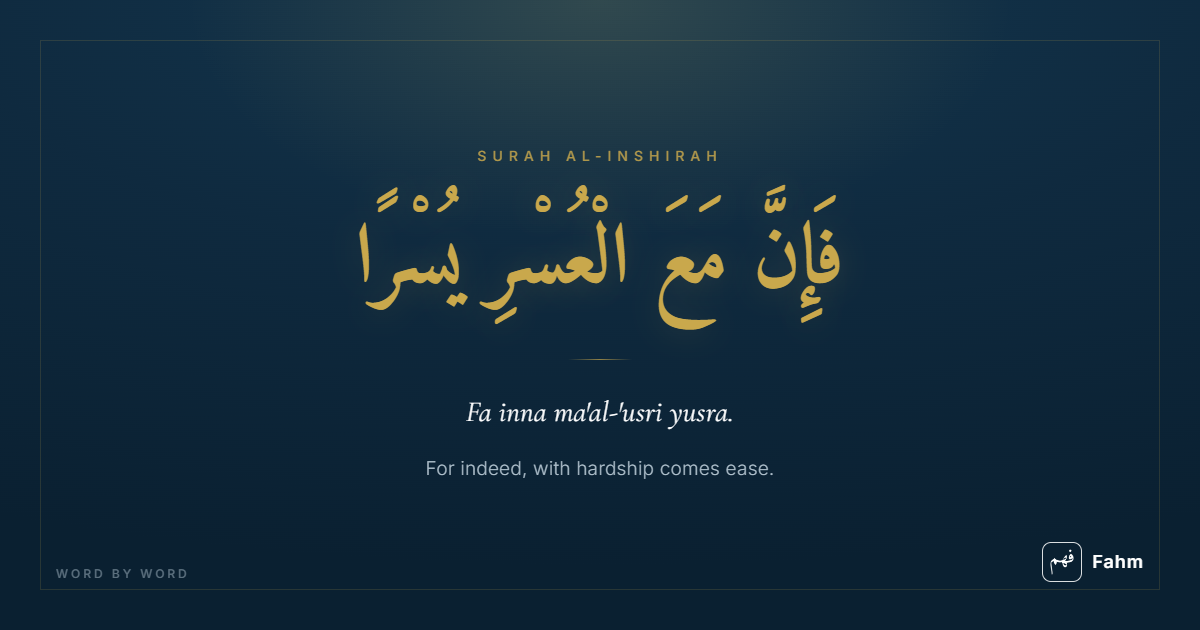
"Fa inna ma'al usri yusra."
With hardship comes ease. Most Muslims know it. Many have it memorized. Some have it on their walls.
But here is what almost nobody knows: the Arabic grammar of this verse contains a hidden precision that the translation "with hardship comes ease" does not capture — a precision that the Prophet ﷺ himself pointed to when he emerged from his house smiling and said to his companions:
"One hardship cannot overcome two eases." — Reported by Hasan al-Basri; recorded in Tafsir Ibn Kathir, 94:5-6
One hardship. Two eases. That is the mathematical reality embedded in the Arabic of Ayahs 5 and 6 of Surah Al-Inshirah — and it is not visible in any English translation.
This post is the complete Surah Al-Inshirah word by word translation — all 8 ayat, every Arabic word broken down, transliterated, and explained with tafsir from Imam Ibn Kathir and Mufti Muhammad Shafi's Maarif ul-Quran. By the end, these eight verses will carry a weight they never had before.
What Is Surah Al-Inshirah?
Surah Al-Inshirah (سُورَةُ الْإِنشِرَاح) is the 94th chapter of the Quran. It is also known as Surah Ash-Sharh (سُورَةُ الشَّرْح) — both names refer to the same surah, taken from its opening word sharh (opening, expanding). It consists of 8 ayat and 27 words — one of the shortest surahs in the Quran.
It was revealed in Makkah, during one of the most difficult periods of the Prophet's ﷺ mission — when the early Muslims were being mocked, boycotted, and persecuted by the Quraysh. The Prophet ﷺ bore the weight of prophethood, the grief of watching his companions suffer, and the constant hostility of those closest to him by blood and tribe.
This surah is Allah's direct response to that moment.
Surah Al-Inshirah is always discussed alongside Surah Ad-Duha (93). The two share the same addressee (the Prophet ﷺ directly), the same style (rhetorical questions about divine favor), the same Makkan revelation context, and the same theme (divine consolation in hardship). Some scholars have held that they form a single connected revelation — and for this reason, in prayer, many recite them together in sequence. [Source: Maarif ul-Quran, Mufti Muhammad Shafi, Surah Al-Inshirah introduction]
The Full Surah Al-Inshirah: Arabic, Transliteration, and Translation
Arabic:
أَلَمْ نَشْرَحْ لَكَ صَدْرَكَ ﴿١﴾ وَوَضَعْنَا عَنكَ وِزْرَكَ ﴿٢﴾ الَّذِي أَنقَضَ ظَهْرَكَ ﴿٣﴾ وَرَفَعْنَا لَكَ ذِكْرَكَ ﴿٤﴾ فَإِنَّ مَعَ الْعُسْرِ يُسْرًا ﴿٥﴾ إِنَّ مَعَ الْعُسْرِ يُسْرًا ﴿٦﴾ فَإِذَا فَرَغْتَ فَانصَبْ ﴿٧﴾ وَإِلَىٰ رَبِّكَ فَارْغَب ﴿٨﴾
Transliteration:
Alam nashrah laka sadrak. Wa wada'na 'anka wizrak. Alladhi anqada zahrak. Wa rafa'na laka dhikrak. Fa inna ma'al-'usri yusra. Inna ma'al-'usri yusra. Fa idha faragh-ta fansab. Wa ila Rabbika farghab.
Translation:
Did We not expand for you your chest? And We removed from you your burden which had weighed upon your back. And raised high for you your repute. For indeed, with hardship comes ease. Indeed, with hardship comes ease. So when you have finished, then stand up for worship. And to your Lord direct your longing.
Now let's go inside every word.
Ayah 1: Alam Nashrah Laka Sadrak
أَلَمْ نَشْرَحْ لَكَ صَدْرَكَ
"Did We not expand for you your chest?"
| Arabic | Transliteration | Meaning |
|---|---|---|
| أَلَمْ | Alam | Did We not / Have We not (rhetorical negative question) |
| نَشْرَحْ | Nashrah | Expand / open up / relieve |
| لَكَ | Laka | For you (singular — addressed directly to the Prophet ﷺ) |
| صَدْرَكَ | Sadrak | Your chest / your breast |
Alam — "Did We not?" — is a rhetorical question in Arabic that carries the force of a strong affirmation. When someone says "Did I not tell you this would happen?" they mean: "I did tell you, and it happened." Alam nashrah means: "We absolutely did expand it — here is a reminder of what We have already done for you." [Source: Tafseerstudy.wordpress.com, classical Arabic rhetorical analysis of 94:1]
Nashrah — from the root sh-r-h (ش-ر-ح), meaning to open, to expand, to lay out, to explain. In Arabic, the same word sharh is used when you explain a book — to open up its meaning, to illuminate what was dense or hidden. When applied to the chest (sadr), it means: We have opened your chest, expanded its capacity, removed what was constricting it, and made it spacious and receptive. [Source: Tafseerstudy.wordpress.com, Ibn Fa'ris on the root sh-r-h]
The great linguist Ibn Fa'ris (a classical Arabic scholar of the salaf) argued that sharh carries two fundamental components: the opening of something, and the illuminating of something that was previously obscure or compressed. When Allah expanded the Prophet's ﷺ chest, He did not merely relieve anxiety — He opened the capacity for divine knowledge, wisdom, patience, and the bearing of prophethood's weight.
Sadrak — your chest. Al-sadr in Quranic Arabic is the seat of the heart, the mind, and the soul simultaneously — the center of inner life. "Expansion of the chest" (sharh as-sadr) is a Quranic idiom for spiritual clarity, peace, receptivity to truth, and relief from spiritual or emotional constriction. The Quran uses the same imagery elsewhere: when Musa (عليه السلام) asked Allah for help, he said: "Rabbish-rahli sadri" — "My Lord, expand for me my chest." (Surah Ta-Ha, 20:25) The language of expansion is the language of divine enabling.
Ibn Kathir records that some authentic narrations connect the physical chest-opening miracle of the Isra to this verse — the moment when Jibreel (عليه السلام) opened the Prophet's ﷺ chest and washed his heart with zamzam as a child. Some scholars including Ibn Kathir mention this possibility. However, the majority of mufassireen — and the stronger linguistic position — hold that sharh as-sadr in this verse refers to something different and greater: the spiritual expansion that enabled him to receive prophethood and bear its weight with patience and clarity. [Source: Maarif ul-Quran, Mufti Muhammad Shafi, 94:1; Ibn Kathir, 94:1]
Ayahs 2-3: Wa Wada'na 'Anka Wizrak / Alladhi Anqada Zahrak
وَوَضَعْنَا عَنكَ وِزْرَكَ — الَّذِي أَنقَضَ ظَهْرَكَ
"And We removed from you your burden — which had weighed upon your back"
| Arabic | Transliteration | Meaning |
|---|---|---|
| وَوَضَعْنَا | Wa wada'na | And We removed / We laid down |
| عَنكَ | 'Anka | From you |
| وِزْرَكَ | Wizrak | Your burden / your heavy load |
| الَّذِي | Alladhi | Which / that which |
| أَنقَضَ | Anqada | Had weighed heavily / had made to groan |
| ظَهْرَكَ | Zahrak | Your back |
Wizrak — burden, heavy load. The root w-z-r (و-ز-ر) carries the meaning of weight that oppresses, that prevents movement, that crushes the one beneath it. Wazir (minister or vizier) comes from the same root — one who bears the weight of governance alongside the ruler.
What was this burden? The scholars offer several complementary interpretations:
The weight of the pre-Islamic period — the Prophet ﷺ had lived 40 years in the jahiliyyah (age of ignorance), witnessing shirk, oppression, and corruption, feeling its weight on his fitra (natural disposition) without yet having a way to address it.
The anxiety of the early revelation — the weight of being the recipient of divine guidance, the responsibility of conveying it, the fear of falling short.
The grief of watching his companions suffer — Abu Jahl's persecution, Bilal being tortured on the hot sand, the Prophet's ﷺ own social ostracism from his community. [Source: Tafsir Ibn Kathir, 94:2-3]
Anqada zahrak — literally "had made your back groan." Anqada is an evocative word: it describes the sound a heavy load makes on a camel's back — the creaking, the straining. Your back was being made to groan under the weight. Allah removed it.
This pair of ayahs establishes something theologically important: the relief was not future. It was past tense — wada'na (We have removed). What was weighing on the Prophet ﷺ had already been taken. The burden was gone.
Ayah 4: Wa Rafa'na Laka Dhikrak
وَرَفَعْنَا لَكَ ذِكْرَكَ
"And We raised high for you your repute"
| Arabic | Transliteration | Meaning |
|---|---|---|
| وَرَفَعْنَا | Wa rafa'na | And We raised / We elevated |
| لَكَ | Laka | For you |
| ذِكْرَكَ | Dhikrak | Your mention / your repute / your remembrance |
Rafa'na — We raised, We elevated. Rafa'a (ر-ف-ع) means to lift something to a higher position. Allah raised the Prophet's ﷺ dhikr — his mention, his remembrance — to an elevation that has no parallel in human history.
Dhikrak — your dhikr, your mention. The word dhikr (ذِكْر) is the same root as dhikrullah (remembrance of Allah) — but here it refers to the mention of the Prophet ﷺ himself.
Ibn Kathir records the explanation of Qatadah (a major companion and scholar of tafsir): "Allah raised his fame in this life and the Hereafter. There is no one who gives a sermon, declares the Testimony of Faith (Shahada), or prays a prayer (Salah) except that he proclaims it: I bear witness that there is no god worthy of worship except Allah and that Muhammad ﷺ is the Messenger of Allah." [Source: Tafsir Ibn Kathir, 94:4, citing Qatadah]
The man who was mocked in the streets of Makkah. The man whose enemies called him abtar — cut off, forgotten. The man who, at the lowest point of his mission, had perhaps 40 followers in a city that had turned against him.
Today his name is recited in the Adhan five times a day in every time zone on earth, simultaneously. It is spoken in the Tashahhud of every Muslim's prayer — the prayer we have covered word by word in this series. It appears in the Shahada that over 1.8 billion people affirm. No human name has ever been, or will ever be, mentioned as often.
This is what rafa'na laka dhikrak looks like, fourteen centuries later.
Ayahs 5-6: Fa Inna Ma'al-'Usri Yusra / Inna Ma'al-'Usri Yusra
فَإِنَّ مَعَ الْعُسْرِ يُسْرًا — إِنَّ مَعَ الْعُسْرِ يُسْرًا
"For indeed, with hardship comes ease — Indeed, with hardship comes ease"
| Arabic | Transliteration | Meaning |
|---|---|---|
| فَ | Fa | So / therefore (consequence connector) |
| إِنَّ | Inna | Indeed / certainly (emphatic — removes all doubt) |
| مَعَ | Ma'a | With (simultaneity — not "after") |
| الْعُسْرِ | Al-'usri | The hardship (definite — the specific hardship, with al-) |
| يُسْرًا | Yusran | Ease (indefinite — an ease, without al-) |
These two ayahs are the heart of the surah. And the Arabic contains a grammatical precision that the English translation cannot fully convey — one that the Prophet ﷺ himself highlighted.
The Grammar That Changes Everything
Look carefully at the two key words:
Al-'usr (الْعُسْرِ) — hardship — appears with the definite article al-. In Arabic grammar, a definite noun (ma'rifa) that is repeated refers to the same thing. So al-'usr in Ayah 5 and al-'usr in Ayah 6 are the same hardship — one specific difficulty.
Yusra (يُسْرًا) — ease — appears without the definite article, as an indefinite noun (nakira). In Arabic grammar, when an indefinite noun is repeated, each instance refers to a different thing. So the yusra of Ayah 5 and the yusra of Ayah 6 are two different eases.
The conclusion: One hardship. Two eases.
This is not a modern interpretation — it is the classical position of the scholars:
Maarif ul-Quran (Mufti Muhammad Shafi): "Grammatically, if the Arabic definite article al- is prefixed to an Arabic noun and is repeated with the same definite article al-, they refer to the same antecedent. However, if the same noun is repeated without the definite article, they refer to different antecedents... Thus it may be concluded that there is only one 'usr (hardship) and two yusr (twofold ease)." [Source: Maarif ul-Quran, Mufti Muhammad Shafi, Quran.com tafsir, 94:5-6]
Ibn Kathir records: "The Prophet ﷺ once emerged from his house in a very happy mood and gave his companions the good news based on this verse: 'One hardship cannot overcome twofold ease.'" [Source: Tafsir Ibn Kathir, 94:5-6, citing Hasan al-Basri's narration]
Mufti Muhammad Shafi adds: "One of those eases is in this world — the relief Allah grants in the dunya — the other is in the Hereafter. The hardship of this life is bracketed by ease on both sides of death." [Source: Maarif ul-Quran, 94:5-6]
The Word That Most People Miss: Ma'a
Beyond the grammar of one hardship and two eases, there is another word in this verse that carries enormous weight — and it is almost never discussed.
The verse does not say: ba'da al-'usri yusra — after hardship, ease.
It says: ma'a al-'usri yusra — with hardship, ease.
Ma'a (مَعَ) means with, alongside, simultaneously present with. It is a preposition of accompaniment — the ease is not waiting at the end of the tunnel. It is present with the hardship, traveling alongside it, already here even when the hardship is at its peak.
This single preposition transforms the promise from a future hope into a present spiritual reality. Whatever difficulty you are in right now — the ease is already with you. It may not be visible. It may not be felt. But it is ma'a — alongside, present, already there. [Source: Islamtics.com, Fa Inna Ma'al Usri Yusra Meaning; Sukoonly.com, Fa Inna Ma'al Usri Yusra; multiple tafsir sources]
Why Is It Repeated?
The two ayahs are verbatim identical except for the opening fa (so/therefore) in Ayah 5. Why does Allah repeat the promise word for word?
The classical scholars offer several explanations, all complementary:
Emphasis and certainty: Repetition in classical Arabic is one of the strongest devices for emphasis. Saying something once is a statement. Saying it twice is a vow. Saying inna ma'al usri yusra twice is Allah swearing to it by His own words — leave no room for doubt.
Two eases for two realities: As Maarif ul-Quran notes — one ease in the dunya, one in the akhirah. The repetition of yusra is not mere emphasis but the announcement of two distinct blessings.
Reassurance to a heart in pain: Ibn Kathir records that this repetition was specifically intended to reassure the Prophet ﷺ — the bad times he was passing through would not last. The second repetition drives the message home past the resistance of a grieving heart. [Source: Tafsir Ibn Kathir, 94:5-6; Maarif ul-Quran, 94:5-6]
Ayah 7: Fa Idha Faragh-ta Fansab
فَإِذَا فَرَغْتَ فَانصَبْ
"So when you have finished, then stand up for worship"
| Arabic | Transliteration | Meaning |
|---|---|---|
| فَإِذَا | Fa idha | So when |
| فَرَغْتَ | Faragh-ta | You have finished / you are free |
| فَانصَبْ | Fansab | Then stand up / then exert yourself |
Faragh-ta — from the root f-r-gh (ف-ر-غ), meaning to be empty, to be free of something, to have finished. Faragha means the task is done, the vessel is empty, the obligation is complete.
Fansab — from nasab (ن-ص-ب), meaning to erect, to set upright, to exert effort. As Maarif ul-Quran notes: "The word fansab derived from nasab means 'to be tired.' The verse signifies that one should tire oneself when carrying out acts of worship." [Source: Maarif ul-Quran, Mufti Muhammad Shafi, 94:7]
The command is: when you complete your worldly work — your preaching, your obligations, your tasks — do not rest in idleness. Stand up immediately for worship. Move from one form of service to another. The Prophet ﷺ was the busiest person alive — leading a community, receiving revelation, resolving disputes, preparing for expeditions. And Allah's command was: when that is done, stand up for worship. The two categories of activity were not opposites — they were sequential obligations, each to be pursued with full energy.
Ibn Kathir records that the scholars have understood this ayah as applying to every Muslim: "When you are finished with your worldly matters and what you need to do from them, then stand up for worship and make your heart free for it." [Source: Tafsir Ibn Kathir, 94:7]
Ayah 8: Wa Ila Rabbika Farghab
وَإِلَىٰ رَبِّكَ فَارْغَب
"And to your Lord direct your longing"
| Arabic | Transliteration | Meaning |
|---|---|---|
| وَإِلَىٰ | Wa ila | And to / and toward |
| رَبِّكَ | Rabbika | Your Lord |
| فَارْغَب | Farghab | Direct your longing / desire ardently |
Farghab — from the root r-gh-b (ر-غ-ب), meaning desire, longing, inclination toward something with hope and yearning. Raghiba is a desire that reaches toward — an active orientation of the heart. The word is distinct from mere want (arada) or love (ahaba) — it carries the sense of earnest, purposeful striving toward the object of desire.
Wa ila Rabbika — and toward your Lord. The preposition ila (toward) is used rather than fi (in) or bi (with) — it is directional. Your longing should be aimed toward Allah, moving in His direction.
The closing command of the surah is not about action — it is about the orientation of the heart. Everything that came before — the expanded chest, the removed burden, the elevated repute, the promise of ease — was leading here: direct all your longing, all your hope, all your reaching — toward your Lord.
Ibn Kathir records: "Meaning — make your du'a, your hope, and your seeking of need directed toward your Lord alone. Do not hope except in Him and do not ask except from Him." [Source: Tafsir Ibn Kathir, 94:8]
This is tawakkul (complete reliance on Allah) expressed as a command of the heart. Not merely "pray to Allah" but "orient your inner longing toward Him" — make Allah the direction your hope moves in, at all times.
The Context That Makes Every Word Heavier
Understanding when this surah was revealed makes its words land differently.
Makkah. Early Islam. The Prophet ﷺ is perhaps 40 years old. He has been receiving revelation for three to four years. His followers are a small, persecuted group. Bilal (رضي الله عنه) is being tortured on the hot sand. Families are being torn apart. The Quraysh mock the Prophet ﷺ openly in the streets. His own uncle Abu Lahab is among his most vicious opponents.
Into this moment — this specific, crushing, dark moment — Allah reveals:
Did We not expand your chest? — We have already given you what you need. We removed your burden — What was crushing you is gone. We raised your repute — Your name will be spoken until the Last Day. With hardship comes ease — Not after. With. Already present. When you finish, stand up — Never stop. Direct your longing toward your Lord — And He will be enough.
This is not a motivational poster. This is Allah speaking to His most beloved creation at his most difficult hour — and the words He chose were precise, grammatically exact, and theologically complete. [Source: Maarif ul-Quran, Mufti Muhammad Shafi, Surah Al-Inshirah overview]
Why This Surah Is for Every Muslim, Not Just the Prophet ﷺ
Surah Al-Inshirah was addressed directly to the Prophet ﷺ — the grammatical second person singular (laka — for you, sadrak — your chest) makes this clear. But the promise of Ayahs 5-6 is universal — it is stated as a principle, not as a personal promise to one individual.
When the Prophet ﷺ emerged happy and said "one hardship cannot overcome two eases" — he was not claiming the promise for himself alone. He was sharing it with his companions as a divine law about how the universe is structured: hardship always comes with ease already alongside it.
This is why Muslims recite this surah in difficult times — not as a supplication but as a reminder of an already-established divine fact. The ease is not something to be prayed for as if it might not come. It is already ma'a al-'usr — already with the hardship, by divine design, waiting to become visible.
Surah Al-Inshirah and Surah Ad-Duha: The Pair of Consolation
As mentioned above, classical scholars consider Surah Al-Inshirah and Surah Ad-Duha (93) as deeply connected — revealed around the same time, to the same addressee, with the same consoling purpose. Together they form what scholars call the "Pair of Consolation":
Surah Ad-Duha asks: Did Allah not find you an orphan and shelter you? Did He not find you lost and guide you? Did He not find you in need and enrich you? — reminding the Prophet ﷺ of past divine care.
Surah Al-Inshirah asks: Did We not expand your chest? Did We not remove your burden? Did We not raise your repute? — and then promises: with hardship comes ease.
The two surahs together address two dimensions of divine care: what Allah has already done in the past (Ad-Duha) and what is structurally true about how Allah arranges difficulty and ease (Al-Inshirah). [Source: Maarif ul-Quran, Mufti Muhammad Shafi, Surah Al-Inshirah introduction]
Frequently Asked Questions
What is the meaning of Surah Al-Inshirah? Surah Al-Inshirah (also called Surah Ash-Sharh) means "The Relief" or "The Expansion." It is the 94th chapter of the Quran, consisting of 8 ayat. It was revealed in Makkah to console the Prophet ﷺ during a period of intense persecution and difficulty. It reminds the Prophet ﷺ of three divine favors already given him — the expansion of his chest, the removal of his burden, and the elevation of his repute — and then promises that with every hardship comes ease.
What does "fa inna ma'al usri yusra" mean? It means "For indeed, with hardship comes ease." The key word is ma'a — "with," not "after." The ease is not waiting at the end of the difficulty; it is present simultaneously with the hardship. The verse appears twice (Ayahs 5 and 6) — and because al-'usr (hardship) is definite and yusra (ease) is indefinite, classical scholars conclude there is one hardship and two eases. The Prophet ﷺ himself said: "One hardship cannot overcome two eases." [Source: Tafsir Ibn Kathir, 94:5-6; Maarif ul-Quran]
Why is the verse "inna ma'al usri yusra" repeated twice? Because Arabic repetition is a device of emphasis and certainty — saying something twice in classical Arabic is a vow, not mere repetition. Additionally, because yusra (ease) is grammatically indefinite (without the definite article al-) each time it appears, classical grammar holds that the two instances of yusra refer to two different eases. The repetition communicates both emphasis and mathematical reality: two eases accompany the one hardship.
What does "alam nashrah laka sadrak" mean? "Did We not expand for you your chest?" Sharh as-sadr (expansion of the chest) in Quranic Arabic means spiritual clarity, receptivity to truth, the capacity to bear the weight of divine responsibility — the inner spaciousness that enables one to function under pressure. The rhetorical question means: "We absolutely did expand it" — it is a reminder of a favor already given.
What does "wa rafa'na laka dhikrak" mean? "And We raised high for you your repute." Dhikr here means the Prophet's ﷺ mention and remembrance. Ibn Kathir records Qatadah's explanation: no sermon is given, no Shahada is declared, no prayer is performed except that the Prophet's ﷺ name is mentioned alongside Allah's. His name is in the Adhan, the Iqamah, the Tashahhud, and the Shahada — recited billions of times daily across every time zone.
Is Surah Al-Inshirah Makki or Madani? Makki — revealed in Makkah before the Hijrah. It is classified in Juz 30 (the 30th part of the Quran) and was revealed during the early and most difficult years of the Prophet's ﷺ mission. [Source: Maarif ul-Quran; Wikipedia, Ash-Sharh]
What is the difference between Surah Al-Inshirah and Surah Ash-Sharh? They are the same surah. Al-Inshirah (from inshirah, relief/expansion) and Ash-Sharh (from sharh, opening/explaining) are two names for Surah 94, both derived from the same opening word and concept. Both names are used interchangeably in Islamic scholarship.
How Surah Al-Inshirah Connects to Fahm's Curriculum
The vocabulary of Surah Al-Inshirah links directly to words encountered across this series:
- Rabbika (your Lord) — Rabb from Al-Fatiha, Al-Falaq, An-Nas, and the Tashahhud — one root, now appearing in a new context
- Sadrak — chest — the same word sudur (plural of sadr) appears in Surah An-Nas: "alladhi yuwaswisu fi sudur an-nas" — the one who whispers in the chests of people
- Dhikr — remembrance/mention — the root appears in dhikrullah (remembrance of Allah), in the Tashahhud's description of the Prophet ﷺ, and throughout the Quran's commands to remember Allah
- Yusra / 'usr — ease / hardship — yusra from the same root as yusr (ease) in the Quranic principle "Allah intends ease for you" (Surah Al-Baqarah, 2:185), which we referenced in the last two ayat of Surah Al-Baqarah post
- Rafa'a — to raise — the same root appears in descriptions of Allah's elevation throughout the Quran, including in Surah Al-Mujadilah (58:11): "Allah raises those who have believed among you and those who were given knowledge by degrees"
The Quran's vocabulary is a web, not a list. Every root you learn in one surah surfaces in others — and the more you know, the more the Book opens up. This is what Fahm's curriculum is built around: learning the roots of your Salah is learning the roots of the Quran.
Barakallahu Feekum. May the next time hardship finds you — and it will — Surah Al-Inshirah be what you hear in your chest: ma'al usri yusra. Not after. Not eventually. With.
Start learning the words of your prayer today.
Sources
- Tafsir Ibn Kathir, Surah Al-Inshirah (Ash-Sharh), Ayahs 1-8 (Imam Ismail ibn Kathir, d. 774 AH)
- Maarif ul-Quran (Mufti Muhammad Shafi) — Surah Al-Inshirah, Ayahs 1-8, via Quran.com and IslamicStudies.info
- Surah Ta-Ha (20:25) — Musa's dua: "Rabbish-rahli sadri"
- Surah Al-Baqarah (2:185) — "Allah intends ease for you and not hardship"
- Surah Al-Mujadilah (58:11) — Allah raises those of knowledge by degrees
- Hasan al-Basri's narration — Prophet ﷺ emerging happy with the news of one hardship and two eases — recorded in Tafsir Ibn Kathir, 94:5-6
- Qatadah's explanation of rafa'na laka dhikrak — recorded in Tafsir Ibn Kathir, 94:4
- Ibn Fa'ris — classical Arabic linguistic analysis of the root sh-r-h — referenced in Tafseerstudy.wordpress.com (citing classical salaf scholarship)
- Islamtics.com — Fa Inna Ma'al Usri Yusra Meaning: Quran 94:5-6 Tafsir & Lessons (islamtics.com)
- IslamQA.info, Answer 227148 — The meaning of the expansion of the chest in Surah Al-Inshirah (islamqa.info)
- Dorar.net — Tafsir of Surah Al-Inshirah (dorar.net)