Assalamualaikum wa rahmatullahi wa barakatuhu,
Someone once came to the Prophet ﷺ and told him they had overheard a man reciting Qul Huwa Allahu Ahad in his prayer — over and over, again and again, as if he could not stop. They seemed to think the man was falling short, not reciting enough of the Quran.
The Prophet ﷺ replied:
"By Him in Whose Hand is my soul, it equals one-third of the Quran." — Sahih al-Bukhari (5013), Sahih Muslim (811)
Four verses. Twenty-three words in Arabic. One-third of the entire Quran.
Surah Al-Ikhlas is the 112th chapter of the Quran. It is one of the most recited surahs in existence — in daily prayers, in morning and evening adhkar, before sleep, in Witr. Yet for most English-speaking Muslims, what it actually says — word by word, root by root — remains largely unknown.
This post is the complete Surah Al-Ikhlas word by word translation — every Arabic word broken down, transliterated, and explained with tafsir from Imam Ibn Kathir and the companion narrations that illuminate its depth. By the end, you will understand not just what these four verses say, but why the Prophet ﷺ said reciting them once equals reciting a third of the Book of Allah.
What Is Surah Al-Ikhlas?
Surah Al-Ikhlas (سُورَةُ الْإِخْلَاص) is the 112th surah of the Quran. It consists of four short ayat and was revealed in Makkah, making it among the earliest revelations given to the Prophet ﷺ.
The name Al-Ikhlas (الْإِخْلَاص) comes from the root kh-l-s (خ-ل-ص), meaning to be pure, refined, or free of impurity. Ikhlas in Islamic practice means sincerity — the purification of one's intention to be for Allah alone. And here is something remarkable: the word ikhlas does not appear anywhere in the text of this surah. The surah was named after its effect — not its content. Whoever truly understands and believes what this surah teaches will have their faith purified of every trace of shirk.
It carries several other names used by the companions:
- Surah Al-Tawhid — the Chapter of Oneness, because it defines Tawheed in its purest form
- Surah Al-Samad — named after the divine name in Ayah 2
- Surah Al-Muqashkishah — "the one that removes disease," removing the disease of shirk from the heart
- Surah Al-Asas — the Foundation, because Tawheed is the foundation of all of Islam
[Source: Alim.org, Surah Introduction 112; Quran Academy blog on Surah Ikhlas]
Why This Surah Was Revealed: The Question They Asked
The occasion of revelation (Asbab al-Nuzul) of Surah Al-Ikhlas is established through multiple authentic narrations converging on the same essential story.
Ubayy ibn Ka'b (رضي الله عنه) reported that the polytheists of Makkah came to the Prophet ﷺ and said:
"Tell us the lineage of your Lord."
They were accustomed to their gods having genealogies — descended from other gods, connected to the earth, embedded in human-like family structures. They wanted to fit Allah into this framework. What was His origin? Who were His parents? Did He have children?
Allah answered them with four verses. [Source: Musnad Ahmad; Jami' al-Tirmidhi, 3364 — graded authentic]
On other occasions — in Madinah, when Jews asked about Allah's attributes, and when Christians raised similar questions — the Prophet ﷺ would recite the same surah in response. Ibn Kathir notes this in his tafsir: it was not that a new revelation descended each time, but that this surah had already been revealed as the definitive answer to every such question. It was revealed once, and the Prophet ﷺ returned to it again and again because it was the complete answer. [Source: Tafsir Ibn Kathir, Surah Al-Ikhlas, Introduction]
Four verses, sent to answer the most fundamental question any human being can ask: Who is God, exactly?
The Full Surah Al-Ikhlas: Arabic, Transliteration, and Translation
Arabic:
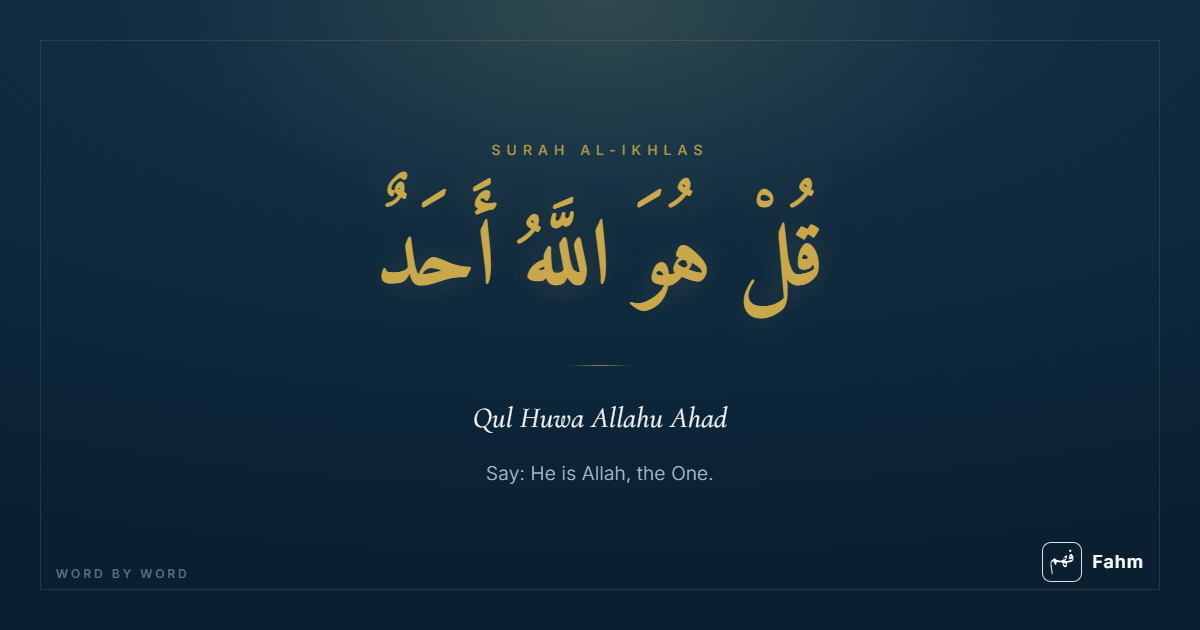
قُلْ هُوَ اللَّهُ أَحَدٌ ﴿١﴾ اللَّهُ الصَّمَدُ ﴿٢﴾ لَمْ يَلِدْ وَلَمْ يُولَدْ ﴿٣﴾ وَلَمْ يَكُن لَّهُ كُفُوًا أَحَدٌ ﴿٤﴾
Transliteration:
Qul Huwa Allahu Ahad. Allahu As-Samad. Lam yalid wa lam yulad. Wa lam yakun lahu kufuwan ahad.
Translation:
Say: He is Allah, the One. Allah, the Eternal Refuge. He neither begets nor was He begotten. And there is none comparable to Him.
Now let's go inside every word.
Ayah 1: Qul Huwa Allahu Ahad
قُلْ هُوَ اللَّهُ أَحَدٌ
"Say: He is Allah, the One"
| Arabic | Transliteration | Meaning |
|---|---|---|
| قُلْ | Qul | Say (command directed at the Prophet ﷺ, and through him, every Muslim) |
| هُوَ | Huwa | He (pronoun — establishing a distinct, independent existence) |
| اللَّهُ | Allahu | Allah (the proper, personal name of God) |
| أَحَدٌ | Ahad | The One / The Uniquely One |
Qul — the imperative "Say." Every time you recite this surah, you are responding to a divine command. The first addressee was the Prophet ﷺ himself — this was Allah's instruction to him on how to answer those who asked about His nature. But after him, every believer who recites this surah is fulfilling the same command. You are not reciting a description about Allah; you are being commanded to declare who He is.
Huwa — "He." This pronoun does something important before the name Allah is even mentioned: it establishes God as a distinct, independent, third-person reality. Not "I" (as if the surah is spoken by Allah), not "You" (as if addressed to a listener), but He — a being who exists independently of the one speaking and the one hearing. Ibn al-Qayyim notes in his commentary that huwa creates immediate theological separation: God is not a projection of human consciousness; He is a real, external, objective existence. [Source: QuranMyWay.com, Tafsir Al-Ikhlas citing Ibn al-Qayyim]
Allahu — the proper name of God in Islam. Not ilah (a generic word for deity), not Rabb (Lord), not Al-Khaliq (the Creator) — but Allah, the proper, personal name that encompasses every attribute of divinity. Ibn Kathir notes that this name is unique: it cannot be made plural, cannot be made feminine, cannot be possessed by or shared with any created being. [Source: Tafsir Ibn Kathir, Surah Al-Ikhlas, Ayah 1]
Ahad — and this is the theological heart of the entire surah.
Arabic has two words that both translate roughly as "one": Wahid and Ahad. They are not the same. Wahid means one in a sequence — the first in a series (one, two, three...). You can say there is one apple and mean there could be two. Ahad, however, signifies a oneness that is absolute, indivisible, incomparable, and completely outside any series or sequence. Ahad cannot be the first of many — it means the only, in a category entirely by itself.
Ibn Kathir emphasizes this linguistic distinction directly: the word Ahad applied absolutely is used only for Allah. No created thing can be described as ahad in this absolute sense. [Source: Tafsir Ibn Kathir, Surah Al-Ikhlas, Ayah 1] Al-Qurtubi extends this: "This verse negates all forms of multiplicity — it negates number, division, and partners." [Source: The Last Dialogue, Surah Ikhlas Timeline]
The first ayah of Surah Ikhlas declares: He exists (huwa), He is Allah (Allahu), and His oneness is of a kind that has no parallel in existence (Ahad).
Ayah 2: Allahu As-Samad
اللَّهُ الصَّمَدُ
"Allah, the Eternal Refuge"
| Arabic | Transliteration | Meaning |
|---|---|---|
| اللَّهُ | Allahu | Allah |
| الصَّمَدُ | As-Samadu | The Eternal Refuge / The Self-Sufficient Master upon whom all depend |
As-Samad (الصَّمَدُ) is one of the most difficult words in the Quran to translate into English, because it contains multiple meanings that no single English word captures. The root s-m-d (ص-م-د) carries connotations of being impenetrable, solid, aimed toward, and supreme.
Ibn Abbas (رضي الله عنه) — the companion the Prophet ﷺ specifically prayed for, saying: "O Allah, give him deep understanding of the deen and interpretation of the Quran" — gave the most comprehensive explanation of this name recorded in the scholarly tradition:
"He is the Master Who is perfect in His sovereignty, the Most Noble Who is perfect in His nobility, the Most Magnificent Who is perfect in His magnificence, the Most Forbearing Who is perfect in His forbearance, the All-Knowing Who is perfect in His knowledge, and the Most Wise Who is perfect in His wisdom. He is the One Who is perfect in all aspects of nobility and authority. These attributes are not befitting anyone other than Him." — Ibn Abbas (رضي الله عنه), as recorded by Ibn Kathir in his Tafsir [Source: Tafsir Ibn Kathir, Surah Al-Ikhlas, Ayah 2; confirmed in Utrujj.org citing Ibn Kathir]
Beyond this description of perfect attributes, As-Samad also carries the meaning: the One to whom all creation turns in its needs. Al-Tabari describes it as the most recognized meaning in Arabic: the Master toward whom everyone directs themselves when they need something. [Source: QuranGallery.app, Allahu Samad Meaning]
And a third meaning — narrated from Mujahid and also attributed to Ibn Abbas — is that As-Samad is the One who has no jawf: no hollow interior, no internal cavity. This is a profound Arabic metaphor: created beings are hollow — we have stomachs that hunger, lungs that breathe, bodies that need to be filled and sustained. Allah is musmat — solid, complete, impenetrable, needing nothing to fill Him because He is already infinite and whole. He does not eat, does not drink, does not sleep. [Source: AbdurRahman.org; Tafsir Ibn Kathir, Ayah 2]
The scholars who have verified these interpretations are unanimous: they do not contradict one another. As Shaykh Ibn 'Uthaymin concluded in his commentary on Al-'Aqeedah Al-Wasitiyyah: "We say that each of these meanings are affirmed due to the lack of contradiction among them. As-Samad is the One Who is Perfect in His Attributes, the One Whom all His creatures are in need of; they are dependent upon Him." [Source: AbdurRahman.org, citing Al-'Aqeedah Al-Wasitiyyah]
So Ayah 2 answers the implicit follow-up to Ayah 1: you say He is the Unique One — but what does that mean in practice, for us? It means He is the One to whom all of creation perpetually turns, the Self-Sufficient Master upon whom every created thing depends, and Who depends on nothing.
Ayah 3: Lam Yalid Wa Lam Yulad
لَمْ يَلِدْ وَلَمْ يُولَدْ
"He neither begets nor was He begotten"
| Arabic | Transliteration | Meaning |
|---|---|---|
| لَمْ | Lam | Did not / has not (negation in past/present) |
| يَلِدْ | yalid | Beget / give birth to / produce offspring |
| وَلَمْ | wa lam | And did not |
| يُولَدْ | yulad | Was begotten / was born / was produced |
Two negations. Two directions. Complete.
Lam yalid — He did not beget. He has no children. He did not produce offspring. This directly refutes the Christian doctrine of the Trinity and the claim that Jesus (عليه السلام) is the son of God. It also refutes the Arab polytheist belief that the angels were Allah's daughters. And it refutes any conception — across any religion — that God has literal progeny.
Wa lam yulad — and He was not begotten. He was not born. He has no origin in another. No parent, no source, no beginning from which He emerged. This refutes any theology that places God within a chain of causation — as if He came from something or someone before Him.
Together, these two negations establish Allah's absolute freedom from the defining characteristic of created life: biological reproduction. Every living thing that exists in this universe was born from something — parents, cells, stars from nebulae. Allah stands entirely outside this chain. He neither enters creation through birth nor extends Himself through offspring.
Ibn Kathir records a powerful Hadith Qudsi in his commentary on this ayah, in which Allah says: "The son of Adam has denied Me and he had no right to do so. He has cursed Me and he had no right to do so. As for his denial of Me — it is his saying, 'He will never re-create me as He created me before.' But the re-creation of him is easier for Me than his original creation. As for his cursing Me — it is his saying, 'Allah has taken a son.' But I am the One, the Self-Sufficient Master. I do not give birth, nor was I born, and there is none comparable to Me." [Source: Tafsir Ibn Kathir, Surah Al-Ikhlas, Ayah 3; Sahih al-Bukhari, 4974]
Notice that in this hadith, Allah Himself uses the language of Surah Al-Ikhlas — As-Samad, lam alid, lam ulad, lam yakun lahu kufuwan ahad — as His own self-description. This surah is not just a human description of Allah; it is Allah's own self-disclosure.
There is also a deep structural reason this ayah follows As-Samad. Ibn Kathir notes that Ayah 3 is an explanation of Ayah 2. If Allah is As-Samad — the Self-Sufficient, the One upon whom all depend and who depends on nothing — then logically, He cannot have children (for that would imply need, continuation, or biological process) and cannot have been born (for that would imply origin, dependency, and a prior cause). Ayah 3 proves Ayah 2 by eliminating what would contradict it. [Source: Tafsir Ibn Kathir, Surah Al-Ikhlas, Ayah 2-3]
Ayah 4: Wa Lam Yakun Lahu Kufuwan Ahad
وَلَمْ يَكُن لَّهُ كُفُوًا أَحَدٌ
"And there is none comparable to Him"
| Arabic | Transliteration | Meaning |
|---|---|---|
| وَلَمْ | wa lam | And not / and there has never been |
| يَكُن | yakun | There is / there exists |
| لَّهُ | lahu | For Him / to Him |
| كُفُوًا | kufuwan | An equal / a comparable / a match / an equivalent |
| أَحَدٌ | ahad | Anyone / any one at all |
The surah closes with a final, absolute, all-encompassing negation. After establishing who Allah is (Ayahs 1-2) and what He is not in terms of lineage (Ayah 3), it ends with the most comprehensive statement of all: there is not, has not been, and never will be anything comparable to Him in any sense whatsoever.
Kufuwan (كُفُوًا) — from the root k-f-a (ك-ف-أ), meaning a match, an equal, something of comparable rank or kind. In Arabic, kuf'u is used in the context of marriage compatibility — you would say two people are akfa' of each other if they are of matching social status, family, and character. By using this word for Allah, the ayah is saying: there is no one of comparable rank, no one of matching attributes, no one who belongs in the same category.
Ahad returns here — the same word from Ayah 1. In Ayah 1, it described Allah: He is the Ahad — the Uniquely One. Here, in Ayah 4, it modifies "anyone": lam yakun lahu kufuwan ahad — not even one single being anywhere in creation is comparable to Him. The surah opens and closes with Ahad, forming a perfect theological frame: He is uniquely One (Ayah 1), and nothing can be placed alongside Him as a comparison (Ayah 4).
Ibn Kathir's tafsir on this ayah connects it directly to the Quranic verse: "There is nothing like unto Him, and He is the All-Hearer, the All-Seer." (Surah Ash-Shura, 42:11) [Source: Tafsir Ibn Kathir, Surah Al-Ikhlas, Ayah 4]
This ayah also closes the loop on the polytheists' original question: "Tell us the lineage of your Lord." They wanted to fit Allah into a genealogical table — to place Him within a family tree of gods. Ayah 4 answers: there is no such table. No one sits beside Him, above Him, or beneath Him as a comparable. He cannot be placed in a row with others because there are no others in His category. The question itself was based on a false premise, and the entire surah dismantles that premise, verse by verse.
Why Surah Al-Ikhlas Equals One-Third of the Quran
The Prophet ﷺ stated this fact on multiple occasions in different wordings, all recorded in the Sahihayn:
"Is any one of you unable to recite one-third of the Quran in a night? They said: How could one of us do that, O Messenger of Allah? He said: 'Qul Huwa Allahu Ahad' is one-third of the Quran." — Sahih al-Bukhari (5013), Sahih Muslim (811)
The scholars have offered two complementary explanations for why this is the case:
First explanation — by content: The Quran covers three broad categories of knowledge: (1) Tawheed — knowledge of Allah, His names, His attributes, and His oneness; (2) Ahkam — rulings, laws, and how to live; and (3) Qisas — stories, history, and accounts of the prophets and nations. Surah Al-Ikhlas is entirely and exclusively about Tawheed. It covers the first category in its entirety. [Source: Alim.org, Surah Introduction 112; Maududi's explanation in Tafheem ul-Quran]
Second explanation — by reward: Reciting Surah Al-Ikhlas once earns the reward equivalent to reading one-third of the Quran. This is a specific divine bounty, not derivable from human calculation — Allah in His generosity assigned it this weight. This is why reciting it three times in succession earns the reward of completing the entire Quran, as the Prophet ﷺ confirmed. [Source: Sahih al-Bukhari (5013)]
Both explanations are affirmed by scholars and both are valid. The surah earns this status by content and by divine assignment of reward.
The Virtues of Surah Al-Ikhlas in Authentic Hadith
Allah loves those who love this surah: Aisha (رضي الله عنها) narrated that the Prophet ﷺ sent a man on an expedition. In every rak'ah, the man would conclude his Quranic recitation with Surah Al-Ikhlas, then add another surah. When his companions mentioned this to the Prophet ﷺ, he said: "Ask him why he does this." When asked, the man said: "Because it describes the attributes of Ar-Rahman, and I love to recite it." The Prophet ﷺ said: "Inform him that Allah loves him." [Source: Sahih al-Bukhari (774), Sahih Muslim (813)]
It equals one-third of the Quran: As established above — reciting it once equals one-third; reciting it three times in a sitting earns the reward of completing the Quran. [Source: Sahih al-Bukhari (5013)]
It is sufficient: Abu Sa'id al-Khudri (رضي الله عنه) narrated that the Prophet ﷺ said about reciting the three Quls (Al-Ikhlas, Al-Falaq, An-Nas) morning and evening: "They will suffice you against every affliction." [Source: Sunan Abu Dawud, 5082; Jami' al-Tirmidhi, recorded in Tafsir Ibn Kathir, Surah Al-Ikhlas]
Reciting ten times earns a palace in Paradise: Mu'adh ibn Anas (رضي الله عنه) reported that the Prophet ﷺ said: "Whoever recites 'Qul Huwa Allahu Ahad' ten times, Allah will build for him a palace in Paradise." [Source: Musnad Ahmad, 15631; referenced in QuranAcademy.io]
It contains Allah's Greatest Name: Buraydah ibn al-Husayb (رضي الله عنه) narrated that the Prophet ﷺ heard a man supplicating using the description in Surah Al-Ikhlas and said: "By Him in Whose Hand is my soul, he has asked Allah by His Greatest Name — the name by which He answers when called upon and gives when asked." [Source: Sunan al-Tirmidhi, 3745 — graded Sahih by al-Albani]
When Surah Al-Ikhlas Is Recited
Based on the authentic Sunnah, Surah Al-Ikhlas is specifically recommended:
In Salah: It is among the most common surahs recited after Al-Fatiha in any rak'ah, alongside other short surahs such as Surah Al-Kawthar. The Prophet ﷺ himself recited it regularly in his prayers — particularly in the two Sunnah rak'ahs before Fajr and in Witr.
Morning and evening adhkar: Recited three times each morning and evening along with Al-Falaq and An-Nas, they suffice against every affliction. [Source: Sunan Abu Dawud, 5082]
Before sleep: The Prophet ﷺ would recite the three Quls, blow into his palms, and wipe his body three times before sleeping. [Source: Sahih al-Bukhari, 5017] He would not sleep without also reciting Surah Al-Mulk, another nightly practice recorded in Sunan al-Tirmidhi.
After every fard Salah: It is narrated that the Prophet ﷺ used to recite Al-Ikhlas, Al-Falaq, and An-Nas after every obligatory prayer. [Source: Sunan al-Tirmidhi, 2903 — graded Sahih]
Three times in the morning and evening: As a protective practice confirmed by multiple narrations.
The Structure of Surah Al-Ikhlas: A Complete Definition of God in Four Lines
Looking at the surah as a whole, its four ayahs form a complete, logically structured definition:
Ayah 1: Who is He? — He is Allah, uniquely and incomparably One. Ayah 2: What is His relationship to creation? — He is As-Samad: all creation depends on Him and turns to Him; He depends on nothing. Ayah 3: What is He free from? — From lineage, from birth, from biological origin or offspring. Ayah 4: Is there anything like Him? — Absolutely not. Nothing in existence is comparable to Him in any way.
The pagans asked: "Tell us the lineage of your Lord." They wanted a genealogy. The surah gives them something else entirely: a theology. Not a family tree, but a complete definition of what God actually is — and what He is categorically not.
This is why the scholars say Surah Al-Ikhlas is the answer to every theology in human history that has distorted the concept of God. It addressed Arab polytheism (gods with genealogies), Christianity (God has a Son), certain Jewish theological schools at the time, and every form of pantheism or anthropomorphism — all with four sentences.
Frequently Asked Questions
What is the meaning of Surah Al-Ikhlas in English? Surah Al-Ikhlas means "The Chapter of Sincerity" or "The Chapter of Purity." Ikhlas in Arabic means sincere devotion purified of any shirk. The surah's name reflects its effect: whoever understands and believes its teaching will have their faith purified of polytheism completely. The four verses translate as: "Say: He is Allah, the One. Allah, the Eternal Refuge. He neither begets nor was He begotten. And there is none comparable to Him."
Why does Surah Al-Ikhlas equal one-third of the Quran? The Prophet ﷺ confirmed this in multiple authentic hadith (Sahih al-Bukhari 5013, Sahih Muslim 811). Scholars explain it in two ways: first, the Quran covers three broad categories — Tawheed, rulings, and stories — and Surah Al-Ikhlas covers the category of Tawheed entirely. Second, Allah in His generosity assigned it a reward equivalent to one-third of the Quran. Both explanations are valid.
What does Qul Huwa Allahu Ahad mean? It means "Say: He is Allah, the One." Qul is a command — "Say." Huwa means "He" — establishing God as an independent, objective reality. Allahu is the proper name of God. Ahad means uniquely, incomparably One — a oneness that admits no parallel, comparison, or sequence.
What does Allahu As-Samad mean? As-Samad is one of Allah's names, occurring only in this surah in the entire Quran. It means the Self-Sufficient Master upon whom all creation depends, who depends on nothing — the One to whom everyone turns in need, who is perfect in every attribute, and who has no internal need or dependency.
What is the difference between Ahad and Wahid? Both relate to the concept of "one," but they differ fundamentally. Wahid means one in a sequence — the first that could be followed by others. Ahad means uniquely and absolutely singular — a oneness that exists outside any sequence or comparison. In the Quran, ahad used absolutely is reserved for Allah alone.
How many times should Surah Al-Ikhlas be recited? There is no maximum. The Prophet ﷺ said reciting it three times earns the reward of completing the Quran. It is specifically recommended three times each morning and evening (with Al-Falaq and An-Nas), after every fard Salah, before sleep, and as often as desired as dhikr.
Is Surah Al-Ikhlas Makki or Madani? The majority scholarly position is that it is Makki — revealed in Makkah before the Hijrah — based on the narrations that the polytheists of Makkah asked the Prophet ﷺ about his Lord's lineage, and this surah was revealed in response. [Source: IslamWeb Fatwa 132411; Tafsir Ibn Kathir, Surah Al-Ikhlas introduction]
How Fahm Connects Al-Ikhlas to the Rest of Your Salah Vocabulary
Every word in Surah Al-Ikhlas is a root that appears throughout the Quran and throughout your daily prayer:
- Allah (اللَّه) — the name you say in every Takbeer, every Alhamdulillah, every Bismillah
- Ahad (أَحَد) — the concept of divine oneness that underpins the Shahada in the Tashahhud
- As-Samad (الصَّمَد) — appears only here in the Quran, making Al-Ikhlas the only place you encounter this name
- Lam yalid / lam yulad — the negation of lineage and birth, connecting to the Quranic theme of tanzih (declaring Allah free of imperfections) that runs through Al-Fatiha and Ayat Al-Kursi
This is what Fahm is built on: the vocabulary of Salah is the vocabulary of the Quran. When you learn the twenty-three words of Surah Al-Ikhlas, you are not just learning a short surah — you are acquiring roots and concepts that will open meaning across hundreds of verses.
Barakallahu Feekum. May Allah give you love for Surah Al-Ikhlas the way He gave love for it to the man whose habit of reciting it the Prophet ﷺ declared was an expression of Allah's love for him.
Start learning the words of your prayer today.
Sources
- Sahih al-Bukhari, Hadith 5013 (Surah Al-Ikhlas equals one-third of the Quran)
- Sahih al-Bukhari, Hadith 774 (the man who loved reciting Al-Ikhlas — Allah loves him)
- Sahih al-Bukhari, Hadith 5017 (reciting before sleep with the three Quls)
- Sahih al-Bukhari, Hadith 4974 (Hadith Qudsi — Allah's own words using the language of Al-Ikhlas)
- Sahih Muslim, Hadith 811 (Surah Al-Ikhlas equals one-third of the Quran)
- Sahih Muslim, Hadith 813 (the man who loved Al-Ikhlas — Allah loves him)
- Jami' al-Tirmidhi, Hadith 3364 (Ubayy ibn Ka'b — occasion of revelation)
- Jami' al-Tirmidhi, Hadith 3745 (Al-Ikhlas contains Allah's Greatest Name — graded Sahih by al-Albani)
- Sunan Abu Dawud, Hadith 5082 (the three Quls morning and evening suffice against every affliction)
- Musnad Ahmad, Hadith 15631 (reciting ten times earns a palace in Paradise)
- Tafsir Ibn Kathir, Surah Al-Ikhlas, Introduction and Ayahs 1–4 (Imam Ismail ibn Kathir, d. 774 AH)
- IslamWeb, Fatwa 132411 — Reason for Revelation of Surah Al-Ikhlas (islamweb.net)
- IslamQA.info, Answer 175401 — Virtues of Surah Al-Ikhlas (islamqa.info)
- Dorar.net — Tafsir of Surah Al-Ikhlas (dorar.net)
- Alim.org — Surah Introduction 112 (alim.org)