Assalamualaikum wa rahmatullahi wa barakatuhu,
Anas ibn Malik (رضي الله عنه) narrated that one day the Prophet ﷺ dozed off briefly while sitting with his companions. He awoke smiling. They asked: "What made you smile, O Messenger of Allah?"
He said: "A surah has just been revealed to me." And he recited:
"Verily, We have granted you Al-Kawthar. So pray to your Lord and sacrifice. Indeed, your enemy is the one who is cut off."
Then he asked: "Do you know what Al-Kawthar is?" They said: "Allah and His Messenger know best." He said: "It is a river that my Lord has promised me, with abundant goodness. It is a cistern where my Ummah will gather on the Day of Resurrection. Its vessels are as numerous as the stars in the sky." — Sahih Muslim (400)
The Prophet ﷺ awoke smiling. That detail matters. Because Surah Al-Kawthar was revealed at one of the lowest moments of his life — after the death of his infant son, when his enemies were publicly mocking him, calling him abtar: cut off, forgotten, a man with no legacy.
Allah's answer was not a long argument. Not a detailed rebuttal. Three verses. And a smile.
This post is the complete Surah Al-Kawthar word by word translation — every Arabic word broken down, transliterated, and explained with tafsir from Imam Ibn Kathir and the classical scholars. By the end, you will understand not only what these ten words mean, but why this is considered one of the most powerful reversals in the entire Quran.
What Is Surah Al-Kawthar?
Surah Al-Kawthar (سُورَةُ الْكَوْثَر) is the 108th chapter of the Quran. With only three ayat and ten words (excluding Bismillah), it is the shortest surah in the Quran by word count.
Its name comes from its opening ayah: Al-Kawthar — a word meaning overwhelming abundance, a river in Paradise, and every good Allah granted the Prophet ﷺ.
It is a Makki surah — revealed in Makkah — at a specific, documented moment of personal trial. Unlike many surahs that address doctrine or law, Surah Al-Kawthar is strikingly intimate: it is Allah speaking directly to His Prophet ﷺ in a moment of pain, giving him a personal promise, a command, and a verdict — all in three sentences.
Ibn Kathir records the occasion of its revelation in his Tafsir: when the Prophet's ﷺ infant sons — Al-Qasim and Abdullah — died in infancy, his enemies among the Quraysh, led by Al-'As ibn Wa'il Al-Sahmi, began publicly saying: "Leave him — he is a man who is abtar (cut off). He has no surviving sons. When he dies, he will be forgotten." [Source: Tafsir Ibn Kathir, Surah Al-Kawthar, Introduction; confirmed in Sahih Bukhari 4971]
In pre-Islamic Arab culture, a man's legacy and memory lived through his sons. Without male heirs, your name died with you. Al-'As ibn Wa'il used this social reality as a weapon. He was calling the Prophet ﷺ a dead end — a man whose message and memory would disappear.
Allah revealed three verses in response. Fourteen centuries later, the Prophet's ﷺ name is recited by 1.8 billion people every single day. His Sunnah shapes every aspect of Muslim life. And Al-'As ibn Wa'il is remembered only because of these three verses.
The Full Surah Al-Kawthar: Arabic, Transliteration, and Translation
Arabic:
إِنَّا أَعْطَيْنَاكَ الْكَوْثَرَ ﴿١﴾ فَصَلِّ لِرَبِّكَ وَانْحَرْ ﴿٢﴾ إِنَّ شَانِئَكَ هُوَ الْأَبْتَرُ ﴿٣﴾
Transliteration:
Inna a'taynakal-kawthar. Fasalli li-Rabbika wanhar. Inna shani'aka huwal-abtar.
Translation:
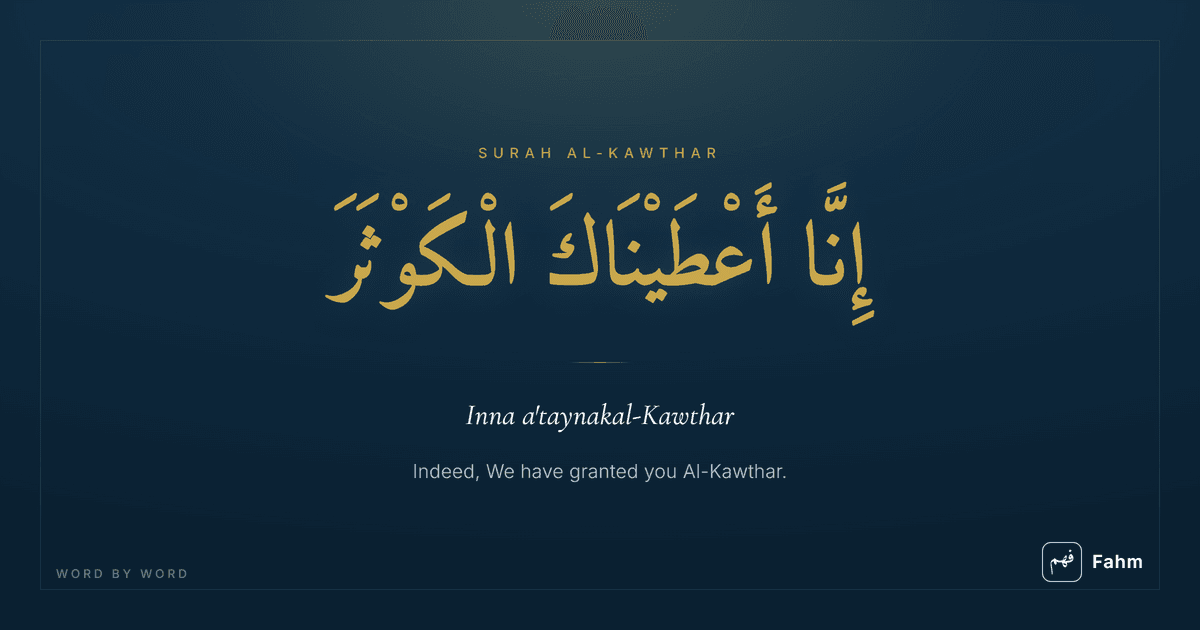
Indeed, We have granted you Al-Kawthar. So pray to your Lord and sacrifice. Indeed, your enemy is the one who is cut off.
Now let's go inside every word.
Ayah 1: Inna A'taynakal-Kawthar
إِنَّا أَعْطَيْنَاكَ الْكَوْثَرَ
"Indeed, We have granted you Al-Kawthar"
| Arabic | Transliteration | Meaning |
|---|---|---|
| إِنَّا | Inna | Indeed We / Verily We (emphatic) |
| أَعْطَيْنَاكَ | A'taynaaka | We have granted you / We have given you |
| الْكَوْثَرَ | Al-Kawthar | The overwhelming abundance / the river in Paradise |
Inna — the emphatic particle inna (إِنَّ) combined with the first-person plural pronoun na (نَا): Indeed We. This opening is an act of direct divine consolation. Allah is not speaking through an intermediary — He is addressing the Prophet ﷺ directly, personally, with the emphatic inna that in Arabic signals: this is certain, this is real, do not doubt what follows.
A'taynaaka — We have given you. The verb is past tense in Arabic (a'ta — to give), which indicates a completed, established, irrevocable act. Not "We will give" — We have given. It is already done. The gift is already granted, already real, already waiting — regardless of what his enemies say about his status or legacy. The plural We here is the royal plural (nahn al-ta'zim) — the plural of majesty — used throughout the Quran to refer to Allah's singular greatness.
Al-Kawthar — this is the theological heart of the surah, and it requires careful unpacking.
The word Al-Kawthar (الْكَوْثَر) is linguistically extraordinary. It comes from the root k-th-r (ك-ث-ر) meaning abundance, multiplicity, and great quantity — the same root as kathir (many), akthar (more), and takathur (competition for worldly abundance, condemned in Surah At-Takathur). But Al-Kawthar is built on the rare faw'al (فَوْعَل) morphological pattern — a form used in Arabic to denote an extreme and immense degree of the root's meaning. It doesn't mean abundance. It means super-abundance beyond measure. [Source: The Last Dialogue, Surah Kawthar Glossary]
Crucially, Al-Kawthar is a hapax legomenon — it appears only once in the entire Quran, in this verse. This uniqueness reinforces its uniqueness as a gift: there is no other word for it because there is no other thing like it.
What exactly is Al-Kawthar? The scholars record two complementary positions:
Position 1 — A specific river in Paradise: Ibn 'Umar narrated that the Messenger of Allah ﷺ said: "Al-Kawthar is a river in Paradise whose banks are of gold and it runs over pearls and rubies. Its water is whiter than milk and sweeter than honey." [Source: Jami' al-Tirmidhi (3361); Musnad Ahmad — authenticated; recorded in Tafsir Ibn Kathir]
The Prophet ﷺ also described it as a cistern (hawd) where his Ummah will gather on the Day of Resurrection, whose vessels are as numerous as the stars. [Source: Sahih Muslim (400), narrated by Anas ibn Malik]
Position 2 — Every good Allah granted the Prophet ﷺ: Ibn Abbas (رضي الله عنه) said: "Al-Kawthar is the abundant good which Allah gave to him." Sa'id ibn Jubayr confirmed: "The river in Paradise is part of the good which Allah bestowed upon him." [Source: Sahih al-Bukhari (4965); Tafsir Ibn Kathir]
Ibn Kathir synthesizes both positions: "The first opinion is supported by the hadith, but it does not negate the second. Because Al-Kawthar linguistically means an abundance of goodness — and the river in Paradise is the most outstanding example of that goodness." [Source: Tafsir Ibn Kathir, Surah Al-Kawthar, Ayah 1]
The comprehensive meaning of a'taynaaka Al-Kawthar therefore encompasses: the river in Paradise, the hawd on the Day of Resurrection, the Quran itself, prophethood, the Ummah of over a billion believers, intercession on the Day of Judgement, and every worldly and otherworldly good Allah granted His Prophet ﷺ.
The enemies called him abtar — cut off, with nothing to his name. Allah's response: We have already given you an abundance that has no equivalent in creation.
Ayah 2: Fasalli li-Rabbika Wanhar
فَصَلِّ لِرَبِّكَ وَانْحَرْ
"So pray to your Lord and sacrifice"
| Arabic | Transliteration | Meaning |
|---|---|---|
| فَ | Fa | So / therefore (consequence particle) |
| صَلِّ | Salli | Pray / perform Salah (imperative) |
| لِرَبِّكَ | li-Rabbika | To your Lord / for your Lord |
| وَ | Wa | And |
| انْحَرْ | Anhar | Sacrifice / slaughter (imperative) |
After the gift comes the command. The particle fa (فَ) — so / therefore — connects the two ayahs causally: because We have given you Al-Kawthar, therefore do this. The gift precedes the instruction. The abundance is granted first; the gratitude is commanded second. This sequence is itself a theological statement: Allah gives before He asks.
Salli — pray. The imperative form of Salah (صَلَاة). Here, in context, it refers specifically to the prayer performed sincerely for Allah — not for reputation, not as cultural observance, not to silence enemies. The preposition li (لِ) — for — emphasizes sincerity of direction. Pray for your Lord, not for the watching Quraysh.
Wanhar — and sacrifice. Nahar (نَحَر) specifically refers to the slaughter of a camel by cutting the throat at the base of the neck — the Arabic term distinct from dhabh (the slaughter of sheep and smaller animals). In context, it refers to the sacrifice of animals as an act of worship, specifically the udhiyyah (sacrificial offering) performed at Eid Al-Adha.
The scholars have discussed the connection between prayer (Salah) and sacrifice (nahr) in this ayah. Maarif ul-Quran explains: these are the two most physical, embodied acts of worship — one involving the whole body in surrender before Allah, the other involving the slaughter of a valuable animal as a material expression of gratitude. Together they represent the full submission of the self: the body in prayer, the wealth in sacrifice. [Source: Maarif ul-Quran, Tafsir Surah Al-Kawthar, Ayah 2, via Quran.com]
Ibn Kathir also notes the specific addition of li-Rabbika (for your Lord) is a refutation of the pre-Islamic practice of slaughtering animals in the name of idols, or sacrificing to create social reputation. The command is explicit: this is for your Lord — not for Al-'As ibn Wa'il, not for the Quraysh, not for anyone watching. [Source: Tafsir Ibn Kathir, Surah Al-Kawthar, Ayah 2]
The practical response to being called abtar — cut off, forgotten — is not to argue, not to retaliate, not to campaign for recognition. It is to turn to Allah in prayer and sacrifice. The proper response to the gift of abundance is worship, not vindication.
Ayah 3: Inna Shani'aka Huwal-Abtar
إِنَّ شَانِئَكَ هُوَ الْأَبْتَرُ
"Indeed, your enemy is the one who is cut off"
| Arabic | Transliteration | Meaning |
|---|---|---|
| إِنَّ | Inna | Indeed / Verily (emphatic — same as Ayah 1) |
| شَانِئَكَ | Shani'aka | Your enemy / the one who hates you with intense enmity |
| هُوَ | Huwa | He himself / he is (emphatic pronoun) |
| الْأَبْتَرُ | Al-Abtar | The cut off one / the truly severed |
This final ayah is one of the most structurally precise reversals in the entire Quran.
Shani'aka — your shani' — from the root sh-n-a (ش-ن-أ), meaning deep, intense personal enmity and hatred. Not a casual critic, not a mild opponent — a shani' is one who holds active, seething animosity. Ibn Kathir identifies Al-'As ibn Wa'il as the primary figure, alongside Abu Lahab, Abu Jahl, and others among the Quraysh leaders who specifically targeted the Prophet ﷺ with the abtar slur after his sons died. [Source: Tafsir Ibn Kathir, Surah Al-Kawthar, Ayah 3; Sahih al-Bukhari 4971]
Huwa — he himself. The emphatic pronoun huwa (هُوَ) is inserted before al-abtar to create a specific grammatical effect in Arabic: it restricts the predicate to the subject. Not "he is also cut off" — but "he is the one who is truly cut off." He, and not the Prophet ﷺ. The pronoun transfers the identity completely. [Source: Eaalim.com, Surah Al-Kawthar analysis]
Al-Abtar — the word the enemies threw at the Prophet ﷺ, returned to them with divine authority.
The root b-t-r (ب-ت-ر) means to cut, sever, or amputate. The word was used in pre-Islamic Arabia for an animal whose tail had been docked — and by extension, as a cruel social insult for a man who had no surviving male children, implying his lineage and name would be severed at death. [Source: The Last Dialogue, Surah Kawthar Glossary; Al-Ocean of the Quran, 108:3, citing Lane's Lexicon]
Like Al-Kawthar, the word Al-Abtar appears only once in the entire Quran — in this verse alone. It is a hapax legomenon — used once, precisely, as a divine verdict. And it is built on the af'al (أَفْعَل) grammatical pattern — a superlative form. Not merely abtar (cut off) but al-abtar (the most cut off, the definitively severed). [Source: The Last Dialogue, Surah Kawthar Glossary]
The surah takes the exact word the enemy wielded as a weapon, strips it from the Prophet ﷺ, applies it with maximum force to the one who threw it, and seals it with inna — the same emphatic particle that opened Ayah 1.
The symmetry is complete:
- Ayah 1 opens with inna: Indeed, We have given you abundance.
- Ayah 3 opens with inna: Indeed, your enemy is the truly cut off.
The same divine certainty that promises the Prophet ﷺ Al-Kawthar declares his enemies al-abtar. Both are equally final.
The historical verdict: Al-'As ibn Wa'il died as a disbeliever. His name is remembered today only because Allah mentioned him in the Quran as the Prophet's enemy. The Prophet ﷺ — the man he called abtar — has his name recited in the Tashahhud of every prayer by every Muslim on earth until the Day of Judgement, his Sunnah preserved in billions of hearts and books, his Ummah 1.8 billion strong. By any measure of legacy, lineage, and lasting memory — the reversal is total.
The Structure of Surah Al-Kawthar: Three Sentences, Complete
Despite being the shortest surah in the Quran, Al-Kawthar has a perfectly complete structure:
Ayah 1 — The Gift: Allah declares what He has already given the Prophet ﷺ. Ayah 2 — The Command: The proper response to the gift is worship directed sincerely to Allah. Ayah 3 — The Verdict: The true definition of being cut off belongs to the enemy, not the Prophet ﷺ.
The three movements — gift, gratitude, vindication — follow a logic that applies beyond the Prophet ﷺ to any believer facing injustice: when you are wronged and mocked, the response is not to chase vindication from people. Turn to Allah in worship. The verdict on who is truly cut off from good belongs to Him — and He delivers it in His own time.
The Meaning of Al-Kawthar: Two Truths, Not One
It is worth dwelling on the dual meaning of Al-Kawthar because most people know only one half of it.
The River: The Prophet ﷺ described it in multiple authentic narrations. Its banks are of gold. It flows over pearls and rubies. Its water is whiter than milk and sweeter than honey. Its vessels on the Day of Resurrection are as numerous as the stars in the sky. It is the hawd where the Ummah will gather before entering Paradise, and where those who died holding to the Sunnah will drink and never thirst again. [Source: Sahih Muslim (400), Jami' al-Tirmidhi (3361), Musnad Ahmad]
The Abundance: Ibn Abbas's comprehensive definition — "all the good Allah gave him" — encompasses: the Quran itself as the most complete and preserved revelation, the Sunnah as a living example for all time, the Ummah as the largest and most enduring religious community in history, intercession on the Day of Judgement, and the honor of being Allah's final messenger.
Ibn Kathir's synthesis is the most accurate: Al-Kawthar is the river in Paradise, and the river is one manifestation of the broader abundance that defines the word. The two meanings are not competing — they are nested. [Source: Tafsir Ibn Kathir, Surah Al-Kawthar, Ayah 1]
The Virtues and Sunnah of Reciting Surah Al-Kawthar
The Prophet ﷺ recited it in Salah: Anas ibn Malik (رضي الله عنه) narrated that the Prophet ﷺ regularly recited Surah Al-A'la and Surah Al-Kawthar in the two Sunnah rak'ahs before Fajr. [Source: Sahih Muslim (726); also in Sunan al-Nasa'i]
It was the surah being recited when revealed: The occasion of revelation (Sahih Muslim 400) itself shows the Prophet ﷺ immediately sharing it with his companions — it was not a private revelation kept for later, but one he recited and explained on the spot. This is itself a Sunnah of engagement with newly revealed verses.
Sunan of recitation: Based on the broader Sunnah of reciting from Juz Amma in optional prayers, Surah Al-Kawthar is among the recommended surahs for Sunnah rak'ahs. It is short enough to memorize in minutes for those who have not yet committed it to memory, making it an accessible surah for new Muslims and children beginning to build their Salah vocabulary.
Frequently Asked Questions
What is the meaning of Surah Al-Kawthar in English? Surah Al-Kawthar means "The Chapter of Overwhelming Abundance." Al-Kawthar is an Arabic word of extreme intensity meaning super-abundance of good — specifically a river in Paradise promised to the Prophet ﷺ, and more broadly every good Allah granted him. The surah was revealed to console the Prophet ﷺ after his enemies mocked him following the death of his infant sons.
What does Al-Kawthar mean in Arabic? Al-Kawthar comes from the root k-th-r (meaning abundance) but is built on a rare morphological pattern (faw'al) that intensifies the meaning to an extreme degree — super-abundance beyond measure. It refers to: a specific river in Paradise whose banks are of gold and whose water is sweeter than honey [Sahih Muslim 400; Jami' al-Tirmidhi 3361]; and comprehensively to all the good Allah gave the Prophet ﷺ [Sahih al-Bukhari 4965, Ibn Abbas].
What does Al-Abtar mean and why is it important? Al-Abtar comes from the root b-t-r (to cut off) and was a cruel pre-Islamic insult used against men without male heirs, implying their lineage and legacy would be severed at death. Al-'As ibn Wa'il used it against the Prophet ﷺ after his sons died. Ayah 3 takes this exact word and returns it to the enemy — declaring that it is the hater, not the Prophet ﷺ, who is truly and definitively cut off from all good. [Source: Ibn Kathir; Tafsir Ibn Abbas — Sahih al-Bukhari 4971]
Why is Surah Al-Kawthar the shortest surah in the Quran? By word count, Surah Al-Kawthar contains only ten words (excluding Bismillah), making it the shortest surah. By ayah count, it shares this distinction with Surah Al-'Asr (three ayat) and a few others. Its brevity is part of its power — three sentences deliver a complete consolation, command, and verdict.
Who was Al-'As ibn Wa'il? Al-'As ibn Wa'il Al-Sahmi was a prominent Quraysh leader and one of the strongest opponents of the Prophet ﷺ in Makkah. After the death of the Prophet's ﷺ infant sons, he publicly called him abtar — cut off, without legacy. He died as a disbeliever. His son, 'Amr ibn Al-'As, later accepted Islam, became a companion of the Prophet ﷺ, and played a defining role in the early Islamic conquests, particularly the conquest of Egypt. [Source: Tafsir Ibn Kathir; Eaalim.com historical notes]
What is the connection between Surah Al-Kawthar and the Day of Judgement? The Prophet ﷺ explained that Al-Kawthar includes a hawd (cistern) where his Ummah will gather on the Day of Resurrection to drink, never to thirst again. Those who kept to the Sunnah will drink from it; those who introduced innovations after the Prophet ﷺ will be turned away. [Source: Sahih Muslim (400); Sahih al-Bukhari (6211) — narrated by Anas ibn Malik]
Is Surah Al-Kawthar Makki or Madani? The overwhelming scholarly consensus is that it is Makki — revealed in Makkah, specifically in connection with the death of the Prophet's ﷺ sons and the subsequent mockery by Al-'As ibn Wa'il and others. This is the position of Ibn Kathir, Al-Tabari, Al-Qurtubi, and the majority of classical scholars. [Source: Tafsir Ibn Kathir, Surah Al-Kawthar Introduction]
How Surah Al-Kawthar Connects to Fahm's Curriculum
The vocabulary of Surah Al-Kawthar links directly to words you already know from the previous posts in this series:
- Salli / Salah (صَلِّ / صَلَاة) — the same root as the prayer discussed in Durood Ibrahim. Salli in Ayah 2 is the same verb used in Allahumma salli ala Muhammad.
- Rabb (رَبِّكَ) — the same Rabb from Al-Fatiha, Surah Al-Falaq, and Surah Nas. One root, one meaning, everywhere in your prayer.
- Inna (إِنَّ) — the emphatic particle appears throughout the Quran including Ayat Al-Kursi (inna lillahi wa ala Allahi raaji'oon).
- Al-Kawthar and Al-Abtar are both hapax legomena — words that appear only here, making this surah the only place in the entire Quran where you encounter them.
The Quran's vocabulary is deeply interconnected. What you learn in one surah echoes through every other. This is why Fahm's curriculum builds on core roots rather than isolated words — the same ten roots appear hundreds of times across the Book, and recognizing one instance unlocks all the others.
Barakallahu Feekum. May every recitation of Surah Al-Kawthar remind you that Allah's gifts cannot be measured by the metrics your enemies use — and that true abundance, and true legacy, belong to whoever He wills.
Start learning the words of your prayer today.
Sources
- Sahih al-Bukhari, Hadith 4965 (Ibn Abbas — Al-Kawthar is the abundant good)
- Sahih al-Bukhari, Hadith 4971 (occasion of revelation — Al-'As ibn Wa'il)
- Sahih al-Bukhari, Hadith 6211 (the hawd on the Day of Resurrection)
- Sahih Muslim, Hadith 400 (Anas ibn Malik — the Prophet ﷺ awoke smiling, the full description of Al-Kawthar)
- Sahih Muslim, Hadith 726 (the Prophet ﷺ reciting Surah Al-Kawthar in Fajr Sunnah)
- Jami' al-Tirmidhi, Hadith 3361 (description of the river Al-Kawthar — authenticated)
- Musnad Ahmad (Ibn 'Umar — Al-Kawthar: banks of gold, runs over pearls)
- Tafsir Ibn Kathir, Surah Al-Kawthar, Introduction and Ayahs 1–3 (Imam Ismail ibn Kathir, d. 774 AH)
- Maarif ul-Quran (Mufti Muhammad Shafi) — Tafsir Surah Al-Kawthar, Ayah 2, via Quran.com
- The Last Dialogue — Surah Kawthar Ultimate Dictionary: Key Arabic Terms Explained (thelastdialogue.org)
- Al-Ocean of the Quran — Al-Kawthar 108:3: The Prophecy of Al-Abtar (theoceanofthequran.org), citing Lane's Lexicon and classical tafsir
- IslamQA.info, Answer 7669 — What is Al-Kawthar? (islamqa.info)
- Dorar.net — Tafsir of Surah Al-Kawthar (dorar.net)