Assalamualaikum wa rahmatullahi wa rahmatullahi wa barakatuhu,
Ibn al-Qayyim al-Jawziyyah — one of the greatest scholars in Islamic history — made a remarkable statement about the last two surahs of the Quran:
"The effectiveness of these surahs is great to repel magic, evil eye, and the rest of the evils. The need of a slave for these two surahs is greater than his need for himself, his food, his drink, and his clothing." — Ibn al-Qayyim, Zad al-Ma'ad [Source: SincerityRuqyah.co.uk, citing Zad al-Ma'ad]
Greater than food. Greater than water. Greater than clothing.
Surah Al-Falaq is the 113th surah of the Quran and the first of the two Mu'awwidhatayn — the Pair of Protections. Together with Surah An-Nas, it forms the final two chapters of the Book of Allah, placed at the very end not by coincidence but because they are the last defense, the protective seal, the divine shield that closes the Quran.
Most Muslims have memorized Surah Al-Falaq. Most recite it daily — in morning and evening adhkar, before sleep, after every fard Salah. Yet very few know what every word actually means: what falaq is, why the Lord of the dawn is specifically invoked, what the four evils are and why they are listed in this particular order, and what the extraordinary story is behind this surah's revelation.
This post is the complete Surah Al-Falaq word by word translation — every Arabic word, transliterated and explained, with tafsir from Imam Ibn Kathir and Ibn al-Qayyim al-Jawziyyah, grounded in authentic hadith.
What Is Surah Al-Falaq?
Surah Al-Falaq (سُورَةُ الْفَلَق) is the 113th chapter of the Quran. It consists of five ayat and is considered by the majority of scholars to be Madani — revealed in Madinah — specifically in connection with one of the most remarkable and well-authenticated events in the Seerah of the Prophet ﷺ.
Its name comes from the first ayah: Al-Falaq (الْفَلَق) — the Daybreak, or the Dawn. The Lord of Al-Falaq is the One who splits the darkness to bring light.
Together with Surah An-Nas (chapter 114), it is known as:
- Al-Mu'awwidhatayn (الْمُعَوِّذَتَانِ) — The Two Surahs of Seeking Refuge, or The Pair of Protections
- Al-Muqashqishataan — the Two that Remove Disease (from the heart and the body)
The Prophet ﷺ described their extraordinary status to 'Uqbah ibn 'Amir (رضي الله عنه):
"Do you know what kind of verses have been revealed to me tonight? These are matchless verses — A'udhu bi-Rabbil-Falaq and A'udhu bi-Rabbin-Nas." — Sahih Muslim (814); Sunan al-Nasa'i
The Story Behind the Revelation: The Magic of Labid ibn Al-A'sam
The occasion of revelation (Asbab al-Nuzul) of Surah Al-Falaq — together with Surah An-Nas — is one of the most extensively authenticated events in the entire hadith corpus. It is narrated by Aisha (رضي الله عنها) and recorded in both Sahih al-Bukhari and Sahih Muslim.
After the peace treaty of Hudaybiyyah, when the Prophet ﷺ had returned to Madinah, a man named Labid ibn Al-A'sam — from the Banu Zurayq tribe, known as a hypocrite — worked black magic against the Prophet ﷺ. Through a Jewish boy who served the Prophet ﷺ, Labid obtained strands of the Prophet's ﷺ hair from his comb and some comb teeth. He tied eleven knots on a string, stuck a needle into each knot, and placed the spell inside the spathe of a male date palm tree, burying it under a stone in a well called Bi'r Dharwan.
The Prophet ﷺ began experiencing the effects — a confusion in which he would imagine he had done something he had not done. He said to Aisha (رضي الله عنها):
"I asked my Lord and He showed me. Two persons came — one sat near my head and the other near my legs. The one near my head asked the other: 'What is wrong with this man?' He said: 'He is under a spell.' He asked: 'Who bewitched him?' He said: 'Labid ibn Al-A'sam, from the Banu Zurayq tribe. He used a comb, hair, and the spathe of a male palm tree, buried in the well of Dharwan.'" — Sahih al-Bukhari (5765), Sahih Muslim (2189); narrated by Aisha (رضي الله عنها)
Jibreel (عليه السلام) then descended with Surah Al-Falaq and Surah An-Nas — eleven verses total, one for each knot. As the Prophet ﷺ recited each verse, one knot came undone. When all eleven verses were recited, all eleven knots were untied, and he ﷺ was cured.
Ibn Kathir narrates this in full in his Tafsir, affirming the authentic chain of transmission. [Source: Tafsir Ibn Kathir, Surah Al-Falaq, Introduction; Sahih al-Bukhari 5765, 5766]
This is not a peripheral story. It is the direct context of revelation. Every time you recite Surah Al-Falaq, you are reciting the verses that Allah sent to heal His Prophet ﷺ from black magic, one verse untying one knot.
The Full Surah Al-Falaq: Arabic, Transliteration, and Translation
Arabic:
قُلْ أَعُوذُ بِرَبِّ الْفَلَقِ ﴿١﴾ مِن شَرِّ مَا خَلَقَ ﴿٢﴾ وَمِن شَرِّ غَاسِقٍ إِذَا وَقَبَ ﴿٣﴾ وَمِن شَرِّ النَّفَّاثَاتِ فِي الْعُقَدِ ﴿٤﴾ وَمِن شَرِّ حَاسِدٍ إِذَا حَسَدَ ﴿٥﴾
Transliteration:
Qul a'udhu bi-Rabbil-falaq. Min sharri ma khalaq. Wa min sharri ghasiqin idha waqab. Wa min sharrin-naffathati fil-'uqad. Wa min sharri hasidin idha hasad.
Translation:
Say: I seek refuge with the Lord of the Daybreak, from the evil of what He has created, and from the evil of darkness when it settles, and from the evil of the blowers in knots, and from the evil of an envier when he envies.
Now let's go inside every word.
Ayah 1: Qul A'udhu bi-Rabbil-Falaq
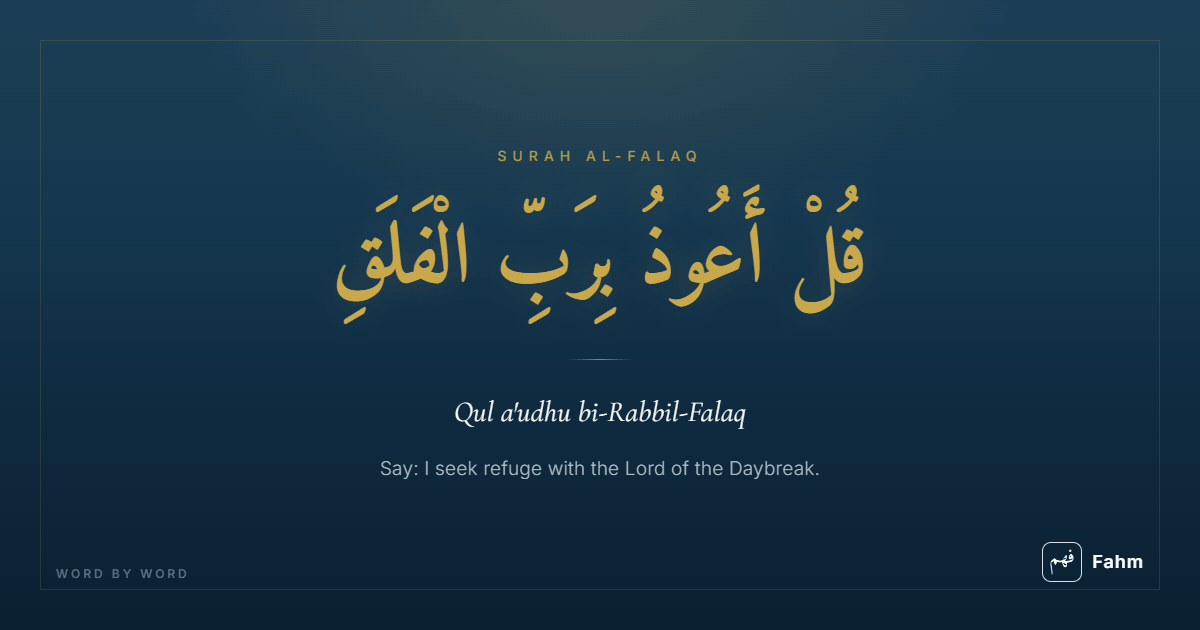
قُلْ أَعُوذُ بِرَبِّ الْفَلَقِ
"Say: I seek refuge with the Lord of the Daybreak"
| Arabic | Transliteration | Meaning |
|---|---|---|
| قُلْ | Qul | Say (divine command) |
| أَعُوذُ | A'udhu | I seek refuge / I take shelter |
| بِ | bi | With / in |
| رَبِّ | Rabbi | Lord / Master / Sustainer |
| الْفَلَقِ | Al-falaq | The Daybreak / the Dawn |
Qul — the same opening command as Surah Al-Ikhlas. You are commanded to speak this declaration — not merely to think it, but to say it. Seeking refuge with Allah is an active, verbal, conscious act.
A'udhu — "I seek refuge." The root '-w-dh (ع-و-ذ) means to flee to something for shelter, to hold fast to it for protection. The image in classical Arabic is of an animal pressing itself against a rock, a cave wall, or a larger creature for protection from a predator. When you say a'udhu, you are pressing yourself against Allah — placing Him between you and everything that would harm you. Ibn Kathir notes that this verb implies complete dependence: you are not asking for a weapon to fight with; you are fleeing to the One who cannot be overcome. [Source: Tafsir Ibn Kathir, Surah Al-Falaq, Ayah 1]
Rabbi Al-Falaq — the Lord of the Daybreak. There is a scholarly difference of opinion on the precise meaning of Al-Falaq:
- Ibn Jarir al-Tabari and Imam al-Bukhari held that Falaq means the morning — the breaking of dawn, the cleaving of darkness by light. This is the most widely accepted position. [Source: SunnahOnline.com, Tafsir Al-Falaq]
- Ibn Abbas (رضي الله عنه) said Falaq means all of creation — that which Allah splits and brings forth, encompassing everything He has created.
- Ka'b al-Ahbar said Falaq refers to a pit in Hell whose intensity of heat causes all of Hell's inhabitants to cry out when its gate is opened.
Ibn Kathir covers all three positions and inclines toward the first — the morning — as the most linguistically and contextually supported. [Source: Tafsir Ibn Kathir, Surah Al-Falaq, Ayah 1]
The choice of the Lord of the Daybreak as the specific title of Allah invoked here carries deep meaning. Ibn al-Qayyim explains: "The secret behind seeking refuge with the Lord of the Dawn becomes clear — the dawn represents the beginning of the day and the appearance of light which repels the armies of darkness and the evil elements of the night." [Source: QuranMyWay.com, Tafsir Al-Falaq, citing Ibn al-Qayyim] You are seeking refuge with the One who controls the very moment when darkness yields to light — the ultimate symbol of divine authority over all forms of harm.
Ayah 2: Min Sharri Ma Khalaq
مِن شَرِّ مَا خَلَقَ
"From the evil of what He has created"
| Arabic | Transliteration | Meaning |
|---|---|---|
| مِن | Min | From |
| شَرِّ | Sharri | The evil / the harm |
| مَا | Ma | What / that which |
| خَلَقَ | Khalaq | He has created |
This ayah is the broadest refuge: from the evil of everything Allah has created. Not some things. Not most things. Everything. Thabit al-Bunani and Imam al-Hasan al-Basri both identified the scope: this includes Hell, Iblis and his offspring, and every created entity capable of harm. [Source: Tafsir Ibn Kathir, Surah Al-Falaq, Ayah 2, citing both companions]
Ma khalaq — "what He has created" — includes human souls. Ibn al-Qayyim identifies two fundamental types of evil that can befall a person: evil that originates from outside the person — such as the harm from other creatures, magic, and envy — and evil that originates from within — from one's own nafs (soul). He connects this to Surah Yusuf (12:53): "Indeed, the soul is inclined to evil, except when my Lord bestows His Mercy." [Source: QuranMyWay.com, Tafsir Al-Falaq, citing Ibn al-Qayyim]
Why does the surah begin with this general refuge before specifying three particular evils in the next three ayat? Because the general covers everything the specific mentions, and more. Ayah 2 is the umbrella; Ayahs 3-5 are the specific dangers named because they were the most relevant — darkness, magic, and envy — and because they correspond directly to the eleven knots of Labid ibn Al-A'sam's spell.
Ayah 3: Wa Min Sharri Ghasiqin Idha Waqab
وَمِن شَرِّ غَاسِقٍ إِذَا وَقَبَ
"And from the evil of darkness when it settles"
| Arabic | Transliteration | Meaning |
|---|---|---|
| وَمِن شَرِّ | Wa min sharri | And from the evil of |
| غَاسِقٍ | Ghasiqin | Darkness / the darkening night |
| إِذَا | Idha | When |
| وَقَبَ | Waqab | It settles / it penetrates / it completely overspreads |
Ghasiq comes from ghasaq — to become dark, or intensely dark. Ibn Abbas (رضي الله عنه), al-Hasan al-Basri, and Mujahid all explained ghasiq as referring to the night. The verb waqaba means for darkness to overspread completely and intensely — not just the onset of night, but when it has fully settled, when the darkness is at its deepest. [Source: Tafsir Ibn Kathir, Surah Al-Falaq, Ayah 3, citing all three companions]
Why specifically the deep of night? The scholars explain this practically: nighttime is when the forces of harm are at their most active. Ibn Kathir notes: "This is the time when jinn, shayateen, harmful insects, animals, and reptiles appear. Thieves and robbers emerge at this time. Enemies attack at this time. Black magic has its worst effect when darkness is at its most intense." [Source: Tafsir Ibn Kathir, Surah Al-Falaq, Ayah 3]
There is also a narration from Aisha (رضي الله عنها) in which the Prophet ﷺ pointed to the moon rising on a particular night and said: "This is the Ghasiq when it waqab." [Source: Sunan al-Tirmidhi, 3366; graded Hasan] Some scholars have taken this narration to indicate that ghasiq can also refer to the moon — specifically when it rises full and bright, a night when its light is maximum, connected in Arab tradition with the prevalence of certain harms and the thinning of the boundary between the world and spiritual forces.
Ibn al-Qayyim adds a beautiful observation: the dawn invoked in Ayah 1 as Allah's title is the polar opposite of the deep night sought refuge from in Ayah 3. The surah moves between the two extremes — light and darkness — establishing Allah as the Lord who controls both, and whose protection covers both. [Source: QuranMyWay.com, Tafsir Al-Falaq, citing Ibn al-Qayyim]
Ayah 4: Wa Min Sharrin-Naffathati Fil-'Uqad
وَمِن شَرِّ النَّفَّاثَاتِ فِي الْعُقَدِ
"And from the evil of the blowers in knots"
| Arabic | Transliteration | Meaning |
|---|---|---|
| وَمِن شَرِّ | Wa min sharri | And from the evil of |
| النَّفَّاثَاتِ | An-naffathati | The blowers (intensive plural form) |
| فِي | Fi | In / upon |
| الْعُقَدِ | Al-'uqad | The knots (plural of 'uqdah) |
This is the most specific ayah in the surah — and the one most directly connected to the story of its revelation.
An-Naffathat — from nafth, meaning to blow with saliva, specifically the act of blowing while incanting a spell. The fa'ala intensive pattern (naffathat vs. nafithat) indicates someone who does this repeatedly, habitually, with intention. These are not accidental blowers — they are those who blow for the purpose of magic.
Al-'Uqad — the plural of 'uqdah, meaning a knot. In the practice of sihr (black magic), knots are tied in string or thread while magical incantations are recited and blown upon, binding the spell into physical form. Labid ibn Al-A'sam tied eleven such knots. Each of the eleven verses of Al-Mu'awwidhatayn untied one.
The feminine plural form (an-naffathat) generated scholarly discussion. Maarif ul-Quran explains two positions: first, that the pre-adjectival noun is nufus (souls), making the verse apply to any soul — male or female — that practices magic; second, that women are specifically mentioned because women were culturally known as more frequent practitioners of this type of magic in the Arabian context of revelation, or because Labid ibn Al-A'sam specifically had his daughters assist him in the act. [Source: Tafsir Ibn Kathir via Maarif ul-Quran, Surah Al-Falaq, Ayah 4; Quran.com Maarif tafsir]
Al-Qurtubi adds the critical legal dimension: the act of blowing on knots for magical purposes constitutes sihr — sorcery — which is classified as a form of shirk (associating with Allah) and is among the seven destructive sins (al-mubiqat) the Prophet ﷺ warned against. [Source: QuranGallery.app, Naffathat Fil Uqad Meaning, citing Al-Qurtubi]
This ayah confirms that black magic is real, that it can affect people, and that the divine antidote to it is the recitation of these verses — which healed the Prophet ﷺ himself.
Ayah 5: Wa Min Sharri Hasidin Idha Hasad
وَمِن شَرِّ حَاسِدٍ إِذَا حَسَدَ
"And from the evil of an envier when he envies"
| Arabic | Transliteration | Meaning |
|---|---|---|
| وَمِن شَرِّ | Wa min sharri | And from the evil of |
| حَاسِدٍ | Hasidin | An envier / a person who envies |
| إِذَا | Idha | When |
| حَسَدَ | Hasad | He envies / acts upon his envy |
The surah closes with what Ibn al-Qayyim calls the most comprehensive and dangerous evil of all — hasad.
Hasad (حَسَد) — envy — is defined by the scholars as: the desire for a blessing to be removed from another person. It is not merely wishing for the same blessing oneself (that is ghibtah, which is permissible). Hasad is the active desire to see someone else's blessing taken away. Al-Qurtubi notes: "Hasad is the first sin committed in the heavens — Iblis was jealous of Adam — and the first sin committed on earth — Qabil was jealous of his brother Habil." [Source: QuranGallery.app, Protection from Envy Surah Al-Falaq 113:5, citing Al-Qurtubi]
Idha hasad — "when he envies." The word idha (when) is critical. The refuge sought is not from envy itself sitting dormant in someone's heart — it is from the envy when it is acted upon, when it manifests through speech, through action, through the evil eye. Al-Wasit and other scholars explain: the internal disease of hasad becomes an external evil when it crosses from feeling into expression. That is the moment the surah guards against. [Source: QuranGallery.app, citing Al-Wasit and As-Sa'di]
Ibn al-Qayyim explains the relationship between envy (hasad) and the evil eye ('ayn) with precision: "Every possessor of the evil eye is jealous — but not every jealous person possesses the evil eye. Since jealousy is the general category and the evil eye is specific, seeking refuge from jealousy includes seeking refuge from the evil eye." [Source: QuranMyWay.com, Tafsir Al-Falaq, citing Ibn al-Qayyim; confirmed in PreciousGemsFromTheQuranAndSunnah.wordpress.com citing Zad al-Ma'ad]
In other words: by seeking refuge from the envier, Ayah 5 simultaneously encompasses the evil eye — making it the single most comprehensive protection in the surah. The Prophet ﷺ confirmed the reality of the evil eye:
"The effect of the evil eye is real. If there were anything that could overtake divine decree, it would be the evil eye." — Sahih Muslim (2188); narrated by Ibn Abbas
The Four Evils: Why This Specific Order?
Looking at the five ayat as a whole, a beautiful progression emerges. Ayah 1 establishes who you are fleeing to. Ayahs 2-5 name what you are fleeing from — in expanding order of intimacy:
Ayah 2: The evil of all creation — the widest category, everything Allah has made. Ayah 3: The evil of darkness — a natural phenomenon, external and environmental. Ayah 4: The evil of magic — a deliberate, planned, hidden human act. Ayah 5: The evil of envy — an internal spiritual disease that produces external harm.
The progression moves from the cosmic (all creation) to the environmental (darkness) to the social (magic) to the personal (envy). The final evil — hasad — is the most intimate and most dangerous because it originates within a human heart and can operate invisibly, without physical contact, affecting its target through the very air between them.
Ibn al-Qayyim identifies these as the two fundamental categories of evil: that which comes from the physical world (darkness, environmental forces) and that which comes from corrupted human souls (magic, envy). The surah addresses both completely. [Source: QuranMyWay.com, Tafsir Al-Falaq, citing Ibn al-Qayyim's two categories]
The Virtues of Surah Al-Falaq and Al-Mu'awwidhatayn
The Prophet ﷺ called them matchless: "Do you know what verses have been revealed to me tonight? These are matchless verses — 'A'udhu bi-Rabbil-Falaq' and 'A'udhu bi-Rabbin-Nas.'" [Source: Sahih Muslim (814); Sunan al-Nasa'i — narrated by 'Uqbah ibn 'Amir]
Before sleep: Aisha (رضي الله عنها) narrated: "Whenever the Prophet ﷺ went to bed every night, he used to cup his hands together and blow over them after reciting Surah Al-Ikhlas, Surah Al-Falaq, and Surah An-Nas, and then rub his hands over whatever parts of his body he was able to rub, starting with his head, face, and the front of his body." [Source: Sahih al-Bukhari (5017)]
Morning and evening — sufficient against every affliction: Abu Sa'id al-Khudri (رضي الله عنه) narrated that the Prophet ﷺ said: "Recite 'Qul Huwa Allahu Ahad' and the Mu'awwidhatayn in the morning and evening, three times each — they will suffice you against every affliction." [Source: Sunan Abu Dawud (5082); Jami' al-Tirmidhi — graded Hasan]
After every fard Salah: 'Uqbah ibn 'Amir (رضي الله عنه) narrated that the Prophet ﷺ instructed him to recite the Mu'awwidhatayn after every obligatory prayer. [Source: Sunan al-Nasa'i (1336); Sunan Abu Dawud (1523) — graded Sahih]
Ibn al-Qayyim's verdict: "The effectiveness of these surahs is great to repel magic, evil eye, and the rest of the evils. The need of a slave for these two surahs is greater than his need for himself, his food, his drink, and his clothing." [Source: Ibn al-Qayyim, Zad al-Ma'ad]
When to Recite Surah Al-Falaq
Based on the authentic Sunnah, Surah Al-Falaq is specifically recommended at the following times:
Before sleep — recite Al-Ikhlas, Al-Falaq, and An-Nas, blow into cupped hands, and wipe the body three times. [Sahih al-Bukhari, 5017]
Morning and evening adhkar — three times each, together with Al-Ikhlas and An-Nas. [Sunan Abu Dawud, 5082]
After every fard Salah — once after each of the five daily prayers. [Sunan al-Nasa'i, 1336]
As ruqyah — for spiritual healing, the Prophet ﷺ used these verses to cure himself from the magic of Labid ibn Al-A'sam. Reciting them over water and drinking it, or blowing them over someone afflicted, is an established Prophetic practice.
When feeling fear or unease — the Prophet ﷺ used to recite them in times of distress and illness.
Frequently Asked Questions
What is the meaning of Surah Al-Falaq in English? Surah Al-Falaq means "The Chapter of the Daybreak" or "The Chapter of the Dawn." Al-Falaq refers to the breaking of dawn — the moment Allah cleaves darkness with light. The five verses ask for Allah's protection as Lord of the daybreak from four specific categories of evil: all created harm, the deep of night, black magic, and the evil of enviers.
What is Al-Mu'awwidhatayn? Al-Mu'awwidhatayn (الْمُعَوِّذَتَانِ) means "The Two Surahs of Seeking Refuge" or "The Pair of Protections." It refers to Surah Al-Falaq (chapter 113) and Surah An-Nas (chapter 114) together. They are always recited as a pair and share the same protection theme.
Why was Surah Al-Falaq revealed? It was revealed in Madinah when the Prophet ﷺ was afflicted by the black magic of Labid ibn Al-A'sam, who tied eleven knots on a string buried in a well. Allah revealed eleven verses — five in Surah Al-Falaq and six in Surah An-Nas — and as the Prophet ﷺ recited each verse, one knot came undone until he was completely cured. [Source: Sahih al-Bukhari 5765, Sahih Muslim 2189]
What does Ghasiq mean in Surah Al-Falaq? Ghasiq refers to the darkness of the night when it fully settles and overspread — the deep of night. Ibn Abbas, al-Hasan al-Basri, and Mujahid all explained it as the night. Some scholars also interpret it as the moon based on a narration from the Prophet ﷺ. [Source: Tafsir Ibn Kathir, Ayah 3]
What are the naffathat fil uqad? They are those who blow on knots as an act of sorcery or black magic — tying knots in string, reciting incantations, and blowing on each knot to cast a spell. This was the exact method Labid ibn Al-A'sam used against the Prophet ﷺ. [Source: Tafsir Ibn Kathir, Ayah 4]
What is the difference between hasad and the evil eye? Ibn al-Qayyim explains: "Every possessor of the evil eye is jealous, but not every jealous person possesses the evil eye." Hasad is the general category — the internal desire for someone's blessing to be removed. The evil eye ('ayn) is a specific manifestation where that envy causes physical or spiritual harm through a person's gaze. By seeking refuge from the haasid (envier), Ayah 5 protects against both. [Source: Zad al-Ma'ad, Ibn al-Qayyim]
Is the evil eye real in Islam? Yes — confirmed by the Prophet ﷺ in authentic hadith: "The effect of the evil eye is real. If there were anything that could overtake divine decree, it would be the evil eye." [Sahih Muslim, 2188] Surah Al-Falaq, Ayah 5 is the divine protection from it.
How Surah Al-Falaq Connects to Fahm's Curriculum
Every word in Surah Al-Falaq is a root that deepens your understanding of Quranic Arabic:
- Rabbi (رَبِّ) — the same word from Al-Fatiha's Rabbil-'Alamin. Knowing Rabb in Al-Fatiha unlocks it immediately here.
- Khalaq (خَلَقَ) — to create. The root kh-l-q appears throughout the Quran in descriptions of Allah as Creator.
- Sharr (شَرّ) — evil, harm. Appears in dozens of Quranic contexts including dua and protection verses.
- Hasad (حَسَد) — envy. Appears in the story of Yusuf, in Surah Al-Baqarah's discussion of the People of the Book, and throughout the Quran's moral framework.
This is Fahm's core insight: the vocabulary of your daily prayers — Al-Fatiha, Ayat Al-Kursi, the Tashahhud, the Mu'awwidhatayn — is the vocabulary of the Quran. Learning these words is not just learning to understand your prayer. It is building the foundation that unlocks the entire Book.
Barakallahu Feekum. May Surah Al-Falaq — recited together with Surah An-Nas as the Mu'awwidhatayn — be a daily shield for you, your family, and every person you love, and may Allah protect you from every evil it names.
Start learning the words of your prayer today.
Sources
- Sahih al-Bukhari, Hadith 5765 (Aisha — the magic of Labid ibn Al-A'sam, full narration)
- Sahih al-Bukhari, Hadith 5766 (parallel narration of the same event)
- Sahih al-Bukhari, Hadith 5017 (reciting Al-Ikhlas, Al-Falaq, An-Nas before sleep)
- Sahih Muslim, Hadith 2189 (Aisha — the magic incident)
- Sahih Muslim, Hadith 2188 (Ibn Abbas — the evil eye is real)
- Sahih Muslim, Hadith 814 ('Uqbah ibn 'Amir — the Prophet's description of the Mu'awwidhatayn as matchless)
- Sunan Abu Dawud, Hadith 5082 (reciting three times morning and evening, sufficient against every affliction)
- Sunan al-Nasa'i, Hadith 1336 (reciting after every fard Salah)
- Sunan al-Tirmidhi, Hadith 3366 (the moon narration for Ghasiq — graded Hasan)
- Tafsir Ibn Kathir, Surah Al-Falaq, Introduction and Ayahs 1–5 (Imam Ismail ibn Kathir, d. 774 AH)
- Ibn al-Qayyim al-Jawziyyah, Zad al-Ma'ad — on the two types of evil, the evil eye, and the need for the Mu'awwidhatayn
- Maarif ul-Quran (Mufti Muhammad Shafi) — Tafsir of Surah Al-Falaq, via Quran.com
- SunnahOnline.com — Tafsir of Chapter 113: Surah Al-Falaq (sunnahonline.com)
- IslamQA.info, Answer 13792 — Is the evil eye real and what is the remedy? (islamqa.info)
- Dorar.net — Tafsir of Surah Al-Falaq (dorar.net)