Assalamualaikum wa rahmatullahi wa barakatuhu,
Surah Al-Falaq sought refuge from four external evils — darkness, magic, envy, and the harm of creation. It asked for protection from what comes at you from the outside world.
Surah Nas (also written as Surah Al-Naas, Surah Naas, Surat Annas, and Suratul Nas) takes that protection one step deeper. It seeks refuge from an enemy that doesn't knock on your door or come at you in the dark. It seeks refuge from an enemy that is already inside — already whispering, already working, already retreating and returning, invisibly, in the space between your thoughts.
That enemy is Al-Waswas Al-Khannas — the retreating whisperer. And the fact that the Quran ends with this specific protection is not an accident.
Surah Nas is the 114th and final surah of the Quran — the last word, the closing seal, the final protection Allah placed at the end of His Book. It is six ayat, invoking three names of Allah against a single adversary. And the scholars note something extraordinary about this structure: while Surah Al-Falaq names four evils and uses one divine attribute, Surah Nas invokes three divine attributes to protect against just one evil. The ratio tells you how dangerous that one evil is.
This post is the complete Surah Nas word by word translation — every Arabic word broken down, transliterated, and explained with tafsir from Imam Ibn Kathir and Maarif ul-Quran, grounded in authentic hadith. By the end, you will understand exactly what you are saying — and exactly who you are protecting yourself from.
What Is Surah Nas?
Surah An-Nas (سُورَةُ النَّاس) is the 114th and final chapter of the Quran. Its name means "The People" or "Mankind" — An-Nas (النَّاس) being the Arabic word for people, humanity, or mankind. The word nas appears six times in these six ayat — once in each verse — making the surah a sustained declaration of who Allah is to mankind, and what threatens mankind from within.
It is the second of the Al-Mu'awwidhatayn — the Pair of Protections — alongside Surah Al-Falaq. Together they are the closing two chapters of the Quran, always recited as a pair, forming a complete protection against external evil (Al-Falaq) and internal evil (An-Nas).
The scholarly majority holds that Surah Nas was revealed in Madinah, together with Surah Al-Falaq, in connection with the incident of Labid ibn Al-A'sam's magic against the Prophet ﷺ. The same eleven verses — five in Al-Falaq, six in An-Nas — untied the eleven knots, one verse per knot.
The surah carries several names used by the early Muslims:
- Surah Al-Muqashkishah — "The one that removes disease" (shared with Al-Falaq)
- Surah Al-Mu'awwidhah — "The surah of seeking refuge" (the second of the pair)
The Mirror Structure: Al-Falaq and An-Nas
Before breaking down the words, it helps to see the theological architecture of the two surahs together.
Surah Al-Falaq: Four evils listed. One divine attribute invoked (Rabb Al-Falaq — Lord of the Daybreak). External evils — darkness, magic, envy — things that come from outside.
Surah An-Nas: One evil named. Three divine attributes invoked — Rabb (Lord), Malik (King), Ilah (God). Internal evil — the whispering that comes from within.
The scholars point to this asymmetry as deeply intentional. IslamOnline's tafsir commentary notes: "While other Surahs might list many evils and only one attribute, Surah An-Nas invokes three Divine attributes to protect against a single evil. This emphasis highlights that the mischief of the whisperer is the most dangerous threat to a human being's eternal success." [Source: IslamOnline.net, Surah An-Nas Tafsir]
External harms — darkness, magic, envy — can be repelled, healed, or escaped. The enemy within is different. He works in the very faculty you use to think, to judge, to choose. Three names of Allah are needed because this is the most intimate battlefield.
The Full Surah Nas: Arabic, Transliteration, and Translation
Arabic:
قُلْ أَعُوذُ بِرَبِّ النَّاسِ ﴿١﴾ مَلِكِ النَّاسِ ﴿٢﴾ إِلَٰهِ النَّاسِ ﴿٣﴾ مِن شَرِّ الْوَسْوَاسِ الْخَنَّاسِ ﴿٤﴾ الَّذِي يُوَسْوِسُ فِي صُدُورِ النَّاسِ ﴿٥﴾ مِنَ الْجِنَّةِ وَالنَّاسِ ﴿٦﴾
Transliteration:
Qul a'udhu bi-Rabbin-nas. Malikin-nas. Ilahin-nas. Min sharril-waswasil-khannas. Alladhi yuwaswisu fi sudurin-nas. Minal-jinnati wan-nas.
Translation:
Say: I seek refuge with the Lord of mankind, the King of mankind, the God of mankind — from the evil of the retreating whisperer, who whispers in the breasts of mankind — from among the jinn and mankind.
Now let's go inside every word.
Ayah 1: Qul A'udhu bi-Rabbin-Nas
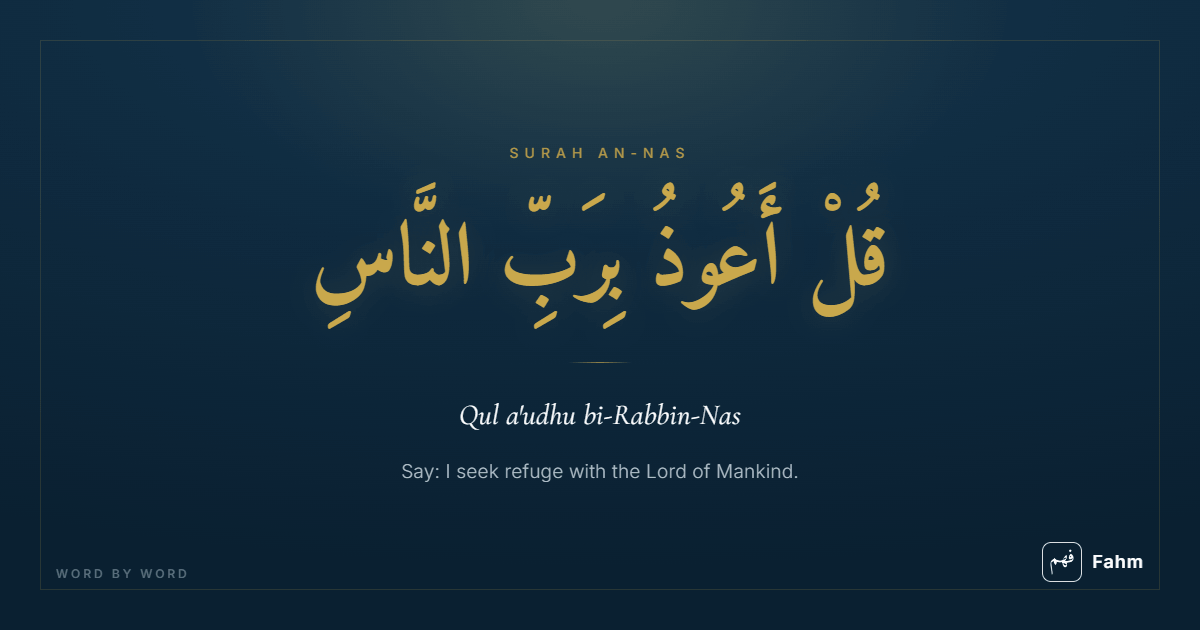
قُلْ أَعُوذُ بِرَبِّ النَّاسِ
"Say: I seek refuge with the Lord of mankind"
| Arabic | Transliteration | Meaning |
|---|---|---|
| قُلْ | Qul | Say (divine command) |
| أَعُوذُ | A'udhu | I seek refuge / I take shelter |
| بِرَبِّ | bi-Rabbi | With the Lord / in the Lord |
| النَّاسِ | An-Nas | Of mankind / of people |
Qul — the same command that opens Surah Al-Ikhlas and Surah Al-Falaq. A commanded declaration, not a private thought. You are instructed to say this — to make it verbal, conscious, and active.
A'udhu — from the root '-w-dh (ع-و-ذ): to flee to something for shelter, to press oneself against a protector. We explained this in the Al-Falaq post: the image is of an animal pressing against a rock or a larger creature for protection from a predator. Here, you are pressing yourself against Rabbin-Nas — the Lord of all people.
Rabbin-Nas — "the Lord of mankind." Rabb (رَبّ) here carries its full triple meaning: the One who creates, sustains, and nurtures. But why say Rabb of the Nas rather than simply Rabb of all creation, as in Al-Fatiha's Rabbil-'Alamin?
Maarif ul-Quran explains: the specific mention of mankind (An-Nas) is because the evil sought refuge from — Shaytan's whispering — targets mankind specifically. Shaytan declared his specific enmity against humans: "I will come at them from their front and from behind and from their right and from their left." (Surah Al-A'raf, 7:17) By invoking Rabb of mankind specifically, the dua calls upon Allah in His most relevant capacity: the One who nurtures and sustains the very beings under attack. [Source: Maarif ul-Quran, Tafsir Surah An-Nas, via IslamicStudies.info]
Ibn Kathir also notes that the use of Rabb as the first of three names connects to childhood and nurturing: every human starts as a helpless child entirely dependent on their Rabb for survival. Allah's Rabb-ness over mankind precedes everything — it was operative before any human could even form a thought, let alone be tempted by Shaytan. [Source: Tafsir Ibn Kathir, Surah An-Nas, Ayah 1]
Ayahs 2-3: Malikin-Nas, Ilahin-Nas
مَلِكِ النَّاسِ — إِلَٰهِ النَّاسِ
"The King of mankind — the God of mankind"
| Arabic | Transliteration | Meaning |
|---|---|---|
| مَلِكِ | Maliki | King / Sovereign / absolute ruler |
| النَّاسِ | An-Nas | Of mankind |
| إِلَٰهِ | Ilahi | God / the One worthy of worship |
| النَّاسِ | An-Nas | Of mankind |
These two ayat are grammatically linked to Ayah 1 — they are appositions, expanding descriptions of the same Being you are seeking refuge with. The three together form a single invocation: you are fleeing to one Allah described in three ways.
Why three names instead of one? The scholars of tafsir provide a precise, logically sequential answer.
Rabb (Lord/Sustainer) alone is insufficient as a basis for refuge, because the word rabb in Arabic can refer to any authority — a landlord (rabb al-dar), an owner of wealth (rabb al-mal). Saying "I seek refuge with the lord" leaves the identity ambiguous. So a second attribute is added:
Malik (King) — absolute sovereign authority over all of mankind. Not every lord is a king. A landlord has authority over his property but not over all people. By adding Malikin-Nas, the surah establishes that this Rabb holds supreme, unchallenged political sovereignty — there is no competing authority. [Source: Maarif ul-Quran via Quran.com, Ayah 3 Tafsir]
But even this is not enough, because not every king is worthy of worship. History is full of kings who demanded obedience but had no rightful claim to it. So the third attribute is added:
Ilah (God — the One worthy of worship) — from the root a-l-h (أ-ل-ه), the same root as Allah. Ilah is the One to whom the heart turns in love, reverence, hope, and fear. Not just the One who has authority, not just the One who has power — but the One who deserves the orientation of the entire human being. [Source: Tafsir Ibn Kathir, Surah An-Nas, Ayahs 1-3]
Ibn Kathir summarizes these three together: "They are lordship, sovereignty, and divinity. Thus, He is the Lord of everything, the King of everything, and the God of everything. All things are created by Him, owned by Him, and subservient to Him." [Source: Tafsir Ibn Kathir, Surah An-Nas, Ayah 3; SurahQuran.com]
The progression also represents the three stages of the human relationship with authority across a life:
- Rabb — the child's relationship: total dependence on a sustainer and nurturer
- Malik — the adult's relationship: living under a sovereign and system of law
- Ilah — the believer's relationship: orienting the entire heart toward the One worthy of worship
All three are needed because Shaytan attacks at every stage of life, in every capacity of the human being. The three attributes provide the complete answer to the complete threat.
Ayah 4: Min Sharril-Waswasil-Khannas
مِن شَرِّ الْوَسْوَاسِ الْخَنَّاسِ
"From the evil of the retreating whisperer"
| Arabic | Transliteration | Meaning |
|---|---|---|
| مِن شَرِّ | Min sharri | From the evil of |
| الْوَسْوَاسِ | Al-Waswas | The whisperer / the one who whispers incessantly |
| الْخَنَّاسِ | Al-Khannas | The retreating one / the one who slinks back |
This is the theological center of Surah Nas — and the two words that name the enemy deserve the deepest examination.
Al-Waswas (الْوَسْوَاسِ) — the whisperer. This word is originally a verbal noun (masdar) from the root w-s-w-s (و-س-و-س), meaning to whisper or to make a faint, rustling sound. The scholars describe its basic meaning as: to say something in barely audible way, using breath instead of voice, casting a suggestion that is felt rather than heard. [Source: Maarif ul-Quran, Surah An-Nas, Ayah 4, via Quran.com]
But the grammatical form used here — Al-Waswas rather than Al-Muwaswis — is significant. Al-Qurtubi explains that using the verbal noun itself as the name means Shaytan is not merely one who whispers — he is the embodiment of whisper itself. He is whispering personified. His entire mode of existence, his entire methodology, is this one thing: the incessant, barely perceptible injection of suggestions into the human heart. [Source: Maarif ul-Quran, Surah An-Nas, Ayah 4]
Al-Khannas (الْخَنَّاسِ) — the retreating one. This is the most linguistically distinctive word in the surah and the key to understanding Shaytan's methodology.
The root kh-n-s (خ-ن-س) means to retreat, to withdraw, to sneak away, to slink back. The fa'aal intensive pattern (khannas) indicates this is his perpetual, defining characteristic — he is the constant retreater, the one who repeatedly draws back. [Source: The Last Dialogue, Surah Nas Ultimate Dictionary, citing the root kh-n-s]
What does he retreat from? The scholars are unanimous: he retreats when Allah is remembered. Ibn Kathir explains: "Shaytan withdraws when Allah is remembered but returns when a person becomes heedless." [Source: Tafsir Ibn Kathir, Surah An-Nas, Ayah 4; confirmed in Urdu-Point.com Tafsir]
This single word — Al-Khannas — reveals Shaytan's most important weakness and the believer's most powerful defense simultaneously. He is not a fearless predator. He is a furtive coward who can only operate in the darkness of our own heedlessness. The moment you say Bismillah, the moment you make dhikr, the moment you turn consciously to Allah — he retreats. He slinks back. He cannot advance against the remembrance of Allah.
The name itself contains the strategy for defeating him: dhikr, constant remembrance of Allah, is the antidote to waswasah — constant whisper.
Ayah 5: Alladhi Yuwaswisu fi Sudurin-Nas
الَّذِي يُوَسْوِسُ فِي صُدُورِ النَّاسِ
"Who whispers in the breasts of mankind"
| Arabic | Transliteration | Meaning |
|---|---|---|
| الَّذِي | Alladhi | Who / the one who |
| يُوَسْوِسُ | Yuwaswisu | Whispers (present tense — continuously) |
| فِي | Fi | In / into |
| صُدُورِ | Sudur | Breasts / chests (plural of sadr) |
| النَّاسِ | An-Nas | Of mankind |
Yuwaswisu — the present tense form. Not waswasa (he whispered, past) but yuwaswisu — he is whispering, right now, continuously, without stopping. The present tense in Arabic indicates an ongoing, habitual action. Shaytan's whispering is not occasional or intermittent — it is his permanent state of operation. [Source: Maarif ul-Quran, Surah An-Nas, Ayah 5]
Fi suduri — in the breasts, into the chests. Sadr (صَدْر) in Arabic refers to the chest — but in Quranic usage, the chest (sadr) is the seat of the heart and the mind together, the place where thoughts, feelings, intentions, and convictions are housed. When the Quran says something enters the sudur, it means it enters the innermost center of the human being — not the ear, not the eye, but the heart-mind, the place where decisions are made.
This is what makes Shaytan's whisper different from any external threat. Darkness harms your body. Magic can be dispelled. Envy comes from outside you. But the whisper is already inside your chest, already in the seat of your thoughts, already at the very point where you decide what to believe and what to do. It does not need to penetrate any external defense — it bypasses all external defenses by operating from within.
This is why three names of Allah were needed as the source of refuge: the threat is more intimate than anything Al-Falaq addressed.
Ayah 6: Minal-Jinnati Wan-Nas
مِنَ الْجِنَّةِ وَالنَّاسِ
"From among the jinn and mankind"
| Arabic | Transliteration | Meaning |
|---|---|---|
| مِنَ | Mina | From among |
| الْجِنَّةِ | Al-Jinnati | The jinn |
| وَ | Wa | And |
| النَّاسِ | An-Nas | Mankind / people |
The final ayah reveals something that surprises many Muslims: the whisperer (Al-Waswas Al-Khannas) is not one entity. There are two categories of whisperers.
Al-Jinnah — the jinn. Shaytan and his offspring from among the jinn who whisper into human hearts. This is the primary understanding — the unseen enemy who was commanded to bow before Adam and refused, and who declared enmity against the human race until the Day of Judgement.
An-Nas — mankind. Human whisperers. This is the part most people overlook. The surah explicitly establishes that evil whispering also comes from people.
How can a human "whisper" the way Shaytan whispers? Two scholarly explanations:
First explanation (Ibn Kathir, al-Tabari): Human whisperers are people who cast doubts, spread misguidance, plant evil suggestions, use subtle persuasion and indirect insinuation to lead others away from the truth — without stating their intent openly. A human who says "have you considered that maybe Allah doesn't care about your prayer?" is functioning as a whisperer. [Source: Tafsir Ibn Kathir, Surah An-Nas, Ayah 6; Maarif ul-Quran via IslamicStudies.info]
Second explanation (Shaykh 'Izzuddin Ibn 'Abdus-Salam): The "whisperer from mankind" is the human being's own nafs — the base self. Just as Shaytan casts evil thoughts from outside, the nafs al-ammarah (the commanding self) urges evil from within. This is why the Prophet ﷺ taught us to seek refuge not only from Shaytan but from our own selves: "O Allah, I seek refuge in You from the evil of my nafs, from the evil of Shaytan and his shirk." [Source: Maarif ul-Quran, Surah An-Nas, Ayah 6, citing Ibn 'Abdus-Salam's Al-Fawa'id fi Mushkilat Al-Quran; IslamicStudies.info]
The conclusion of both explanations is the same: your enemies in the matter of your heart are not limited to Shaytan alone. They include corrupted human beings around you and — most intimately — your own lower self. The surah names all three with its final word.
And the word it closes on is An-Nas — people, mankind, the same word it opened with in Ayah 1. The surah is a perfect ring: it begins and ends with mankind, enclosing everything within the scope of human vulnerability and divine protection.
Why the Quran Ends With Surah Nas
Surah Nas is the last surah in the Quran. This is not incidental. The placement of the final surah is a statement about what the entire Quran has been about and what the human being's most enduring need is.
The Quran begins with Al-Fatiha — a declaration of who Allah is and a request for guidance to the straight path. It ends with An-Nas — a declaration of who Allah is to mankind specifically and a request for protection from the enemy that most threatens the ability to walk that straight path.
The enemy named at the end of the Quran is not an army, not a disaster, not a natural force. It is a whisperer in your chest who causes you to doubt, to delay, to prefer immediate desire over eternal truth, to forget, to become heedless. Everything the Quran has addressed — belief, practice, ethics, stories of the prophets, descriptions of paradise and hell — was revealed to counter exactly what this whisperer does: make you forget, make you doubt, make you choose wrongly.
The Quran begins: "Guide us to the straight path." It ends: "Protect us from the one who tries to lead us off it." The two brackets of the Book are the same prayer, expressed differently.
The Virtues and Benefits of Surah Nas
All the virtues established for Al-Mu'awwidhatayn together apply to Surah Nas alongside Surah Al-Falaq — they are always discussed as a pair. We will note the key ones here with sources:
Reciting before sleep — protection through the night: Aisha (رضي الله عنها) narrated: "Whenever the Prophet ﷺ went to bed every night, he used to cup his hands together and blow over them after reciting Surah Al-Ikhlas, Surah Al-Falaq, and Surah An-Nas, and then rub his hands over whatever parts of his body he was able to rub, starting with his head, face, and the front of his body. He would do this three times." [Source: Sahih al-Bukhari (5017)]
Morning and evening — sufficient against every affliction: "Recite 'Qul Huwa Allahu Ahad' and the Mu'awwidhatayn in the morning and evening, three times each — they will suffice you against every affliction." [Source: Sunan Abu Dawud (5082); Jami' al-Tirmidhi — graded Hasan]
After every fard Salah: 'Uqbah ibn 'Amir (رضي الله عنه) narrated that the Prophet ﷺ instructed him to recite the Mu'awwidhatayn after every obligatory prayer. [Source: Sunan al-Nasa'i (1336) — graded Sahih]
Ibn al-Qayyim's verdict on their necessity: "The effectiveness of these surahs is great to repel magic, evil eye, and the rest of the evils. The need of a slave for these two surahs is greater than his need for himself, his food, his drink, and his clothing." [Source: Ibn al-Qayyim, Zad al-Ma'ad]
The Prophet ﷺ called them matchless: "Do you know what verses have been revealed to me tonight? These are matchless verses — 'A'udhu bi-Rabbil-Falaq' and 'A'udhu bi-Rabbin-Nas.'" [Source: Sahih Muslim (814)]
How to Defeat the Whisperer: What the Name Al-Khannas Reveals
Al-Khannas retreats. This is his defining, permanent characteristic — built into his very name. And he retreats specifically when Allah is remembered.
The practical implication is one of the most actionable pieces of guidance in the entire Quran: dhikr — the remembrance of Allah — is the direct antidote to waswasah — the whisper of Shaytan.
The Prophet ﷺ confirmed this mechanism directly:
"Shaytan runs in the son of Adam like the running of the blood. And verily, I feared that he might cast something into your hearts." — Sahih al-Bukhari (3281), Sahih Muslim (2175)
He is always running — always present, always looking for the opening of heedlessness. The moment you are ghaafil (heedless, distracted, absent-minded about Allah), the door opens. The moment you say Bismillah, make dhikr, recite Quran, or turn consciously to Allah — the door closes. He retreats.
This is why the Muslim tradition builds dhikr into every moment of the day: before eating, entering the home, leaving the home, before sleep, upon waking. Not as ritual habit but as an active defense — keeping the door of the heart closed by keeping Allah's name on the tongue and in the heart.
When to Recite Surah Nas
Based on the authentic Sunnah:
Before sleep — with Al-Ikhlas and Al-Falaq, blown into cupped hands, body wiped three times. [Sahih al-Bukhari, 5017]
Morning and evening adhkar — three times each with Al-Ikhlas and Al-Falaq. [Sunan Abu Dawud, 5082]
After every fard Salah — once after each of the five daily prayers. [Sunan al-Nasa'i, 1336]
As ruqyah — for spiritual healing. The Prophet ﷺ used the Mu'awwidhatayn as his ruqyah for self-healing and for others.
When experiencing waswasah — if you feel the whisper of doubt, distraction in prayer, or evil suggestion, reciting Surah Nas specifically addresses the source directly.
Frequently Asked Questions
What is the meaning of Surah Nas in English? Surah Nas (also written Surah Al-Naas, Surah Naas, Surat Annas, and Suratul Nas) means "The Chapter of Mankind." Nas (النَّاس) is Arabic for people or mankind. The six verses ask Allah — as the Lord, King, and God of mankind — for protection from the whisperer who retreats, who whispers in the breasts of people from among jinn and human beings.
What does Al-Waswas Al-Khannas mean? Al-Waswas means the whisperer — the one who incessantly casts faint, barely perceptible suggestions into the human heart. Al-Khannas means the retreating one — the one who slinks back and withdraws when Allah is remembered. Together the phrase describes Shaytan: a cowardly, furtive enemy who can only operate when you are heedless, and who retreats the moment you remember Allah.
Why does Surah Nas invoke three names of Allah for one evil? Because the evil of the whisperer is the most dangerous single threat to the human being's spiritual life and eternal success. External harms can be healed or escaped. The whisperer operates inside the chest, at the very seat of thought and decision. Three names are invoked — Rabb (Lord), Malik (King), Ilah (God) — because the protection needed is total, covering nurturing, sovereign authority, and divine worship simultaneously.
Who are the whisperers from mankind in Ayah 6? Scholars identify two meanings: first, evil human beings who cast doubts, spread misguidance, and plant suggestions through subtle speech and indirect persuasion. Second (Shaykh Ibn 'Abdus-Salam's interpretation), the human being's own nafs — the lower self that inclines toward evil — which functions as an internal whisperer alongside Shaytan.
What is the difference between Surah Al-Falaq and Surah Nas? Surah Al-Falaq seeks refuge from four external evils: all created harm, the deep of night, magic/sorcery, and the evil of enviers. Surah Nas seeks refuge from one internal evil: the whisperer who enters the chest and operates from within. Together they form a complete protection — the pair of protection surahs (Al-Mu'awwidhatayn).
Is Surah Nas Makki or Madani? The majority scholarly position is Madani — revealed in Madinah together with Surah Al-Falaq in connection with the magic of Labid ibn Al-A'sam. Some scholars hold it is Makki based on its style and other narrations. Both positions exist in the scholarly literature; the Madani view is more widely held based on the strength of the hadith evidence. [Source: Mishkah Academy; Alim.org Surah Introduction]
How is Surah Nas used as ruqyah? Recite it (along with Al-Fatiha, Ayat Al-Kursi, and Surah Al-Falaq) over water, drink it, or recite and blow over the person seeking healing. The Prophet ﷺ used the Mu'awwidhatayn for his own ruqyah after the incident of Labid ibn Al-A'sam's magic, reciting each verse and untying one knot with each. [Source: Sahih al-Bukhari 5765, Sahih Muslim 2189]
How Surah Nas Connects Your Entire Salah Vocabulary
With Surah Nas, the circle of Fahm's core Salah vocabulary is now complete:
- Al-Fatiha — the opener of every rak'ah, the conversation with Allah
- Ayat Al-Kursi — the greatest verse, recited after every Salah
- The Tashahhud — the testimony recited in every sitting
- Durood Ibrahim — the blessing upon the Prophet ﷺ in the final sitting
- Surah Al-Ikhlas — the definition of Allah, one-third of the Quran
- Surah Al-Falaq — protection from external evil
- Surah An-Nas — protection from the whisperer within
Every word across these texts shares roots with the broader Quran. Nas appears in Al-Fatiha (sirata alladhina an'amta 'alayhim). Rabb runs through every surah. Malik appears in Ayat Al-Kursi. Sharr connects Al-Falaq and An-Nas. Learning the vocabulary of your Salah is not a side project separate from learning the Quran — it is the foundation of learning the Quran.
Barakallahu Feekum. May Surah Nas be a shield for your heart, and may the name Al-Khannas remind you forever that your most powerful defense against your most intimate enemy is the simplest thing: remembering Allah.
Start learning the words of your prayer today.
Sources
- Sahih al-Bukhari, Hadith 5017 (Aisha — reciting Al-Ikhlas, Al-Falaq, An-Nas before sleep)
- Sahih al-Bukhari, Hadith 3281 (Shaytan runs in the son of Adam like blood)
- Sahih al-Bukhari, Hadith 5765 (Aisha — the magic of Labid ibn Al-A'sam)
- Sahih Muslim, Hadith 814 ('Uqbah ibn 'Amir — the Mu'awwidhatayn as matchless verses)
- Sahih Muslim, Hadith 2175 (Shaytan runs like blood — parallel narration)
- Sahih Muslim, Hadith 2189 (Aisha — the magic incident, parallel narration)
- Sunan Abu Dawud, Hadith 5082 (reciting three times morning and evening, sufficient against every affliction)
- Sunan al-Nasa'i, Hadith 1336 (reciting after every fard Salah)
- Surah Al-A'raf (7:17) — Shaytan's declaration of enmity from four directions
- Tafsir Ibn Kathir, Surah An-Nas, Introduction and Ayahs 1–6 (Imam Ismail ibn Kathir, d. 774 AH)
- Maarif ul-Quran (Mufti Muhammad Shafi), Vol. 8, pp. 926–936 — Tafsir Surah An-Nas, via Quran.com and IslamicStudies.info
- Ibn al-Qayyim al-Jawziyyah, Zad al-Ma'ad — on the Mu'awwidhatayn and their necessity
- Shaykh 'Izzuddin Ibn 'Abdus-Salam, Al-Fawa'id fi Mushkilat Al-Quran — on the whisperer from mankind as the nafs
- IslamOnline.net — Objectives and Lessons of Surah An-Nas (islamonline.net)
- IslamQA.info, Answer 26763 — Surah An-Nas and seeking refuge from the whisperer (islamqa.info)
- Dorar.net — Tafsir of Surah An-Nas (dorar.net)