Assalamualaikum wa rahmatullahi wa barakatuhu,
If you've ever sat in Taraweeh or opened your Quran and felt overwhelmed by the amount of Arabic you don't know, I understand the feeling. For a long time, it felt like a mountain that was too high to climb without years of formal study.
When I began creating Fahm, I wanted to tackle this from a new angle. Instead of the traditional, exhaustive approach, I wanted to find the "Main Issue" — the bottleneck that keeps most of us from feeling a real connection to the words being recited.
The "Underwhelming" Experience of Traditional Learning
Most traditional courses are excellent, but they can often feel "overcooked." They ask you to memorize complex rules and obscure words that might only appear once in the entire Quran. It's like a meal where the main course is dry and the sides aren't seasoned — an underwhelming experience for the effort you put in.
I realized we needed a more focused approach. We needed to prioritize the words that actually move the needle for a beginner.
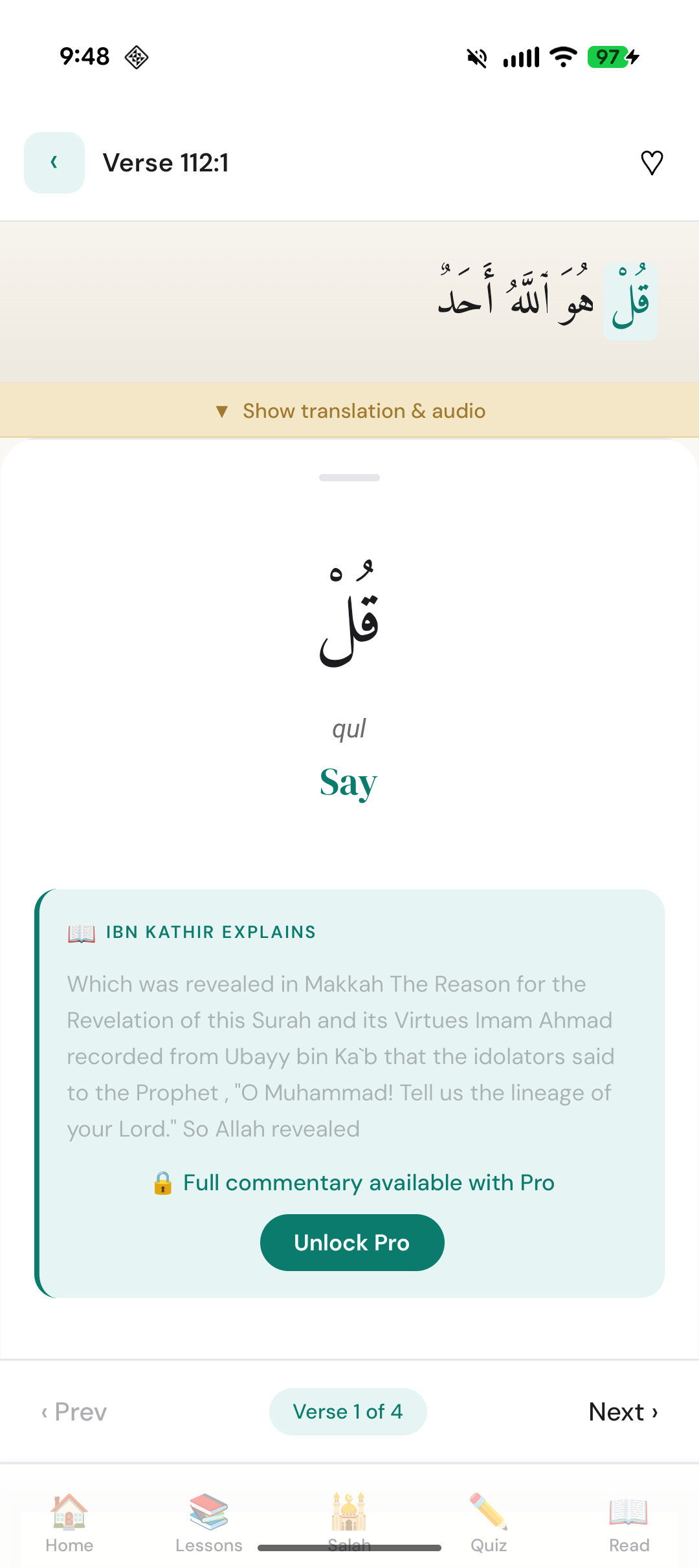
The 70% Rule: Why 300 Words is the "Tipping Point"
Linguistic data shows that the Quran contains roughly 77,430 total words. However, a very small percentage of words does the "heavy lifting."
I've seen claims that you can understand 80% or 90% of the Quran with just a few hundred words. To be honest, that can be a bit misleading. While those numbers are possible if you count "roots," the reality for someone learning individual word forms is different.
Based on the research used to build the Fahm curriculum, here is the realistic breakdown:
| Vocabulary Milestone | Quranic Coverage | Level |
|---|---|---|
| First 100 Words | ~50% of the Quran | Beginner Foundation |
| 300 High-Frequency Words | ~70% of the Quran | The Fahm Phase G Goal |
| 500+ Words | ~80%+ of the Quran | Intermediate Mastery |
By mastering these 300 Foundation Words, you aren't just learning a list — you are gaining the ability to recognize 7 out of every 10 words on any given page. This moves you from "total stranger" to "active participant" in the shortest time possible.
How Fahm Solves the "Forgetting" Problem
Finding the right words is only half the battle. The other half is retention.
I've seen this pattern many times: a student learns a word, feels confident, and then two weeks later, it's forgotten. To fix this, I made sure Fahm was built using the SM-2 Spaced Repetition Algorithm.
The system tracks how well you know a word. If you struggle with a specific term, it appears more frequently. If you've mastered it, the interval increases. This ensures your study time is optimized — no wasted effort on words you already know, and no "losing your appetite" for study because the progress is too slow.
The Roadmap: Where We Go From Here
While designing the initial Phases A through G in Fahm, I chose 300 words because it provides the highest "Return on Investment" for a learner's time. It's the point where the Quran stops feeling like a foreign text and starts feeling familiar.
The vision for Fahm doesn't stop at 70%. As we grow, I plan to expand the curriculum to include:
- Intermediate Modules: Pushing toward that 80% and 90% comprehension mark.
- Thematic Collections: Vocabulary specific to the stories of the Prophets.
- Advanced Root Analysis: Deep dives into the linguistic "DNA" of the most profound Quranic terms.
A Final Thought
My goal with Fahm is to provide a structured, data-driven roadmap that respects your time and your spiritual goals. When you can recognize the core vocabulary, your Salah changes. You stop just "hearing" the Quran and start "following" it.
InshaAllah, I hope this tool helps you on your journey. Let me know if you have any questions about the curriculum or how the phases work.
Barakallahu Feekum