How to Learn Quranic Arabic for Beginners: The 2026 Roadmap
For many, the goal of learning Arabic isn't to navigate a bustling market or conduct business in a boardroom; it is to unlock the profound, multi-layered depth of the Quran in its original language. In 2026, the barrier to entry has never been lower, yet the "information overwhelm" has never been higher.
If you've ever felt like you're staring at a "leaky bucket"—memorizing words only to forget them a week later—it's likely because you're using general-purpose language methods for a specific, sacred task. To succeed, we must move away from rote memorization and toward a strategic, high-impact approach to Quranic Arabic for beginners.
1. Why Most Beginners Fail (and How to Avoid It)
Traditional Arabic classes often start with complex grammar rules and modern conversational vocabulary that take months to yield results. This "grammar-first" approach is why many students quit. To stay motivated, you need quick wins—the ability to recognize a word in your daily prayer and understand its essence immediately.
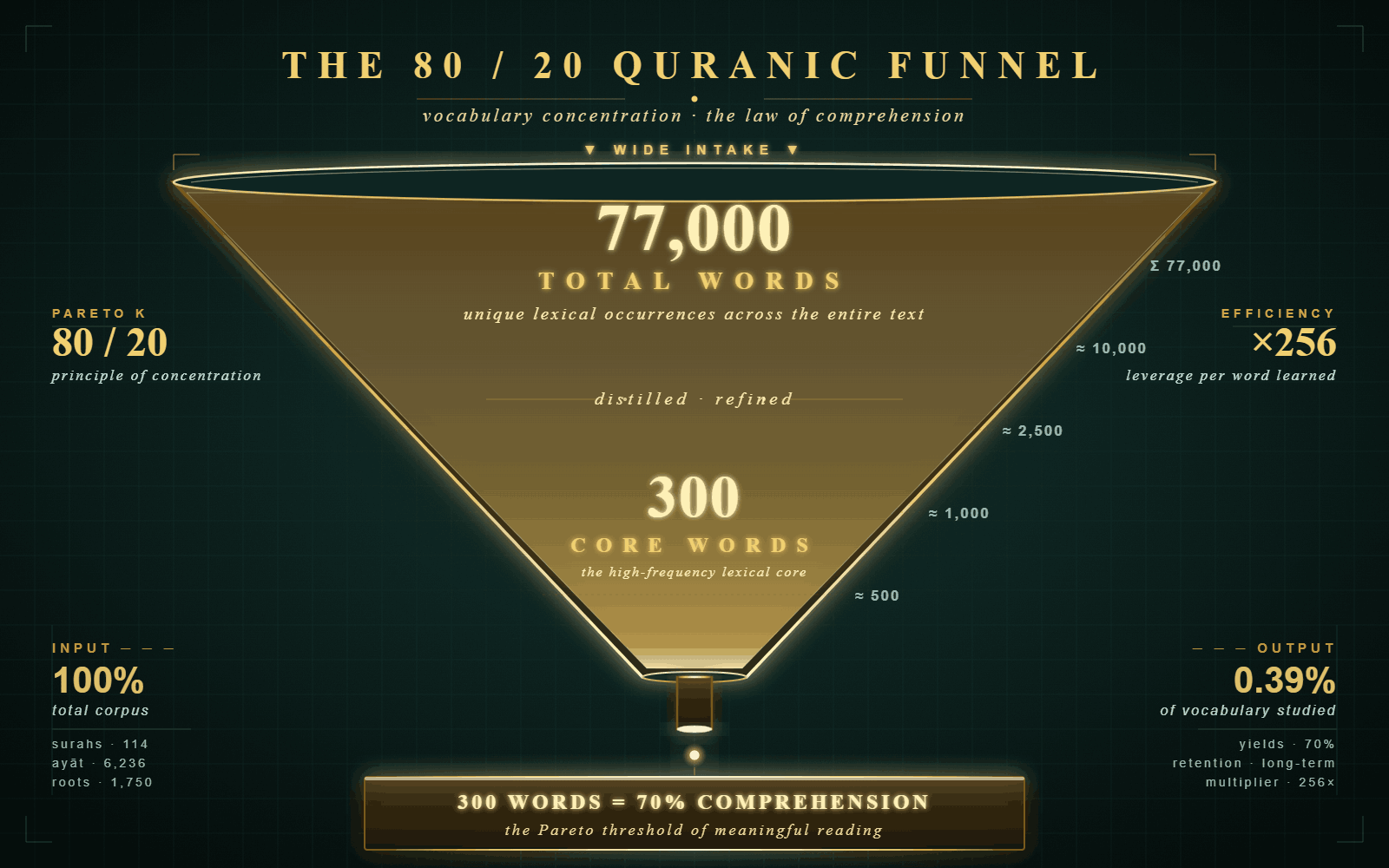
The secret lies in the 80/20 Rule. In the Quran, roughly 300 words account for nearly 70% of the entire text. By focusing on these high-frequency words first, you transition from "reciting" to "comprehending" in weeks, not years. This is the fastest way to build the "momentum of understanding."
2. The 3 Pillars of Quranic Fluency
To master the language of the Quran, you don't need to be a linguist. You need to master three specific, functional areas:
A. High-Frequency Vocabulary
Your brain has limited "storage" for new data. Instead of learning words for everyday modern objects, prioritize words that appear hundreds of times across every Juz. Focus on essential nouns like Ardh (earth), Samaa (sky), and Yawm (day). Using a Spaced Repetition System (SRS) is the most efficient way to ensure these stay in your long-term memory.
B. Morphology (Sarf): The Power of Patterns
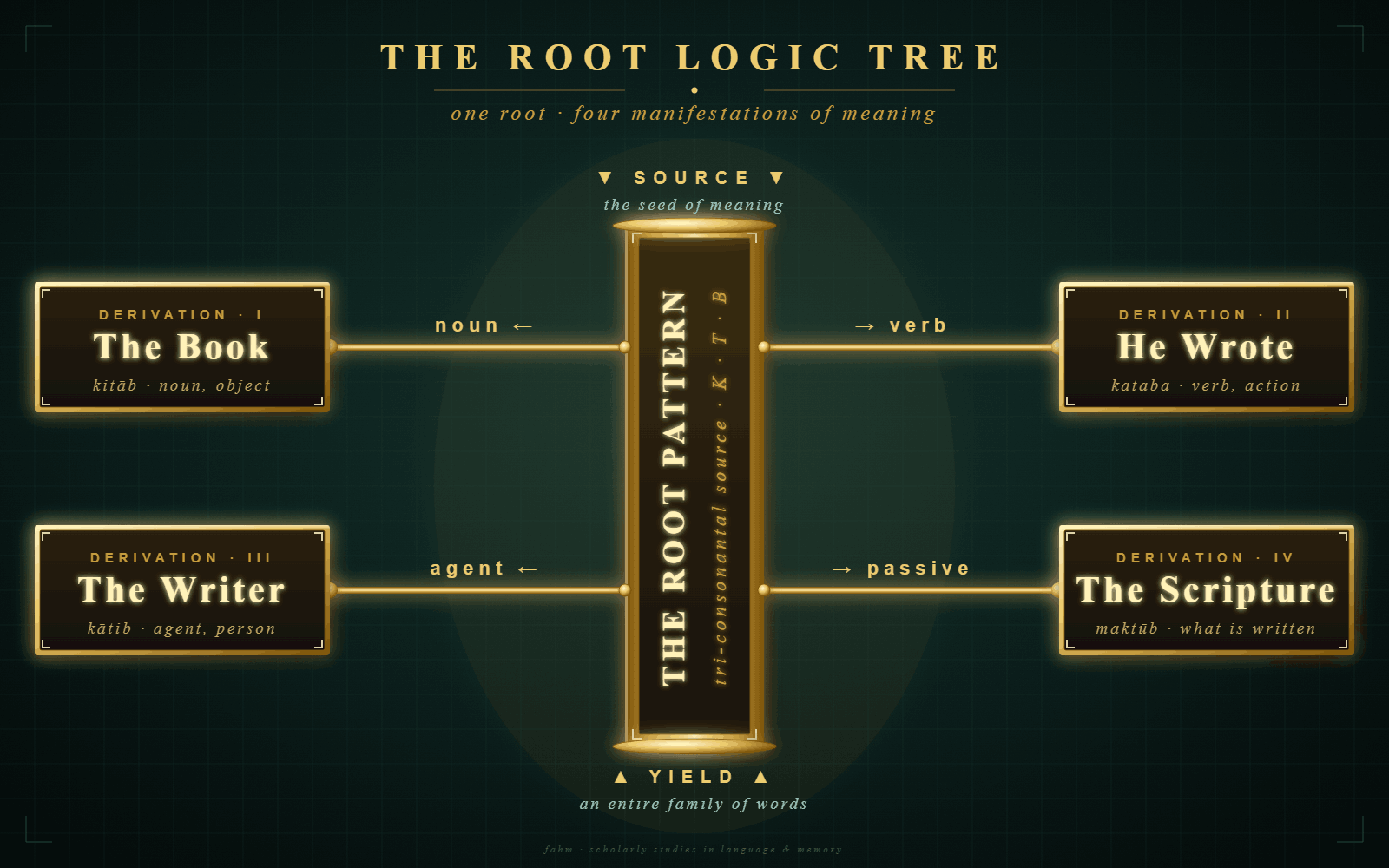
Arabic is a mathematical, "root-based" language. Almost every word is built from a 3-letter root. Once you learn to recognize these roots, you stop seeing thousands of isolated words and start seeing patterns. For example, the root K-T-B relates to the concept of writing. When you see this root, you instantly know the verse involves something written, whether it's a "Book," a "Decree," or the act of "Writing" itself.
C. Functional Grammar (Nahw): Connecting the Dots
You don't need to master the entire Arabic grammatical tradition. For beginners, focus on sentence patterns. How do verbs change when they refer to "They" versus "You"? How do pronouns attach to the end of nouns (e.g., "His Lord" vs "Your Lord")? These small endings are the "logic gates" of the Quran; once you unlock them, verses start to "unfold" their meaning as you read.
To see how these principles apply to our core curriculum, read our deep dive on The 300-Word Foundation.
3. The 2026 Learning Tech Stack
In 2026, AI and algorithmic learning have revolutionized how we study sacred texts. Here is the optimal setup for the modern student:
- SM-2 Powered Apps: Ensure your vocabulary tool uses the SM-2 algorithm to schedule reviews at the perfect moment of decay.
- Word-by-Word Interlinear Tools: Use digital Mushafs that allow you to toggle translations for individual words, bridging the gap between your recitation and your intellect.
- Audio-Visual Immersion: Listen to recitations while following along with high-frequency word highlighting to build "auditory recognition."
Conclusion: Your Spiritual Investment
Learning Quranic Arabic is not just a cognitive exercise; it is a spiritual investment that pays dividends every time you stand in prayer. By focusing on frequency, root patterns, and smart technology, you can turn the "leaky bucket" of rote memorization into a stable reservoir of understanding.
The best way to learn Arabic for the Quran is to start small but start smart. Focus on your first 10 high-frequency words today, and watch how the pages of the Quran begin to speak to you with a depth you've never experienced before.