Assalamualaikum wa rahmatullahi wa barakatuhu,
There is a verse in the Quran that the Prophet Muhammad ﷺ called the greatest ayah in the Book of Allah.
Not the most recited. Not the most beautiful. The greatest.
When the companion Ubayy ibn Ka'b (رضي الله عنه) was asked which verse was greatest, he said: "Ayat Al-Kursi." The Prophet ﷺ responded: "Congratulations for your knowledge, O Abu Al-Mundhir." [Source: Sahih Muslim, 810; Musnad Ahmad]
That verse is Ayatul Kursi — the 255th verse of Surah Al-Baqarah (2:255). It is also written as Ayat Al-Kursi, Ayat ul Kursi, and Ayahtul Kursi — different spellings of the same extraordinary ayah.
Hundreds of millions of Muslims have memorized it. It is recited after every Salah — like Surah Al-Fatiha, which opens every rak'ah of that same prayer — before sleep, upon leaving the home. Yet for most English-speaking Muslims, it remains a sequence of familiar sounds whose meaning lives somewhere between "vaguely known" and "completely unknown."
This post is the complete Ayatul Kursi translation, word by word — every phrase in Arabic, transliteration, and the meaning behind each one, grounded in the classical tafsir of Imam Ibn Kathir and Ibn al-Qayyim al-Jawziyyah. By the end, you will understand exactly why the Prophet ﷺ called it the greatest verse in the Quran.
What Is Ayatul Kursi?
Ayatul Kursi (آيَةُ الْكُرْسِي) literally means "The Verse of the Throne" or "The Verse of the Footstool." The name comes from one of its most theologically significant phrases: wasi'a kursiyyuhus-samawati wal-ard — "His Kursi extends over the heavens and the earth."
It is found in Surah Al-Baqarah, verse 255 — the longest surah in the Quran, often called the "spine" of the Book. Ayatul Kursi sits near its center, in a passage that deals with the absolute sovereignty and oneness of Allah.
Classical scholars have noted that Ayatul Kursi contains ten distinct sentences — each one a complete theological statement about who Allah is. Ibn Kathir identifies them as ten complete declarations of divine attributes, making this single ayah one of the most information-dense in the entire Quran. [Source: Tafsir Ibn Kathir, 2:255]
The Full Ayatul Kursi: Arabic, Transliteration, and Translation
Arabic:
اللَّهُ لَا إِلَٰهَ إِلَّا هُوَ الْحَيُّ الْقَيُّومُ ۚ لَا تَأْخُذُهُ سِنَةٌ وَلَا نَوْمٌ ۚ لَهُ مَا فِي السَّمَاوَاتِ وَمَا فِي الْأَرْضِ ۗ مَنْ ذَا الَّذِي يَشْفَعُ عِنْدَهُ إِلَّا بِإِذْنِهِ ۚ يَعْلَمُ مَا بَيْنَ أَيْدِيهِمْ وَمَا خَلْفَهُمْ ۖ وَلَا يُحِيطُونَ بِشَيْءٍ مِّنْ عِلْمِهِ إِلَّا بِمَا شَاءَ ۚ وَسِعَ كُرْسِيُّهُ السَّمَاوَاتِ وَالْأَرْضَ ۖ وَلَا يَئُودُهُ حِفْظُهُمَا ۚ وَهُوَ الْعَلِيُّ الْعَظِيمُ
Transliteration:
Allahu la ilaha illa Huwal-Hayyul-Qayyum, la ta'khudhuhu sinatun wa la nawm, lahu ma fis-samawati wa ma fil-ard, man dhal-ladhi yashfa'u 'indahu illa bi-idhnih, ya'lamu ma bayna aydihim wa ma khalfahum, wa la yuhituna bi-shay'in min 'ilmihi illa bima sha', wasi'a kursiyyuhus-samawati wal-ard, wa la ya'uduhu hifzuhuma, wa Huwal-'Aliyyul-'Azim.
Translation:
Allah — there is no deity except Him, the Ever-Living, the Sustainer of all existence. Neither drowsiness overtakes Him nor sleep. To Him belongs whatever is in the heavens and whatever is on the earth. Who is it that can intercede with Him except by His permission? He knows what is before them and what will be after them, and they encompass not a thing of His knowledge except for what He wills. His Kursi extends over the heavens and the earth, and their preservation tires Him not. And He is the Most High, the Most Great.
Now let's go inside every phrase.
Word-by-Word Breakdown
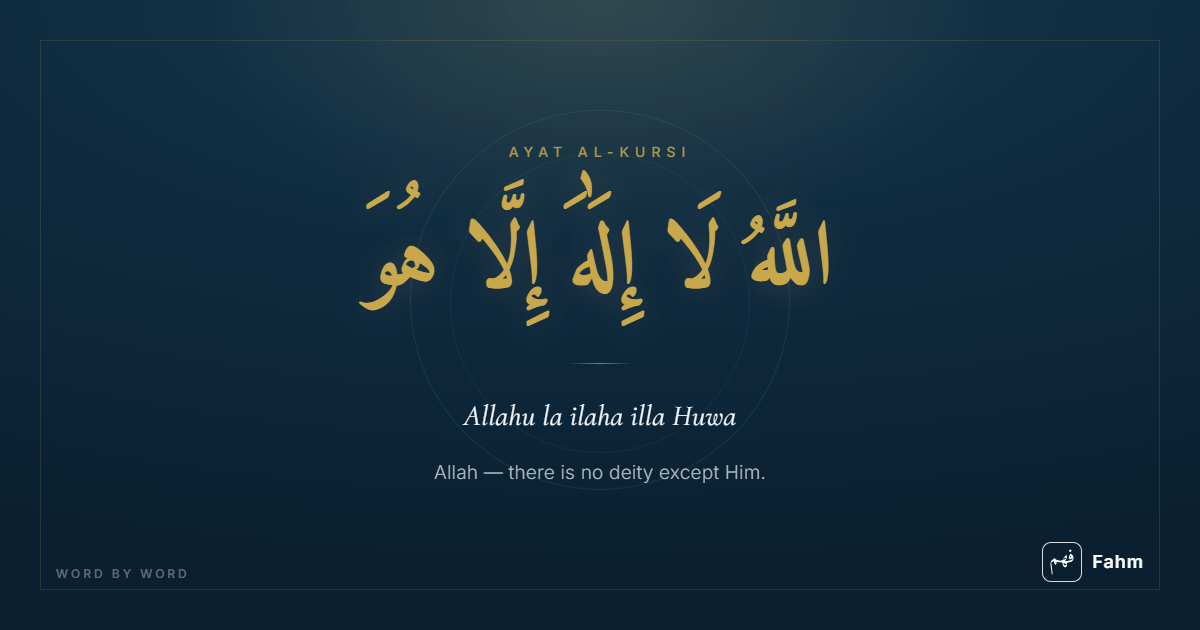
Sentence 1: اللَّهُ لَا إِلَٰهَ إِلَّا هُوَ
Allahu la ilaha illa Huwa "Allah — there is no deity except Him"
| Arabic | Transliteration | Meaning |
|---|---|---|
| اللَّهُ | Allahu | Allah (the proper name of God) |
| لَا | la | No / There is no |
| إِلَٰهَ | ilaha | Deity worthy of worship |
| إِلَّا | illa | Except |
| هُوَ | Huwa | Him / He |
Ayatul Kursi opens the same way the Shahada opens: with a negation before an affirmation. La ilaha — there is no god — sweeps away every false object of worship before illa Huwa — except Him — establishes the only true One.
The word Allah (اللَّه) is not a generic Arabic word for "God" — it is the proper, personal name of the Divine. It is the name that encompasses all other names and attributes. The definite article al- is fused into it permanently, making it uniquely unalterable: it cannot be made plural, cannot be made feminine, cannot be possessed by anyone. Ibn al-Qayyim wrote extensively in Madarij al-Salikin that this name is the greatest of all divine names precisely because it contains and implies every other divine attribute. [Source: Ibn al-Qayyim, Madarij al-Salikin, Vol. 1]
The opening sentence is the entirety of Islamic theology compressed into six words. Everything that follows in Ayatul Kursi is an elaboration of what it means that only He is worthy of worship.
Sentence 2: الْحَيُّ الْقَيُّومُ
Al-Hayyul-Qayyum "The Ever-Living, the Sustainer of all existence"
| Arabic | Transliteration | Meaning |
|---|---|---|
| الْحَيُّ | Al-Hayyu | The Ever-Living (divine name) |
| الْقَيُّومُ | Al-Qayyum | The Self-Sustaining Sustainer (divine name) |
These two names together are considered by multiple classical scholars — including Imam al-Qurtubi — to be Allah's Ism al-A'zam: the Greatest Name, the name by which if Allah is called upon, He answers. Ibn Kathir records reports that the Prophet ﷺ himself affirmed this understanding. [Source: Tafsir Ibn Kathir, 2:255]
Al-Hayy (الْحَيُّ) — The Ever-Living: Allah's life is eternal, uncreated, and without dependency. He was not born into existence; He has no beginning and no end. Every created life — humans, angels, jinn — depends on Him to sustain it. His life depends on nothing. Ibn al-Qayyim explains in Madarij al-Salikin that Al-Hayy is the foundation of all other divine attributes: a God who hears, sees, knows, wills, and acts must first be alive — and Allah's life is the only life that is truly self-sustaining. [Source: Ibn al-Qayyim, Madarij al-Salikin, Vol. 1]
Al-Qayyum (الْقَيُّومُ) — The Self-Sustaining Sustainer: this name comes from the root q-w-m (ق-و-م), meaning to stand, to rise, to sustain. The fa'eel grammatical pattern makes it an intensive form — not merely "one who stands" but "the One who perpetually, completely sustains." Ibn Kathir explains: "Al-Qayyum testifies that Allah sustains everyone and everything. All creation stands in need of Allah and totally relies on Him, while He is the Most Rich, Who stands in need of nothing created." [Source: Tafsir Ibn Kathir, 2:255]
The theological implication is staggering: if Al-Qayyum were to withdraw His sustaining power for a single instant, the entire universe — every atom, every star, every soul — would cease to exist. Not weaken. Cease. You are reading these words right now because Allah is actively, continuously sustaining your existence at this moment.
Sentence 3: لَا تَأْخُذُهُ سِنَةٌ وَلَا نَوْمٌ
La ta'khudhuhu sinatun wa la nawm "Neither drowsiness overtakes Him nor sleep"
| Arabic | Transliteration | Meaning |
|---|---|---|
| لَا | la | Neither / Not |
| تَأْخُذُهُ | ta'khudhuhu | Overtakes Him / seizes Him |
| سِنَةٌ | sinatun | Drowsiness / slumber |
| وَلَا | wa la | Nor |
| نَوْمٌ | nawm | Sleep |
Notice the order: sinatun (drowsiness) is mentioned before nawm (sleep). This is deliberate and precise. Drowsiness comes before sleep — it is the lighter state, the beginning of unawareness. By starting with the lesser and moving to the greater, the Quran is negating both: not even the slightest hint of inattention, let alone deep unconsciousness, ever touches Allah.
Ibn Kathir explains this phrase as: "No shortcoming, unawareness, or ignorance ever touches Allah. Rather, He is aware of and controls what every soul earns, has perfect watch over everything, nothing escapes His knowledge, and no secret matter is secret to Him." [Source: Tafsir Ibn Kathir, 2:255]
There is a narration recorded by Ibn Kathir in which Bani Israel asked Musa (عليه السلام): "Does your Lord sleep?" Allah commanded Musa to hold two bottles and stand through the night. When he began to slumber, the bottles slipped and shattered. Allah said: "If I were to sleep, the heavens and the earth would collapse just as those bottles collapsed." [Source: Tafsir Ibn Kathir, 2:255]
The practical meaning for the believer: there is no moment of your life — no 3am of despair, no hidden act, no private grief, no secret sin — that is outside Allah's awareness. He never "steps away." He never "checks back later." He is always, completely, fully aware.
Sentence 4: لَهُ مَا فِي السَّمَاوَاتِ وَمَا فِي الْأَرْضِ
Lahu ma fis-samawati wa ma fil-ard "To Him belongs whatever is in the heavens and whatever is on the earth"
| Arabic | Transliteration | Meaning |
|---|---|---|
| لَهُ | Lahu | To Him belongs / His is |
| مَا | ma | Whatever |
| فِي السَّمَاوَاتِ | fis-samawati | In the heavens (plural) |
| وَمَا | wa ma | And whatever |
| فِي الْأَرْضِ | fil-ard | On/in the earth |
Lahu opens with the possessive: His is. Not "He created" — His is. The distinction matters. Creation describes what Allah did at a point in time. Possession describes an ongoing, present reality. Everything in existence — every galaxy, every creature, every thought, every moment — is His property right now.
Ibn Kathir connects this to Surah Maryam (19:93-95): "There is none in the heavens and the earth but comes unto the Most Gracious as a servant. Verily, He knows each one of them, and every one of them will come to Him alone on the Day of Resurrection." [Source: Tafsir Ibn Kathir, 2:255]
The plural al-samawati (the heavens) reflects the Quranic description of seven heavens — layers of creation above this world that dwarf it in scale. The earth (al-ard) is mentioned in the singular, as the Quran consistently contrasts the vast plural heavens with the single earth we inhabit. All of it — every dimension of creation — belongs to Him.
Sentence 5: مَنْ ذَا الَّذِي يَشْفَعُ عِنْدَهُ إِلَّا بِإِذْنِهِ
Man dhal-ladhi yashfa'u 'indahu illa bi-idhnih "Who is it that can intercede with Him except by His permission?"
| Arabic | Transliteration | Meaning |
|---|---|---|
| مَنْ ذَا الَّذِي | man dhal-ladhi | Who is it that (rhetorical) |
| يَشْفَعُ | yashfa'u | Intercedes / pleads |
| عِنْدَهُ | 'indahu | With Him / in His presence |
| إِلَّا | illa | Except |
| بِإِذْنِهِ | bi-idhnih | By His permission |
This sentence is a rhetorical question — and the answer is: nobody. No one intercedes with Allah except those He permits to intercede, for those He is pleased with.
Shafa'a (شفاعة) — intercession — was a concept deeply embedded in pre-Islamic Arab culture, where tribal leaders and idols were believed to mediate between humans and the divine. This sentence dismantles that entirely: no prophet, no angel, no saint, no idol has any access to Allah's court except through His explicit permission.
This does not deny intercession — the Prophet ﷺ will intercede for his Ummah on the Day of Judgment, as established in authentic hadith. What it establishes is that even the Prophet's ﷺ intercession is permitted by Allah, not independently exercised. The intercessor does not "override" Allah's judgment — he appeals within the framework of what Allah has already willed and permitted.
Ibn Kathir cites Surah An-Najm (53:26): "And there are many angels in the heavens, whose intercession will avail nothing except after Allah has given leave for whom He wills and is pleased with." [Source: Tafsir Ibn Kathir, 2:255]
The word idhnih (إِذْنِهِ) — His permission — comes from the root a-dh-n (أ-ذ-ن), which also gives us adhaan (the call to prayer). Both carry the meaning of an official announcement, a formal permission granted from a position of authority. Intercession is not smuggled past Allah — it is announced, permitted, and granted by Him.
Sentence 6: يَعْلَمُ مَا بَيْنَ أَيْدِيهِمْ وَمَا خَلْفَهُمْ
Ya'lamu ma bayna aydihim wa ma khalfahum "He knows what is before them and what will be after them"
| Arabic | Transliteration | Meaning |
|---|---|---|
| يَعْلَمُ | ya'lamu | He knows (present tense — always knowing) |
| مَا | ma | What |
| بَيْنَ أَيْدِيهِمْ | bayna aydihim | Before them / in front of them (literally: between their hands) |
| وَمَا | wa ma | And what |
| خَلْفَهُمْ | khalfahum | Behind them / after them |
Bayna aydihim literally means "between their hands" — a classical Arabic idiom for what is immediately before someone, what is present and visible to them. Khalfahum means what is behind them — what is past, or what lies ahead in the future (depending on interpretive context).
The scholars have understood this phrase as covering the totality of time and knowledge: Allah knows the past of every soul, the present of every soul, and the future of every soul simultaneously. Nothing in any direction — temporal or spatial — is outside His knowledge.
The present tense ya'lamu (He knows) is important: this is not a past act of knowledge now stored, like a file that was once read. It is continuous, active, present knowing. Allah is knowing — right now, always — every detail of every created thing.
Sentence 7: وَلَا يُحِيطُونَ بِشَيْءٍ مِّنْ عِلْمِهِ إِلَّا بِمَا شَاءَ
Wa la yuhituna bi-shay'in min 'ilmihi illa bima sha' "And they encompass not a thing of His knowledge except for what He wills"
| Arabic | Transliteration | Meaning |
|---|---|---|
| وَلَا | wa la | And not |
| يُحِيطُونَ | yuhituna | They encompass / they surround (with knowledge) |
| بِشَيْءٍ | bi-shay'in | Anything / a single thing |
| مِّنْ عِلْمِهِ | min 'ilmihi | Of His knowledge |
| إِلَّا | illa | Except |
| بِمَا شَاءَ | bima sha' | What He wills |
Yuhituna comes from the root h-w-t (ح-و-ط), meaning to surround or encompass completely. The image is of knowledge as something that encircles its object entirely — knowing something "all the way around," leaving no gap. Allah encompasses all knowledge this way. Created beings — humans, angels, jinn — cannot encompass even a single thing from His knowledge except what He chooses to reveal.
This is one of the most humbling sentences in the Quran. Every scientific discovery, every piece of wisdom, every insight any human being has ever had — it is a fragment of what Allah has permitted to be known, from an ocean of knowledge that is entirely His. The greatest scientists and scholars in history have only ever touched what He wills to reveal.
Ibn Kathir explains: "This indicates that no one ever acquires knowledge of Allah and His Attributes except what He conveys to them." [Source: Tafsir Ibn Kathir, 2:255] This is why revelation — the Quran and the Sunnah — is the primary source of knowledge about Allah. Unaided human reason can only go so far. Beyond that boundary, only He can teach us about Himself.
Sentence 8: وَسِعَ كُرْسِيُّهُ السَّمَاوَاتِ وَالْأَرْضَ
Wasi'a kursiyyuhus-samawati wal-ard "His Kursi extends over the heavens and the earth"
| Arabic | Transliteration | Meaning |
|---|---|---|
| وَسِعَ | wasi'a | Extends over / encompasses / is as vast as |
| كُرْسِيُّهُ | kursiyyuhu | His Kursi (footstool / throne) |
| السَّمَاوَاتِ | as-samawati | The heavens |
| وَالْأَرْضَ | wal-ard | And the earth |
This is the sentence from which Ayatul Kursi gets its name. Kursi (كُرْسِي) literally means a chair, footstool, or seat — and its mention here has generated extensive scholarly discussion across fourteen centuries of Islamic scholarship.
The mainstream position, affirmed by Ibn Abbas (رضي الله عنه) and reported by both Ibn Kathir and al-Tabari, is that the Kursi is a real creation — the footstool of Allah, distinct from the Throne ('Arsh) which is even greater. The Prophet ﷺ described its scale to Abu Dharr al-Ghifari (رضي الله عنه): "The seven heavens and the earth compared to the Kursi are like a ring thrown into a vast desert. And the Kursi compared to the 'Arsh is like that same ring in that same desert." [Source: Reported by Ibn Kathir in Tafsir, 2:255, from al-Hakim's Mustadrak]
Let that sink in. The observable universe — all hundreds of billions of galaxies — would be like a ring lying in a desert compared to the Kursi. And the Kursi itself is like a ring lying in a desert compared to the 'Arsh.
Some scholars, notably attributed to Ibn Abbas in one narration, have interpreted Kursi as representing Allah's knowledge and sovereignty rather than a physical creation. Ibn Taymiyyah championed the position that the Kursi is real but its nature is entirely unlike anything created — we affirm it exists as described, without attempting to define how. This approach, consistent with the methodology of the righteous early generations (salaf), is the safest and most sound. [Source: Tafsir Ibn Kathir, 2:255, citing Ibn Taymiyyah's Majmu' al-Fatawa]
Sentence 9: وَلَا يَئُودُهُ حِفْظُهُمَا
Wa la ya'uduhu hifzuhuma "And their preservation tires Him not"
| Arabic | Transliteration | Meaning |
|---|---|---|
| وَلَا | wa la | And not |
| يَئُودُهُ | ya'uduhu | Tires Him / burdens Him / weighs upon Him |
| حِفْظُهُمَا | hifzuhuma | Their preservation / guarding them both (the heavens and earth) |
Ya'ood (يَئُودُ) comes from a root meaning to weigh down, to burden, to tire. The dual suffix -huma in hifzuhuma refers to both the heavens and the earth — the two vast creations just mentioned.
After describing the incomprehensible scale of the Kursi — larger than all of creation — this sentence delivers the punchline: maintaining all of it costs Allah nothing. Not effort. Not attention. Not fatigue. The preservation of billions of galaxies and everything in them is no more taxing to Allah than — less than — a thought is to us.
This is the theological opposite of Greek philosophical conceptions of God as a "first mover" who set creation in motion and stepped back. The Quranic Allah is actively, continuously, effortlessly sustaining every particle of existence at every moment — and it does not burden Him at all.
Ibn Kathir comments: "Supporting the two magnificent creations of the heavens and the earth is not the least burdensome for Allah Almighty, since doing so with His perfect power is easy." [Source: Tafsir Ibn Kathir, 2:255]
Sentence 10: وَهُوَ الْعَلِيُّ الْعَظِيمُ
Wa Huwal-'Aliyyul-'Azim "And He is the Most High, the Most Great"
| Arabic | Transliteration | Meaning |
|---|---|---|
| وَهُوَ | wa Huwa | And He is |
| الْعَلِيُّ | Al-'Aliyyu | The Most High (divine name) |
| الْعَظِيمُ | Al-'Azim | The Most Great / the Magnificent (divine name) |
Ayatul Kursi closes with two divine names that serve as the culmination of everything that came before.
Al-'Aliyy (الْعَلِيُّ) — The Most High: Allah is above all of creation in every sense — in rank, in station, in being. He is not "high" in a spatial sense as if located above the clouds; He is high in the absolute sense: nothing is above Him in any dimension. Every attribute described in this ayah — His knowledge, His ownership, His sustaining power, the scale of His Kursi — all of it flows from His being The Most High.
Al-'Azim (الْعَظِيمُ) — The Most Great: from the root '-z-m (ع-ظ-م), meaning greatness, magnitude, and magnificence. This is the same root as 'azm (bone) — the hardest, most fundamental structure of a living being. Al-'Azim is greatness that is structural, foundational, undeniable. Ibn Kathir notes that this name, paired with Al-'Aliyy, commands us to approach these attributes in the manner of the righteous early Muslims: "Let them pass as they have come — without asking how, and without comparison to creation." [Source: Tafsir Ibn Kathir, 2:255]
These two names close the ayah as a seal: after ten sentences that have described Allah's oneness, His eternal life, His knowledge, His ownership, His power, and the incomprehensible scale of His dominion — the final word is simply: He is the Most High. He is the Most Great.
Why the Prophet ﷺ Called It the Greatest Verse
Now that we have walked through all ten sentences, the reason becomes clear.
No other single verse in the Quran contains this concentration of divine attributes. In 255 words, Ayatul Kursi:
- Establishes Tawheed (Allah's absolute oneness) — Sentence 1
- Declares His eternal life and His sustaining of all existence — Sentence 2
- Affirms His perfect, uninterrupted awareness — Sentence 3
- Establishes His ownership of all creation — Sentence 4
- Defines the limits of intercession — Sentence 5
- Declares His total, simultaneous knowledge of past and future — Sentences 6-7
- Reveals the scale of His dominion through the Kursi — Sentence 8
- Affirms that sustaining all of creation is effortless for Him — Sentence 9
- Closes with His absolute transcendence — Sentence 10
It is a complete theology of Allah in a single ayah. This is why scholars across every century have called it Sayyidat Ayat al-Quran — the Chief of the verses of the Quran.
The Benefits and Virtues of Ayatul Kursi
The authentic hadith literature records specific virtues attached to the recitation of Ayatul Kursi:
After every obligatory Salah: The Prophet ﷺ said: "Whoever recites Ayat Al-Kursi after every obligatory prayer, nothing prevents him from entering Paradise except death." [Source: Al-Nasa'i, al-Mu'jam al-Kabir of al-Tabarani; authenticated by al-Albani]
This is among the most cited virtues in Islamic practice. The meaning scholars give: a person who recites it after every fard Salah is in a state of continuous closeness to Allah — and at the moment of death, they enter Paradise immediately.
Before sleep: Abu Hurayrah (رضي الله عنه) narrated that a man he caught stealing from the charity storehouse asked to be released and offered to teach him something beneficial. He taught him Ayatul Kursi and said: "Recite it when you go to bed, and Allah will appoint a guardian for you who will stay with you, and no Shaytan will come near you until morning." The Prophet ﷺ confirmed: "He told you the truth, though he is a liar — that was the Shaytan." [Source: Sahih al-Bukhari, 2311]
Greatest verse: "The Messenger of Allah ﷺ asked Ubayy ibn Ka'b: 'Which verse of the Book of Allah is the greatest?' Ubayy said: 'Allah and His Messenger know best.' He repeated the question. Ubayy said: 'Ayat Al-Kursi.' The Prophet ﷺ said: 'Congratulations for your knowledge, O Abu Al-Mundhir. By the One in Whose hand is my soul, it has a tongue and two lips, and it praises the King (Allah) at the leg of the Throne.'" [Source: Sahih Muslim, 810]
Protection in the home: The Prophet ﷺ said that Shaytan leaves any house in which Ayatul Kursi is recited. [Source: Reported by Abu Hurayrah, in collections of al-Tirmidhi and others]
When to Recite Ayatul Kursi
Based on authentic Sunnah, the established times of recitation are:
After every fard Salah — the most emphasized, with the direct promise of Paradise connected to it.
Before sleep — with the specific protection from Shaytan until morning.
Upon leaving the home — the Prophet ﷺ said that whoever recites it upon leaving the home, Allah assigns seventy thousand angels to pray for him until he returns. [Source: al-Mu'jam al-Awsat of al-Tabarani; graded Hasan by scholars]
As general dhikr — there is no restriction on reciting it at any time. Many scholars recommend it as part of morning and evening adhkar.
Frequently Asked Questions
What does Ayatul Kursi mean in English? Ayatul Kursi (also written Ayat Al-Kursi, Ayat ul Kursi, and Ayahtul Kursi) means "The Verse of the Throne" or "The Verse of the Footstool." It refers to the 255th verse of Surah Al-Baqarah (chapter 2 of the Quran), named after the phrase wasi'a kursiyyuhus-samawati wal-ard — "His Kursi extends over the heavens and the earth."
What is the Kursi in Ayatul Kursi? The Kursi is a real creation — the footstool of Allah, described in hadith as so vast that the seven heavens and the earth together are like a ring lying in a vast desert compared to it. The 'Arsh (Throne) is even greater than the Kursi. Scholars affirm its existence as described, without speculating about its exact nature.
What are the benefits of reciting Ayatul Kursi after prayer? The Prophet ﷺ explicitly promised that whoever recites Ayatul Kursi after every obligatory prayer, nothing prevents them from entering Paradise except death — meaning they enter immediately upon dying. [Al-Nasa'i; authenticated by al-Albani]
Is Ayatul Kursi the greatest verse in the Quran? Yes — confirmed by the Prophet ﷺ himself in Sahih Muslim (810), when he asked Ubayy ibn Ka'b which verse was greatest and affirmed his answer: Ayat Al-Kursi.
How long is Ayatul Kursi? It is a single verse (ayah) — verse 255 of Surah Al-Baqarah — but it contains ten complete theological sentences, making it one of the longest and densest individual verses in the Quran.
Is Ayatul Kursi Surah Al-Kursi? No. Ayatul Kursi is a single verse (ayah), not a full surah (chapter). It is verse 255 of Surah Al-Baqarah. There is no surah named Al-Kursi.
Can Ayatul Kursi be recited for protection? Yes — authentic hadith establish its recitation before sleep as a means of protection from Shaytan until morning, and upon leaving the home as a means of divine protection during travel.
Sources
All hadith references and scholarly citations are from primary and authenticated sources:
- Sahih Muslim, Hadith 810 (Ubayy ibn Ka'b — Ayatul Kursi as the greatest verse)
- Sahih al-Bukhari, Hadith 2311 (Abu Hurayrah — reciting before sleep for protection from Shaytan)
- Al-Nasa'i / Al-Mu'jam al-Kabir of al-Tabarani (reciting after every fard Salah and Paradise)
- Al-Mu'jam al-Awsat of al-Tabarani (reciting upon leaving the home — graded Hasan)
- Tafsir Ibn Kathir, commentary on Surah Al-Baqarah, verse 255 (Imam Ismail ibn Kathir, d. 774 AH)
- Tafsir Maarif ul Quran, commentary on 2:255 (Mufti Muhammad Shafi, published by Quran.com)
- Ibn al-Qayyim al-Jawziyyah, Madarij al-Salikin, Vol. 1 — on the names Al-Hayy and Al-Qayyum
- IslamQA.info, Answer 21843 — The meaning of the Kursi mentioned in Ayat al-Kursi (islamqa.info)
- Dorar.net — Tafsir of Ayat Al-Kursi, the attributes of Allah in 2:255 (dorar.net)
Barakallahu Feekum. May Allah give you the understanding of this verse and the consistency to recite it after every Salah, before every sleep, and whenever you leave your home — and may He make its promise of Paradise true for you and your families.
If you want to own not just Ayatul Kursi but the vocabulary of your entire prayer — every word of Al-Fatiha, the Tashahhud, Durood Ibrahim, the Ruku and Sujood phrases — that is exactly what Fahm is built for. The Quran has a meaning. Start learning it today.