Assalamualaikum wa rahmatullahi wa barakatuhu,
If you've ever looked at a page of the Quran and felt overwhelmed by the sheer number of words you don't know, you aren't alone. There are roughly 77,000 words in the Quran. To a beginner, that looks like a mountain that requires decades of formal study to climb.
But what if I told you that you don't actually need to learn 77,000 words? What if I told you that the entire Quran is built on a "DNA" system so efficient that learning just one 3-letter sequence can unlock dozens of different meanings?
This is the "Secret Key" of the Arabic language: The Root System.
The Overwhelm of Traditional Learning
Most people approach Arabic like they approach English or Spanish—by trying to memorize individual words one by one. In English, the words "Teacher," "School," and "Lesson" have no visible connection. You have to learn three separate words.
In Quranic Arabic, this approach is "overcooked." It's a slow, underwhelming experience that leads to burnout. Because Arabic is a semitic language, it functions mathematically. Almost every word in the Quran is derived from a 3-letter root (the al-jidhr).
When you understand the root, you stop seeing 77,000 disconnected words. You start seeing a beautiful, interconnected web.
The DNA of Arabic: The 3-Letter Root
Think of a root as the "DNA" of a word. These three letters carry a core "concept." No matter how many prefixes, suffixes, or vowels you add to those three letters, that core concept remains.
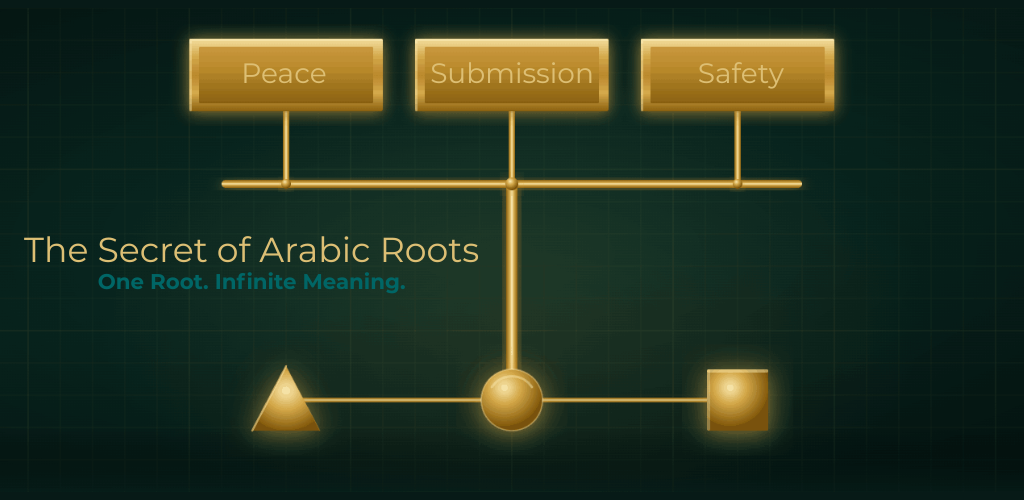
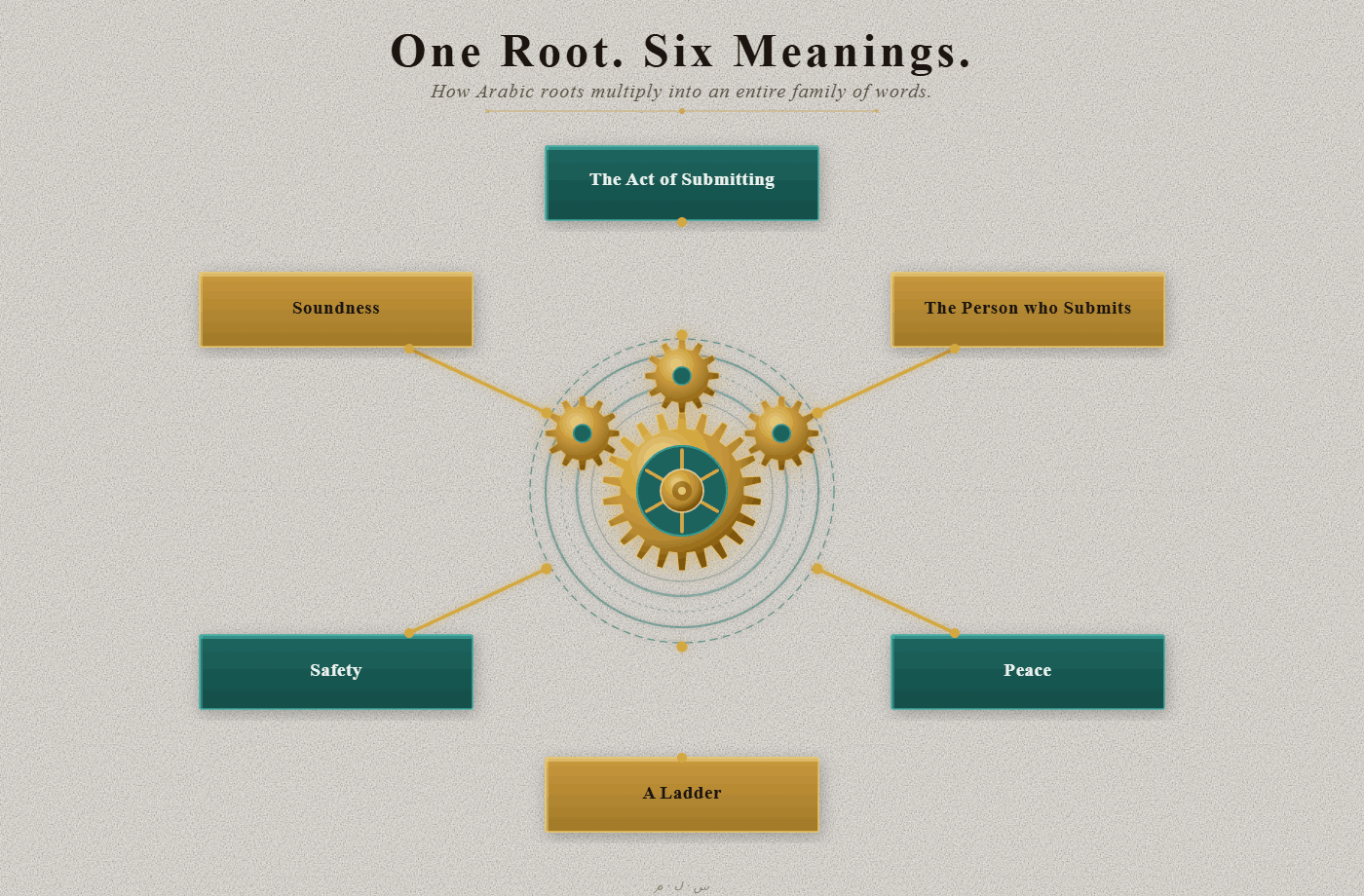
Let's take one of the most famous roots in the Quran: S-L-M (س ل م). The core concept of this root is "Safety, Peace, and Submission."
From these three simple letters, an entire family of words is born:
- Islam: The act of submission to God.
- Muslim: One who submits.
- Salam: Peace / Safety.
- Sullam: A ladder (something that provides a safe way to climb).
- Salim: Someone who is sound or whole.
You'll encounter S-L-M directly in your daily prayer — our Tashahhud word by word post breaks down exactly how this root and eleven others weave through every phrase you recite from the sitting position.
The Multiplier Effect
This is where your learning accelerates. If you learn the 300 most frequent words in the Quran (the foundation we use in the Fahm app), you aren't just learning 300 meanings. You are learning the "patterns" that govern thousands of other words.
The Arabic language uses "templates" (known as Awzan). Once you know the template for a "Doer" (the person doing the action), you can apply it to any root.
- If K-T-B is the root for "Writing," a Ka-ti-b is a "Writer."
- If Q-R-' is the root for "Reading," a Qa-ri' is a "Reader."
Suddenly, you aren't just memorizing; you are decoding. This shift from memorization to structural comprehension is the "Main Issue" we solve with Fahm.
| Pattern | Arabic | English Meaning |
|---|---|---|
| Root | س ل م | Safety / Peace |
| Active Participle | مُسْلِم | Muslim (One who submits) |
| Verbal Noun | إِسْلَام | Islam (Submission) |
| Noun | سَلَام | Peace / Greeting |
How Fahm Uses Root Analysis
When I was designing the interface for Fahm, I knew that simply giving a translation wasn't enough for long-term growth. I wanted to give users the tools to "guess" the meaning of words they've never seen before.
In the Fahm app, every word in our Phase A-G curriculum includes a Root Analysis feature. When you tap a word, the app strips away the "decoration" and shows you the 3-letter DNA.
By seeing the root every time you learn a word, your brain begins to recognize these patterns automatically. InshaAllah, after a few weeks of using the app, you'll find yourself standing in Salah, hearing a word you've never studied, and thinking: "I know those three letters... this must be related to 'Knowledge'."
Your "Root of the Week" Challenge
To start shifting your mindset, I want you to look for one specific root this week: 'A-L-M (ع ل م). This root is all about "Knowledge or Signposts."
Look for it in the Quran. You'll see it in:
- Al-'Alameen (The Worlds/Signs of God's creation)
- Al-'Aleem (The All-Knowing)
- Ta'lamoon (You all know)
Technology in Service of the Message
Building Fahm is about more than just making an app; it's about providing a structured, data-driven roadmap for busy Muslims. By focusing on the 3-letter roots, we respect your time and maximize your spiritual ROI.
When you understand the structure, the Quran stops feeling like a foreign text and starts feeling like a direct message.
Barakallahu Feekum