Assalamualaikum wa rahmatullahi wa barakatuhu,
We’ve all been there: You spend an hour on a Saturday afternoon memorizing a set of 20 new Quranic words. You feel confident, perhaps even a bit inspired. But by Tuesday, you open your Mus'haf and those same words look like total strangers.
It’s a cycle of frustration that leads most students to believe they "just aren't good at languages." But here is the reality: It’s not a problem with your brain; it’s a problem with your system.
The "Underwhelming" Cycle of Rote Memorization
Most of us were taught to learn through "massed practice"—reading a list over and over until it sticks. While this works for the next ten minutes, it is an "overcooked" method for long-term retention.
In the late 19th century, psychologist Hermann Ebbinghaus discovered the Forgetting Curve. He proved that humans lose about 50% of new information within 24 hours, and up to 90% within a week—unless that information is actively reviewed at specific, calculated intervals.
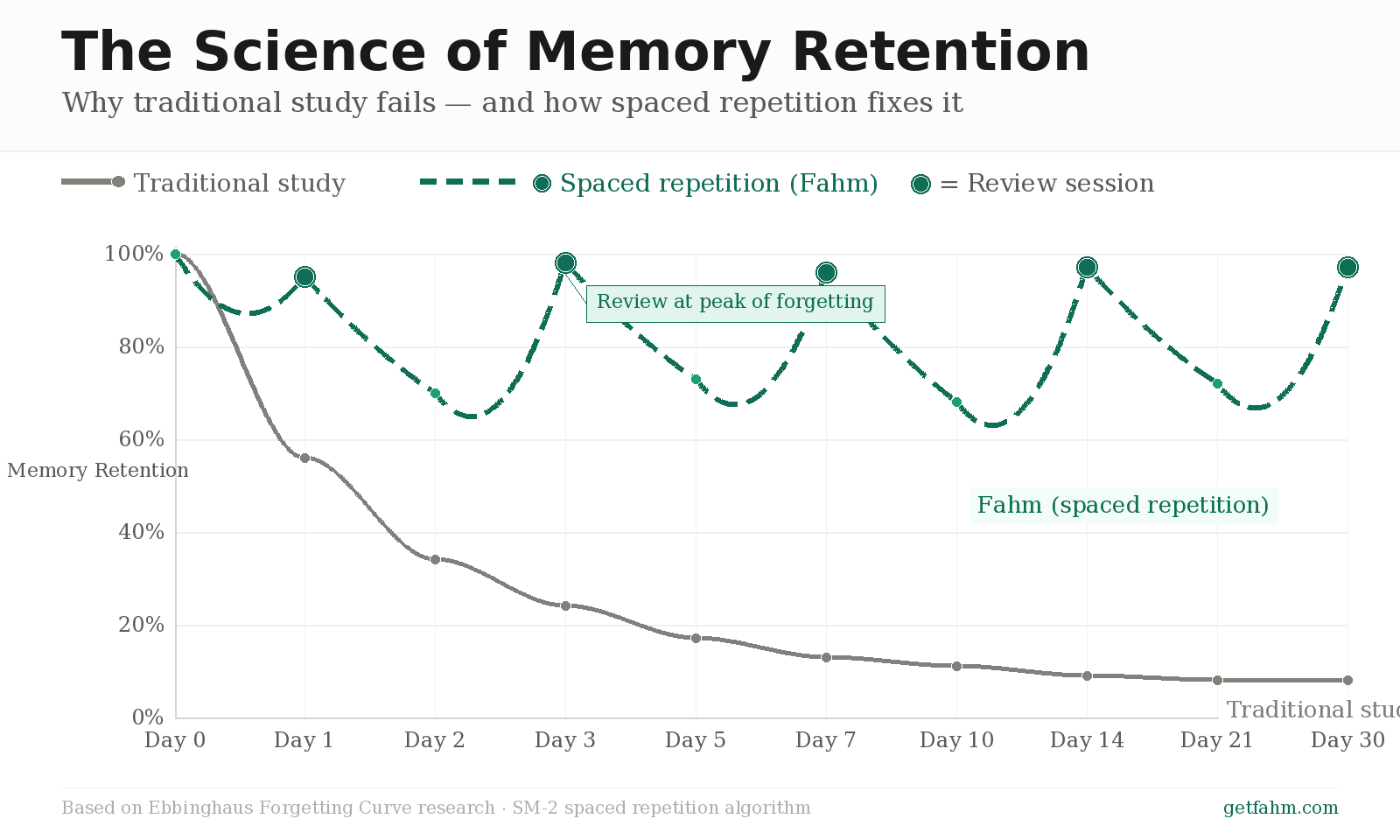
When you "cram," you are fighting against your own biology. To truly understand the Quran, we need a system that works with the brain, not against it.
Enter SM-2: The Brain’s Best Friend
When I began building Fahm, I knew that simply identifying the "300 Foundation Words" wasn't enough. I needed to ensure that once you learned a word, it stayed with you forever. That’s why Fahm is powered by the SM-2 (SuperMemo-2) Spaced Repetition Algorithm.
Instead of showing you every word every day, the algorithm tracks your performance on every single term. It calculates the exact moment you are about to forget a word—the "point of maximum tension"—and shows it to you then.
How it works in Fahm:
- The Initial Exposure: You learn a new word like 'Ar-Rahman'.
- The First Test: The app asks you again in 10 minutes.
- The Expansion: If you get it right, the app waits 2 days. If you get it right again, it waits 5 days, then 12 days, then 30 days.
- The Reset: If you forget the word, the algorithm "shrinks" the interval, bringing it back into focus until it's locked in.
This ensures your study time is surgical. You don't waste time on words you already know, and you never "lose your appetite" for study because you're constantly making visible progress.
A Case Study: From "Translating" to "Following"
Consider the experience of a typical Fahm user. Before using a spaced-repetition system, they might spend 30 minutes a day studying but only retain 5% of what they learned over a month.
After switching to the SM-2 system in Fahm, that same 30 minutes is condensed into 5-10 minutes of daily "Reviews." Because the app only shows them what they are about to forget, their retention rate jumps to nearly 95%.
Within three weeks, they aren't just "remembering" words; they are recognizing them instantly during Salah. The cognitive load of "translating" vanishes, leaving room for Khushu (devotion) and reflection.
Why 5 Minutes Matters
I often get asked: "Can I really learn the Quran in just a few minutes a day?"
The answer is yes, because of The Law of Compound Interest. * Day 1: You know 5 words.
- Day 30: You know 150 words.
- Day 90: You’ve mastered the 300-word foundation, covering 70% of the Quranic text.
By being consistent rather than intense, you build a "Memory Palace" that doesn't crumble.
The Vision: Technology in Service of Revelation
My goal with Fahm is to take the best of modern learning science—the same tools used by medical students and high-stakes linguists—and apply them to the most important book in existence.
When you master the vocabulary through a data-driven roadmap, your relationship with the Quran changes. You stop just "hearing" the recitation and start "following" the message.
InshaAllah, this system will make your path to understanding smoother and more sustainable.
Barakallahu Feekum